2025-26 Training As Action Series
Human Rights Educators USA’s annual Training as Action Series (TAAS) is a virtual training series focused on bridging personal and collective action on some of the most critical human rights issues of today. TAAS creates an educational space to connect and collaborate with others in human rights education and training. It also gives participants the skills and information needed to take action on rights issues in their communities.
The 2025–2026 Training as Action Series will center on the theme, “Defending Democracy and
Human Rights in a Changing World.” This year’s sessions will explore urgent issues such as misinformation, protest rights, climate justice, and digital surveillance, highlighting how human rights education can equip communities to respond with clarity, courage, and collective action. Those who attend five or more sessions will receive a certificate from HRE USA. 2025-26 TAAS Flyer
Saturday, September 13, 2025 — Flyer >>Session recording >> Slides
Module 1: Defending Democracy through Human Rights Education
This module explored how HRE can help defend democracy in the face of current global and local challenges. Participants map threats and reflect on civic roles.
Monday, September 29, 2025 — Session recording >> Slides
Module 2: Protecting Civic Space and Civic Power: Mobilizing for Rights and Democracy
This module highlighted youth activism, digital advocacy, and civic participation, with intergenerational dialogue on how adults can support youth leadership. Focuses on global and local efforts to restrict civic space and protest.
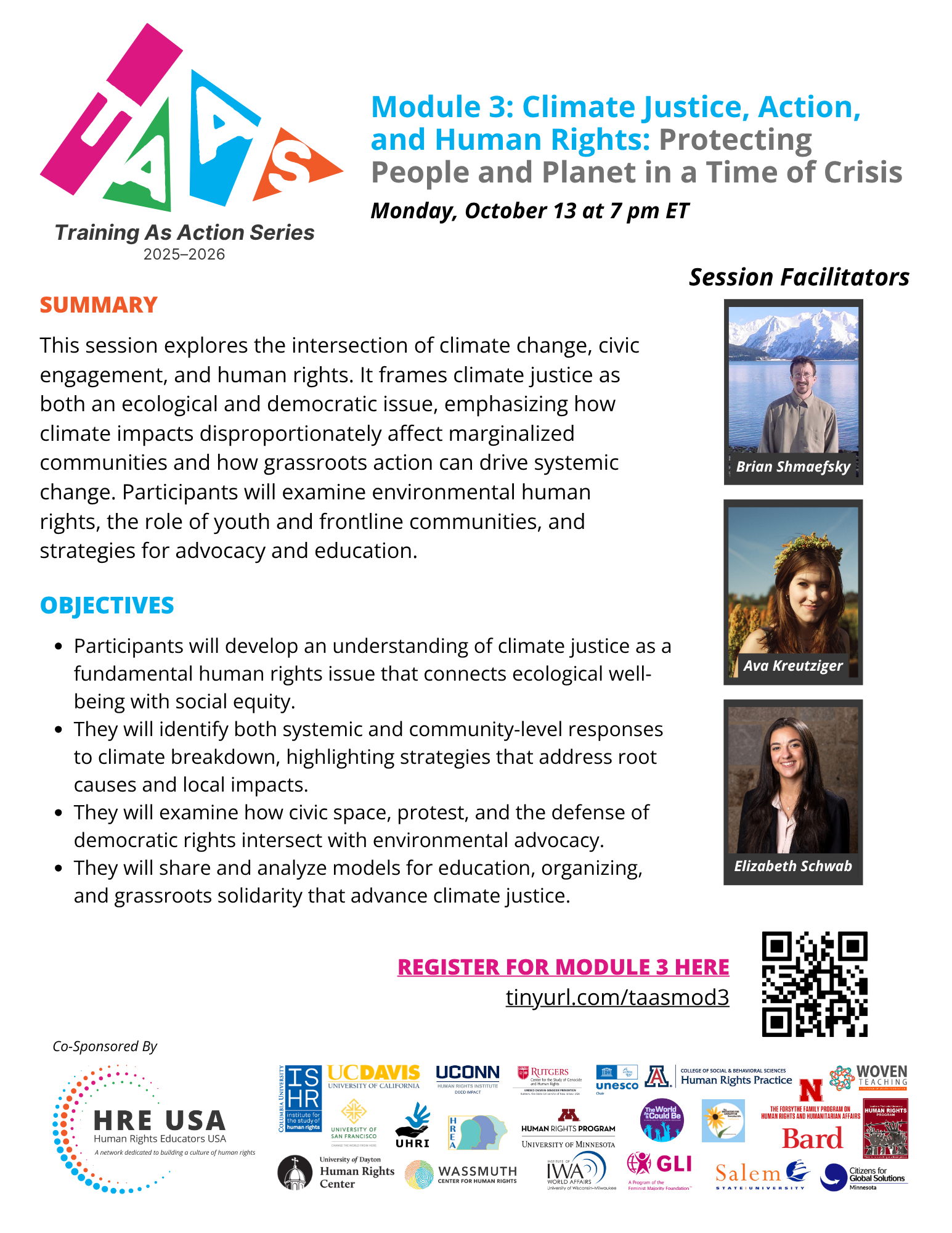
Monday, October 13, 2025 — Flyer >>Session recording >> Slides
Module 3: Climate Justice, Action, and Human Rights: Protecting People and Planet in a Time of Crisis
This session explored the intersection of climate change, civic engagement, and human rights. It framed climate justice as both an ecological and democratic issue, emphasizing how climate impacts disproportionately affect marginalized communities and how grassroots action can drive systemic change. Participants examined environmental human rights, the role of youth and frontline communities, and strategies for advocacy and education.
Saturday, November 1, 2025 — Flyer >> Slides
Module 4: Freedom, Facts, and Filters: A Dialogue on Misinformation
This session explored how misinformation shapes public perception, the role of freedom of speech in digital spaces, and the responsibilities of governments, companies, and communities in safeguarding access to truthful information. Through facilitated dialogue, participants reflected on their own relationship with digital platforms, critically evaluate sources, and consider how human rights education can foster media literacy, civic responsibility, and resilience in the face of disinformation.
Monday, November 10, 2025 — Flyer >>Session recording >> Slides
Module 5: Human Rights Education as a Response to Polarization
This module explored how Human Rights Education (HRE) equips educators and organizers to address controversial issues while promoting dialogue and free expression. Participants learned strategies to engage diverse perspectives, mediate conflict, and create safe spaces for open discussion. The module highlighted how HRE can reduce polarization, foster empathy, and encourage constructive civic engagement.
Monday, January 26, 2026 — Flyer >>Session recording >> Slides
Module 6: Intersectional Democracy: Race and Migration
This module explored how systemic inequalities related to race and migration shape access to and participation in democracy. Participants examined barriers that limit civic engagement and learned strategies to center marginalized voices in democratic processes. Through case studies and interactive activities, the module emphasized inclusive civic education that empowers all individuals to participate meaningfully in democratic life.
Monday, February 9, 2026 — Flyer >>Session recording >> Slides
Module 7: Intersectional Democracy: Gender and Disability rights
This module examined how systemic inequalities related to gender and disability affect access to and participation in democracy. Participants explored barriers that limit civic engagement and learned strategies to center marginalized voices. The module emphasized inclusive civic education that empowers all individuals to engage meaningfully in democratic life.
Monday, March 9, 2026, 7 pm ET Flyer >>Session recording >> Slides
Module 8: Digital Rights and Democracy: Navigating AI, Surveillance, and Privacy – Register here
This module examines how digital technologies, including AI, surveillance systems, and data collection, impact democratic participation and individual rights. Participants will explore the ethical, legal, and social implications of emerging technologies on privacy, freedom of expression, and civic engagement. The module emphasizes strategies for protecting digital rights, promoting transparency, and fostering informed participation in online and offline democratic spaces. Through case studies and interactive discussions, participants will learn how to navigate the digital landscape responsibly while advocating for inclusive, rights-respecting digital governance.
Monday, April 13, 2026, 7 pm ET Flyer >>Session recording >> Slides
Module 9: Action Lab: Strategies for Defending Democracy and Human Rights — Register here
This concluding module focuses on translating learning into practice. Participants co-create action plans, sharing tools, resources, and strategies to support ongoing collective action and the defense of human rights. The session emphasizes collaboration, peer learning, and the practical application of concepts from previous modules, ensuring participants leave with concrete steps to engage in civic and rights-based initiatives within their communities.
2024-25 Training As Action Series
The Human Rights Educators USA’s virtual Training As Action Series (TAAS) focuses on bridging personal and collective action on some of the most critical human rights issues of today. The annual series is offered each year between September and April.
The theme of the 2024-2025 training series is: “Youth Power, Defending Human Rights: Learnings and Actions for the 35th Anniversary of the Convention on the Rights of the Child (CRC).” Sessions discussed topics such as youth rights, the CRC, education as a tool for empowerment, international youth solidarity, the theory of change, digital citizenship, and mental wellness.
You can register for one or more individual sessions, or you can register for the entire series. Participants that attend at least five sessions over the course of the 2024-2025 TAAS program (including the introductory session) will receive a certification from HRE USA. Click here for TAAS 2024-25 Overview.
The 2024-2025 TAAS program included the following modules:
Introduction to HRE USA and Human Rights Education (optional) Flyer
Module 1: Youth Power, Defending Human Rights Flyer
Module 2: Know Your (Human) Rights: Education for Youth Empowerment Flyer
Module 3: Trust Kids! Dismantling Hierarchy in Human Rights Advocacy Flyer
Module 4: A Children’s Rights Lens to Youth Human Rights Advocacy Flyer
Module 5: Digital Citizenship & Human Rights in the Age of Disinformation Flyer
Module 6: Challenging U.S.-Centric Models, Building International Youth Solidarity Flyer
Module 7: Big Actions, Big Feelings: Practical Empathy in Human Rights Flyer
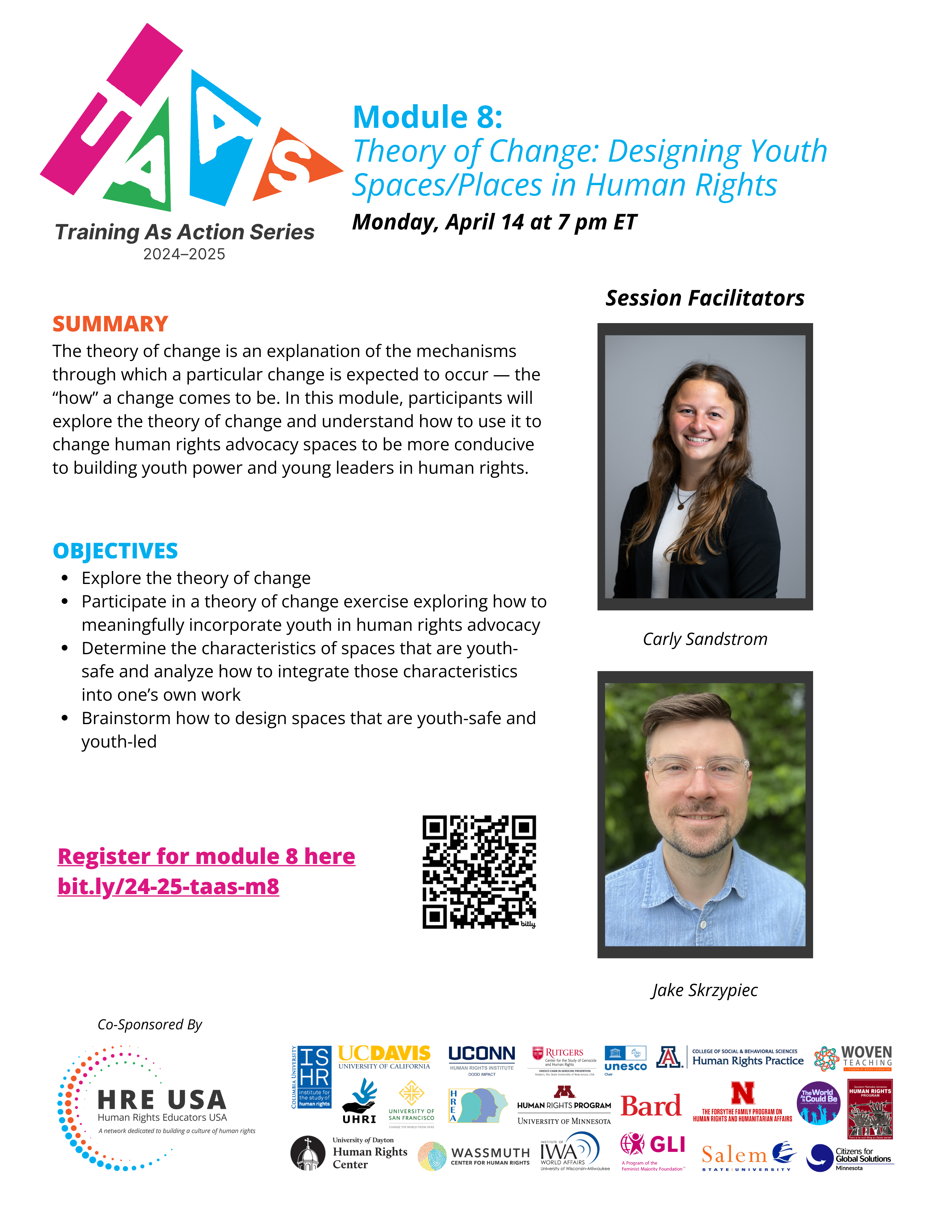
Module 8: Theory of Change: Designing Youth Spaces/Places in Human Rights Flyer
2024-25 TAAS Co-Sponsors

********************************************************************************
2023-2024 Training As Action Series
Spring 2024 TAAS Events
Voting Rights: What You Can Do to Combat Voter Suppression – Flyer
Monday, March 25, 7pm ET
Summary
The right to vote as established in Article 21 of the UDHR is the bedrock of democracy and essential to the fulfillment of other rights. Yet this fundamental right is under attack. This module is designed to address the problem of voter suppression and voter apathy by engaging participants in ways they can promote voting and voting rights in their own communities and classrooms
Objectives
- Establish the importance of voting and civic engagement to human rights and democracy
- Discuss modern day voter suppression and voter apathy
- Develop ways to promote the vote and combat voter suppression in one’s own community
TAAS Global Screening & Conversation: Human Rights Education: Empowering Youth to Promote Gender Equality = Flyer
March 16, 2024 – 8:00 – 9:30 am PT / 11:00 am – 12:30 pm ET
This HRE USA TAAS Special Global Screening, co-sponsored by the Office of the UN High Commissioner for Human Rights (OHCHR), Amnesty International (AI), and Soka Gakkai International (SGI), is centered around the multimedia resource “Changemakers: Stories of Young Human Rights Educators.” Launched in December 2023 by AI, SGI, and the OHCHR, this resource aims to inspire and empower young people to advocate for human rights causes.
Summary and what to expect:
- Screening: Be captivated by the stories of three remarkable young human rights educators whose lives have been transformed by their commitment to human rights education.
- Interactive Discussion: Engage in a thought-provoking dialogue on the role of youth in promoting gender equality through human rights education.
- Q&A Session: Hear directly from three inspiring individuals featured in the multimedia resource
- Ms. Dejana Stosic from Serbia (gender equality and gender-based violence)
- Mr. Soufiane Hennani from Morocco (gender diversity and equality)
- Ms. Aizat Ruslanova from Kyrgyzstan (women’s human rights)
Objectives:
- Present stories of youth empowerment through human rights education, as documented in the multimedia resource.
- Provide a space for dialogue on human rights education for, with and by youth as a tool to promote human rights, including gender equality.
- Discuss ideas on how to utilize the multimedia resource as well as other innovative formats to strengthen human rights education for youth in formal and non-formal contexts.
The event is designed for young individuals and anyone in the general public passionate about advancing human rights and gender equality. Let’s unite to empower youth as effective advocates for gender equality and human rights.
Finding Joy: Integrating Mental Wellness into Your Advocacy Strategies
Monday, February 26, 2024 – 7-9 pm ET – Flyer
Summary
Human rights work often takes an emotional toll on its practitioners, but there are ways to mitigate this toll and find joy and solidarity in the work. This final module aims to explore how to integrate wellness strategies into the various actions discussed throughout the training series, and to establish the importance of self-care in order to care for others.
Objectives
- Understand the importance of maintaining mental wellness during human rights work
- Discuss ways to find joy and solidarity
- Explore how to integrate mental wellness strategies when organizing advocacy campaigns, protests/demonstrations, and other human rights initiatives
2023-24 TAAS Session Recordings: YouTube playlist for TAAS 2023
TAAS Overview
Human Rights Educators USA’s annual Training as Action Series (TAAS) is a virtual training series focused on bridging personal and collective action on some of the most critical human rights issues of today. TAAS creates an educational space to connect and collaborate with others in human rights education and training. It also gives participants the skills and information needed to take action on rights issues in their communities. The 2023-2024 training series will celebrate the 75th anniversary of the Universal Declaration of Human Rights (UDHR) and center on the theme, “Protecting Democracy, Promoting Human Rights.” Sessions will discuss topics such as voting rights, facilitating difficult conversations, organizing an advocacy campaign, communicating with decision makers, protesting, and mental wellness.
TAAS Goals
- Engage members in human rights learning, collaboration, and activism through Human Rights Educators USA’s leadership opportunities and initiatives.
- Enhance the capacity of members to engage in human rights education and training.
- Foster knowledge-sharing and dialogue around human rights and human rights education and training.
- Assist members to bring human rights education and training into their personal and professional contexts.
- Expand the Human Rights Educators USA Training Corps, facilitators who can assist, coach, and mentor others to implement strategies for national and local training and capacity building efforts.
Introduction to HRE USA and Human Rights Education
Thursday, September 28, 2024 – 7-8 pm ET
This module is the first session of the training, but is devised to serve as a kind of prequel to the actual series. It will provide an overview of HRE USA and opportunities for participation in the organization as well as an introduction to human rights education more broadly.
Objectives
- Understand the organization of and action opportunities within HRE USA
- Examine different understandings of human rights and human rights education
- Build connections among participants and between participants and HRE USA staff
- Promote participation in the rest of TAAS 2023
Protecting Democracy, Promoting Human Rights (View Recording)
Thursday, October 5th, 7-8:30 pm ET
This module is intended to be the true start to the training series and all participants are highly encouraged to attend. The purpose of the session is to introduce the series and the theme, “Protecting Democracy, Promoting Human Rights,” while building bonds among participants.
Objectives
- Introduce the 2023 Training As Action Series
- Explore the connection between democracy and human rights Discuss the relationship between civil rights and human rights
- Analyze civic education vs. human rights education
- Build relationships among participants
- Examine local human rights issues in one’s own community and identify key stakeholders to connect with
Calling In: Facilitating Difficult Conversations (View Recording)
Thursday, October 19th, 7-9 pm ET
The ability to navigate and facilitate difficult conversations is essential for discussing human rights issues and protecting rights and democracy. This module will prepare participants to engage in difficult conversations by addressing conflict management and inquiry based questioning strategies, role-playing dialogues, and exploring the importance of calling in in order to create a brave space for discussion.
Objectives
- Understand the importance of creating a brave space for conversation in order to protect human rights and democracy
- Introduce best practices for successfully moderating difficult conversations
- Discuss when and how it is appropriate to call people in and out
- Explore conflict management and inquiry-based questioning strategiesRole-play facilitating human rights based dialogues on current events
- Role-play facilitating human rights based dialogues on current events
Human Rights in Action: Organizing an Advocacy Campaign (View Recording)
Thursday, October 26th, 7-9 pm ET
Advocacy campaigns have the power to enact monumental human rights change. This module will help participants better understand the core elements of successful advocacy campaigns and better prepare them to start their own campaigns.
Objectives
- Explore the role of advocacy campaigns in democracy and promoting human rights
- Examine what an advocacy campaign is and prominent examples
- Understand the key components of a successful advocacy campaign
- Draft a bare-bones campaign plan on a chosen advocacy issue
Communicating with Decision Makers: How to Contact Influential Figures (View Recording)
Thursday, November 2nd, 7-9 pm ET
Communicating with decision makers such as elected officials is key to enacting change. This module will explore the different ways to contact those in positions of power and equip participants with the skills needed to do so effectively.
Objectives
- Identify the role of communicating with decision makers in a democracy and its importance for protecting rights
- Discuss the primary ways to contact decision makers: letters/emails, phone calls, and meetings
- Develop the knowledge and skills needed to communicate with decision makers
- Explore how to use collective action when contacting decision makers, such as through letter writing campaigns, and how these actions can be incorporated into a classroom/educational environment
- Role play advocacy meetings and the Dos and Don’ts of an advocacy meeting
Protest and Beyond: Powerful Ways to Promote Your Message
Thursday, November 9th, 7-9 pm ET
This module is designed so that participants can better understand the purpose and importance of protest, symbolic action, and creative means in promoting a human rights message while developing the necessary knowledge and skills to participate in and organize these actions.
Objectives
- Discuss the importance of the right to protest and freedom of expression to human rights and democracy
- Identify the purpose(s) of protest and symbolic action
- Understand how to safely attend a protestExamine how to organize a protest
- Explore other ways to make a statement such as through art, music, poetry, demonstration, and performance
HOW TO DO HUMAN RIGHTS EDUCATION: A WORKSHOP BY GLOBAL SCHOLAR AUDREY OSLER
MARCH 27, 2023: 11-1:00 PM ET
Human Rights Expert, Audrey Osler, will provide solutions in this workshop on how to integrate Human Rights Education into your courses, organizations, and life
BOOK BANNING ONLINE DISCUSSION
MARCH 30, 2023: 6-7:00 PM ET
This presentation will give a short overview of the history of book banning and focus on current issues that face schools, libraries, families, teachers, and students.
Together we will explore the relevance of the Convention on the Rights of the Child and strategies that can be used to ensure that children have a right to access information in today’s complex world.
HUMAN RIGHTS IN SPORTS CONFERENCE
APRIL 5, 2023: 8:00 AM-6:00 PM ET
Learn more about human rights in sports from leading scholars around the world and their new book. We are here to help you address rights issues for all athletes!
The videos from the conference are available here!
KNOLOGY EVALUATION & IMPACT WORKSHOP – Video Recording
APRIL 12, 2023: 6-7:00 PM ET
This training will cover basic evaluation terminology and approaches, offering several tools that can be easily implemented by HRE practitioners. At the end of the hour- long session, participants will be able to think strategically about how to design and measure HRE initiatives to maximize impact.
MULTICULTURALISM AND BEYOND: REFLECTING ON THE INTERSECTION OF INTERCULUTURAL LEARNING AND HUMAN RIGHTS – Video Recording
APRIL 27, 2023: 5:30 PM CT
What is intercultural learning? How does it advance human rights? In this session, participants will learn how to create impactful intercultural learning experiences to cultivate a culture of peace and human rights in their schools and communities. We will explore examples of how intercultural learning is applied and its connection to human rights in both formal and informal education.
2022-23 TRAINING AS ACTION SERIES
Monday, 10/17/22 7pm–9pm ET: Action for Human Rights
During this workshop, participants explored various tactics for human rights action. Paying particular attention to youth action for human rights, we discussed how to design a plan of action, the right to protest, and student walkouts as human rights actions. This interactive workshop was facilitated by Ben Fleming and Kristina Eberbach. More information on this session
Monday, 10/24/22 7pm–9pm ET: Indigenous Peoples’ Human Rights – Video Recording
This session explored Indigenous Peoples’ and environmental rights as human rights. International Indian Treaty Council (IITC) leaders address indigenous land rights, justice, and the effects of climate change for various communities. The session began with a brief recognition of IITC as the HRE USA first-ever Impact Award recipients for the 50 years of working to educate and defend the rights of Indigenous Peoples in the US, at the United Nations, and with collaborators around the world. The presenter included Bill Means, Founder and Board Member of IITC & Oglala Lakota Nation, Wicahpi Koyaka Tiospaye, Pine Ridge, South Dakota, Andrea Carmen, IITC Executive Director, and Lisa Bellanger IITC Board Member and St. Paul, Minnesota Indigenous Educator, and White Earth Anishinaabe Nation, Three Fires Society, Manitoba Canada. More information on this session
Saturday, 10/29/22 11am-1pm ET: Facilitating Difficult Conversations
During this session, participants workshopped best practices and effective techniques for facilitation, conflict management, and inquiry-based questioning, focusing on current social issues being debated in society. This interactive workshop was facilitated by Kaylee Bradford and Rebecca Cannara.
Monday, 11/7/22 7pm–9pm ET: Children’s Rights & Youth Activism – Video Recording
This session provided an overview of the United States children and youth rights initiatives and organizing around critical children rights and youth activism. The session offered context and content with practical applications for community action and networking resources. This interactive workshop was facilitated by Hallie McRae, Maddy Wegner, and Adrianna Zhang. More information on this session.
Monday, 11/14/22 7pm–9pm ET: Ending Gun Violence – Video Recording
This workshop provided the human rights framework that guided Amnesty International’s groundbreaking research on gun violence in the US. We received information and personal stories from the most vulnerable communities who experience high rates of gun violence. We also learned advocacy skills to act to support efforts to end gun violence on a local and national front. This session was facilitated by Amnesty International USA leaders, Ernest Converson, Ebony McClease, and Cynthia Gabriel Walsh. More information on this session.
Saturday, 11/19/22 11am–1pm ET: Incorporating Human Rights in the Classroom – Video Recording
During this session, we workshopped how to source human rights resources for your classroom and discuss meaningful ways to incorporate human rights into your lesson plans and learning activities. We also practiced developing/revising lessons plans to incorporate human rights within various subjects. Facilitators included Kaylee Bradford, Elana Haviv, and Sandy Sohcot. More information on this session.
HRE USA is grateful for this year’s 2022 TAAS Co-Sponsors to make this series possible    . .   . .   . .    |
Experiential Learning and Human Rights Change with Dr. Carrie Booth Walling – Video Recording
March 11, 2022

About the talk: My human rights students at Albion College and in the G Robert Cotton Correctional Facility have taught me the importance of seeing human rights close to home, the value of applying the human rights framework in the US context, and how human rights education empowers advocacy. My book, Human Rights and Justice for All: Demanding Dignity in the United States and Around the World, encourages learners to traverse the boundaries between the local and the global and between ideas and practice. Teaching human rights with a focus on experiential learning highlights the ways that human rights issues manifest in our own communities and empowers learners to engage in human rights-inspired change on their own campuses and in their own communities.
Carrie Booth Walling is Professor of Political Science and Faculty Director of the Gerald R. Ford Institute for Public Service at Albion College where she designs opportunities for experiential learning. Her research interests are in human rights, human security, transitional justice, and the United Nations Security Council. Walling is Director of the Albion College Human Rights Lab, a Security Fellow with the Truman National Security Project, and teaches for the Inside-Out Prison Exchange Program which brings incarcerated and non-incarcerated people together to study justice behind prison walls.
2021-2022 HRE USA Training As Action Series (TAAS)
The Universal Declaration of Human Rights Preamble (1948) contains a call for “all peoples and all nations” to promote respect for human rights and freedoms through such means as teaching and education. HRE USA responds to this call through the promotion of human dignity, justice, and peace by cultivating an expansive, vibrant base of support for human rights education within the United States.
Since our founding in 2011, HRE USA has established a strong base of 1100 educators across the country: a group of individuals and organizations united by the goal of providing impactful and accessible human rights education for all.
On the 10th anniversary of its founding, HRE USA launched a new 2021-22 Training As Action Series (TAAS) focused on bridging the personal and collective on some of the most critical human rights issues of today. TAAS fosters a productive and creative educational space to connect and collaborate with others in the HRE USA community with the goal of reaching a common understanding and shared language.
The 2021-22 HRE USA Training As Action Series (TAAS) featured a scaffolded three-tier training model. Each tier builds upon the next in terms of depth, participation, and engagement. The trainings were designed to meet the diverse needs of our members. Participants were welcome to register for Tier 1 only, Tier 1 and 2, or all three tiers.
Tier 1 (2 modules, Sep/Oct) provided general grounding in human rights and human rights education applications, including understanding ways to engage within the various committees, action teams, and working groups of HRE USA.
Tier 2 (4 modules, Oct/Nov) engaged HRE USA members in interactive human rights training on urgent topic areas in ways that are applicable to their personal, collective, and professional contexts.
Tier 3 (2 modules, Dec/Jan) developed the HRE USA Training Corps focused on improving, planning, and implementing ongoing community building and training efforts.
How is Preservice HRE Taught in the United States? – Video Recording

Monday, April 19, 2021
This presentation discussed how preservice HRE is currently being taught in the United States and to what extent these courses incorporate ‘good practices’ recommended in the field. The presenter looked at current opportunities and challenges for HRE integration into teacher education programs. Following the presentation, there was an open discussion with participants to identify the next steps for equipping future teachers with HRE competencies.
Pedagogy and Projects Series: Teaching for Racial Justice with Professor Justin Hansford – April 16, 2021 – Video Recording
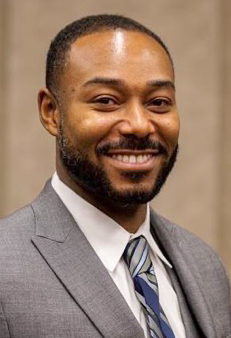
About the talk: Justin Hansford discussed his experience in community-based legal advocacy and addressed how he incorporated his practitioner experience into his teaching and scholarship.
Justin Hansford – Executive Director, Thurgood Marshall Civil Rights Center, Howard University. Professor Hansford was previously a Democracy Project Fellow at Harvard University, a Visiting Professor of Law at Georgetown University Law Center, and an Associate Professor of Law at Saint Louis University. He has a B.A. from Howard University and a J.D. from Georgetown University Law Center, where he was a founder of the Georgetown Journal of Law and Modern Critical Race Perspectives. Professor Hansford also has received a Fulbright Scholar award to study the legal career of Nelson Mandela, and served as a clerk for Judge Damon J. Keith on the United States Court of Appeals for the Sixth Circuit.
Hansford worked to empower the Ferguson community through community based legal advocacy. He co-authored the Ferguson to Geneva human rights shadow report and accompanied the Ferguson protesters and Mike Brown’s family to Geneva, Switzerland, to testify at the United Nations. He has served as a policy advisor for proposed post-Ferguson reforms at the local, state, and federal level, testifying before the Ferguson Commission, the Missouri Advisory Committee to the United States Civil Rights Commission, the President’s Task Force on 21st Century Policing, and the Inter-American Commission on Human Rights.
Professor Hansford co-authored the forthcoming Seventh Edition of Race, Racism and American Law. His interdisciplinary scholarship has appeared in academic journals at various universities, including Harvard, Georgetown, Fordham, and the University of California at Hastings.
 HRE USA