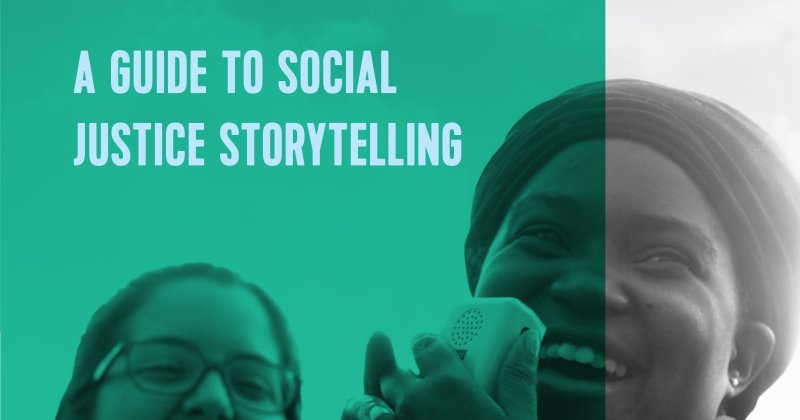
Say it Forward: A Guide to Social Justice Storytelling

This new guide by Voice of Witness provides strategies and resources for creating justice-driven oral history projects.

Oral history is a universal form of storytelling. For many years Voice of Witness has shared powerful stories of people impacted by injustice with a broad audience of readers.

Say It Forward extends this work, offering a DIY guide for social justice storytelling that outlines the critical methodology at the core of Voice of Witness’s evocative oral history collections.

What’s Inside?

  • Information, strategies, and steps to address power discrepancies, awareness of cultural norms, insider/outsider dynamics, self-care for interviewers, and more
  • An extensive resource section for oral history, community storytelling, media options for sharing stories, community-organizing resources, and clinical psychology resources related to traumatic stories and self-care
  • Field reports exemplifying how to harness the power of personal narrative to expose larger issues of inequality

>> Learn more and purchase

Black Lives Matter at School

Mark your calendars! The Black Lives Matter at School week of action will be held from February 4-8, 2019.

Black Lives Matter At School is a national committee of educators organizing for racial justice in education.  BLM at School encourage all educators, parents, students, unions, and community organizations to join the annual week of action during the first week of February each year.

There are many ways to participate in Black Lives Matter at School week. Some educators teach BLM lessons every day of the week, wear their Black Lives Matter At School t-shirt, organize after-school rallies, facilitate their students entering the creative challenge, develop curriculum, post on social media, and rally at the school board meeting. One easy way for everyone to participate is to sign the petition endorsing the week of action

The important thing is that you act in some way to join this movement to bring down the structures of anti-Blackness in education and affirm the lives of Black students in your classroom. 

Email BlackLivesMatterAtSchool If you or your organization would like to support or endorse the week of action.

>> Learn more 
>> More Teach BLM Resources


Happy Human Rights Day

Today, Monday, December 10th marks the 70th ANNIVERSARY of the Universal Declaration of Human Rights. A milestone document in the global history of human rights that is as relevant today as it was when drafted seven decades ago.  

Although the UDHR is not in itself legally binding, it has become the procreator of modern international human rights law, providing safeguards – and sometimes lifelines – for thousands of people from all walks of life when national laws fail them. It has parented 16UN human rights treaties that are legally binding, including the twin UN Covenants spanning economic, social and cultural and civil and political rights respectively, plus a host of regional treaties in Africa, the Americas, and Europe.

We now take for granted that such human rights standards can be used to hold our governments to account, but just 70 years ago there were no internationally recognized human rights norms at all. The very fact that the UDHR has stood the test of time is a testament to the enduring universality of its perennial values of equality, justice, and human dignity.

The promise of the UDHR, however, has yet to be fulfilled because, as all advocates know, human rights are not a given but rather require a continuous struggle to get and once that has been achieved to keep. In other words, it is down to us to promote its ethical vision as new forms of nationalism and populism threaten to challenge our world.  

At HRE USA we believe human rights education is key to ensuring a future in which all people’s rights are respected, protected, and fulfilled. Please consider supporting HRE-USA by making a tax-deductible contribution on our behalf to our fiscal sponsor, the Center for Transformative Action, a 501(c)3organization. Your donation will allow us to continue to advocate for and further develop programming that supports human rights education across the United States.

In honor of the 70th Anniversary and to help everyone celebrate the gift of the UDHR, HRE USA has created this online resource kit. You can also join the international campaign to #Standup4humanrights. 

 HAPPY HUMAN RIGHTS DAY

Never Forget – Teaching 9/11

Each September brings a flurry of excitement and anxiety for parents, teachers, and students. Beginning in September 2002 another factor was added to the list: how and what to teach about 9/11.

“Never forget” became a national rallying cry after the attacks of Sept. 11, 2001.

Yet America’s schools — where collective memory is shaped — are now full of students who never knew. Because they weren’t alive 17 years ago.  In fact, most individuals under the age of 30 have limited or no memories of the world before the attacks of September 11,2001 and were certainly not old enough to fully understand how the subsequent U.S. response, including the so-called “War on Terror” and its resulting policies, impacted human rights.

As such, many teachers struggle with whether and how to teach the attacks and their aftermath, but, in order to never forget, our children need to be taught about 9/11. More importantly, they need to understand how changes in U.S. national security policy post-9/11 continue to manifest themselves in new and different ways today, even as public and media attention wanes. These trends are especially apparent among young people, who reportedly demonstrate low rates of awareness of issues such as indefinite detention or drone strikes, and often exhibit lower levels of civic participation around national security and human rights issues.

That’s where Human Rights in National Security: An Educator’s Toolkit comes in. The events of the past seventeen years are highly relevant in a number of academic disciplines: civics, political science, law, literature, film, religious studies, international relations, and more. This toolkit provides educators with lesson plans and resources to address these issues in the classroom and to empower students to assess their developments through a human rights lens. It also aims to increase participation among high school and college students in activism and advocacy around torture, surveillance, anti-Muslim hate, indefinite detention, and other common human rights violations associated with post-9/11 U.S. policy.

>> Download Toolkit

Need support? If so, please email us. Human Rights Educators USA has teamed up with Amnesty International USA to gather feedback and improve this resource.
Counter Hate in Schools

Since Teaching Tolerance began tracking hate and bias incidents at school in October 2017, they’ve recorded 496 reports spanning 47 states and Washington, D.C.  A recent UCLA study found that teachers are seeing increased incivility, intolerance and polarization in classrooms.

“Back to school” shouldn’t mean “back to hate.” 

To counter this rise of discrimination, hatred, and bigotry in our society and in our schools, the Southern Poverty Law Center has joined forces with 20 other education advocacy groups, including HRE USA, to counter hate in American schools. This coalition is committed to providing resources and support so schools may effectively respond to hateful acts and create learning environments where every student feels welcome.

Read the full statement and add your name* to the list of supporters who believe hate has no place in schools. If you represent an education organization that would like to add your group’s name to this statement, please email againsthate@tolerance.org.

>> Sign on to the Join Statement
>> Learn more

To counter hate in your school, Teaching Tolerance suggests the following: 

  1. Be prepared. Use our Responding to Hate and Bias at School guide to learn what to do before, during and after a crisis. Having protocols in place at the beginning of the school year helps increase administrators’ and teachers’ confidence that they’ll be able to effectively address incidents and alleviate tension.
  2. Develop a zero intolerance policy. Follow our Speak Up at School guide to help respond to prejudice, bias, and stereotypes every day in the classroom.
  3. Take on controversial topics and encourage civil discourse. Civil Discourse in the Classroom lays the groundwork. Let’s Talk! provides strategies to facilitate discussions that might elicit strong emotions.
  4. Create a community where all students can thrive. Use our Social Justice Standards to guide you in the engagement of anti-bias education. Critical Practices for Anti-bias Education ensures teachers can improve academic outcomes by building intergroup awareness, encouraging students to speak out against bias and injustice.

Teach for Environmental Justice

At the heart of our environmental crisis is the idea that nature is a thing to be used for profit. That’s the bad news. The good news is that social movements across the world are challenging this profit-first orientation, and proposing alternatives. And educators are a part of these movements.

The Zinn Education Project (ZEP) has posted five teaching articles that grew out of a writing retreat sponsored by ZEP and This Changes Everything, the project launched by Naomi Klein’s brilliant book. These articles include role plays, stories of activism and resistance, and ideas for how to implement concepts from This Changes Everything: Capitalism vs. the Climate in our classrooms.

>> Learn more

Diverse Democracy Grants

Teaching Tolerance (TT) is funding projects that will help students become empowered voting advocates in their communities through their Diverse Democracy Grants.  TT will be offering awards of $500 to $10,000 to fund projects for educators helping their students to become lifelong voters and empowered voting advocates in their communities.

Available through August 31

>> Learn more

Women’s Rights Coming to a City Near You!

By Kate Kelly & JoAnn Kamuf Ward, Columbia Law School Human Rights Institute

A number of recent and exciting developments in the local implementation of the Convention on the Elimination of All Forms of Discrimination against Women (CEDAW) have occurred over the past year.  There are now 9 ordinances in place, and 28 city, county and state governments have adopted CEDAW resolutions. There is also growing momentum of women’s rights movements around the country, including the #MeToo and #TimesUp movements, as well as the ongoing work evidenced by women’s marches and other groups demanding accountability.

To  build upon this energy, and continue the momentum, the Columbia Law School Human Rights Institute and the Leadership Conference on Civil and Human Rights convened a CEDAW strategy session on the margins of the 2018 UN Commission on the Status of Women (CSW) in New York.  This meeting was a unique chance for advocates from around the country to collaborate, share lessons learned, and support each other in efforts to operationalize CEDAW at the local level. Representatives from CEDAW advocacy groups, local government, and academia, representing over 20 cities and counties were present, from Portland to Pittsburgh and Denver to Durham, and many places in between.

To ensure that advocates across the country can continue to raise awareness of what CEDAW entails and how it can be useful in the local context, the meeting conveners developed user-friendly materials that include a two-pager that distills the basic provisions of CEDAW, as well as a plain language guide to all of the General Recommendations from the CEDAW Committee, reflecting interpretations of the treaty.  These materials are available on the Cities for CEDAW website, along with more in-depth guidance for implementing CEDAW locally.

>> Learn more
>> Join the Cities for CEDAW Coalition

Muslim American Educators Driving Change in the Classroom

Nagla Bedir and Luma Hasan (pictured above), both social studies teachers in New Jersey, co-founded Teaching While Muslim to help address some of the challenges and frustrations they experienced as students growing up as Muslim Americans.

Trying to articulate a complex identity when faced with peers and educators who have a limited understanding of what it means to be Muslim often left Nagla and Luma on the defensive, responding to micro-aggressive questions and bigoted accusations that would not be necessary if school curricula were fully inclusive.

twm-logo.pngNow as educators, they are driving the change to address this lack of inclusion.The Teaching While Muslim site is a space intended to deepen understanding of the complicated identities of Muslims in the United States, including the diverse experiences of Muslim educators. It is also a platform for resources and tools.

Bedir and Hasan took a few minutes to talk about their efforts and where they see their work headed.

>> Read More
>> Support the movement for racial justice in Education

Human Rights as a Tool to Address Climate Change

Professor Rebecca M. Bratspies of CUNY Law School has published a timely new article in the current issue of the University of Miami Law Review, titled The Climate for Human Rights.  Here’s the abstract:

Climate change is the defining challenge of the 21st century.  The United States government is currently ignoring the problem, but wishful thinking alone will not keep global mean temperature rise below 2ºC. This Article proposes a way forward. It advises environmental decision-makers to use human rights norms to guide them as they make decisions under United States law. By reframing their discretion through a human rights lens, decision-makers can use their existing authority to respond to the super-wicked problem of climate change.

>> Read full article