Press Release: International Indian Treaty Council Honored

October 10, 2022

Download full press release here

Human Rights Educators USA (HRE USA) announced today its first Human Rights Educators USA Impact Award honoring the nearly 50 years of extraordinary contribution of the International Indian Treaty Council (IITC) to human rights education in the United States and around the world.  

The IITC, an organization of Indigenous Peoples from North, Central, South America, the Caribbean, and the Pacific, works for the sovereignty and self-determination of Indigenous Peoples and the recognition and protection of their human rights, treaties, traditional cultures, and sacred lands. The IITC brings Indigenous Peoples together to share information and develop collective strategies to defend their rights, and ways of life at International Indian Treaty Conferences hosted by Indigenous Nations in South Dakota, Oklahoma, California, Arizona, Minnesota, Florida, Alaska, Hawaii, Canada, Panama, Mexico, Guatemala, and Aotearoa/New Zealand.

Since its foundation in 1974, the IITC and its many leaders have worked in numerous capacities to further human rights training and education throughout the United States and in global arenas, including at the United Nations. In 1977, the IITC was the first Indigenous organization to receive Consultative Status with the United Nations Economic and Social Council (ECOSOC). In recognition of its long-standing and wide-ranging work within the UN system on behalf of Indigenous Peoples January, in 2011, the IITC became the first Indigenous organization to be granted full General Consultative Status at the UN.

IITC provides training, capacity-building, and access for Indigenous Peoples to utilize a human rights framework to advance the struggles of their Nations and communities and to engage effectively in UN human rights bodies and mechanisms, especially after the Declaration on the Rights of Indigenous peoples (UNDRIP) was adopted by the UN in 2007. Key human rights focus areas for IITC include cultural rights and protection of sacred sites, prisoners’ rights, access to justice, right to health, racial discrimination, rights of Indigenous women and children, water and land rights, Free Prior and Informed Consent, Truth in History, decolonization and protection for Human, Treaty and Environmental rights defenders.

IITC will be recognized at the HRE USA Training As Action Series workshop on “Indigenous Peoples’ Human Rights & Climate Change” session on Monday, October 24, 2022 at 7:00 pm ET. On behalf of IITC, IITC Executive Director Andrea Carmen and IITC Board members, Bill Means and Lisa Bellanger, will share words about its founding and current human rights education initiatives. In addition, IITC will be recognized at the formal HRE USA Human Rights Day Celebration virtual event on Friday, December 9, 2022, at 4 pm ET. 

For more information on IITC see https://www.iitc.org or contact Andrea Carmen at andrea@treatycouncil.org.

HRE USA TAAS Series: Indigenous Peoples’ Human Rights and Climate Change

REGISTRATION: bit.ly/hreusa-taas2022

Monday, October 24, 2022

7pm–9pm ET

Virtual Zoom Session

This session will explore Indigenous Peoples’ and environmental rights as human rights. Indigenous leaders from the International Indian Treaty Council (IITC) will share current initiatives in policy, advocacy, education, and practice. IITC will be honored with the first 2022 Human Rights Educators USA Impact Award.

Today Indigenous Peoples are facing a compounding and multi-level urgent threat, specifically the Climate Crisis. The loss and damage we are already experiencing to our food systems, cultures, and ways of life, combined with the threats we see coming, require a multi-faceted, rights based response. We know that some reservations were already identified as “food deserts” even before the climate crisis came upon us.  Effective response to climate change requires taking urgent steps to protect and revitalize our ancestral practices, knowledge, and food sources such as buffalo and original seed varieties for corn, beans, and squash. It also requires that we defend our rights to Free, Prior and Informed Consent, Self-determination and Treaties in order to oppose fossil fuel development that produces greenhouse gas emissions such as pipelines, drilling. and mining in our homelands. We must also assert our recognized right to participate in decision-making that would affect our rights at the tribal, state, national, and international levels where our contributions as knowledge and rights holders are essential for building effective solutions. Our ancestors left us the warnings about what we as humans would face during these times. But they also left us with solutions that we can put into practice today, in response to these challenges.

IITC was founded on the Standing Rock Reservation in South Dakota in 1974 to be an international voice and advocate for the Rights of Indigenous Peoples. In 1977 IITC was the first Indigenous Peoples organization to receive Consultative Status from the UN Economic and Social Council and in 2011 it was the first to be upgraded to “General Consultative Status.”

Speakers and Facilitators

Lisa Bellanger, Board member, International Indian Treaty Council and District American Indian Specialist, St. Paul Schools, Minnesota

Andrea Carmen, Executive Director, the International Indian Treaty Council

William Means, a Founder and Board member, the International Indian Treaty Council

HRE USA TAAS Series:  Action for Human Rights

REGISTRATION: bit.ly/hreusa-taas2022

Monday, 10/17/22 7pm–9pm ET: Action for Human Rights

Taking Action for Human Rights

During this workshop, participants will explore various tactics for human rights action. Paying particular attention to youth action for human rights, we will explore how to design a plan of action, the right to protest, and student walk-outs as human rights action. This interactive workshop will be facilitated by Ben Fleming and Kristina Eberbach.

Ben Fleming is Adjunct Professor of International Human Rights Law and Adjunct Professor of the International Human Rights of Women Seminar at South Texas College of Law Houston. He was Associate Adjunct Professor of International Human Rights Law at the Graduate School of International and Public Affairs (SIPA) at Columbia University. He is also the co-founder and co-lead of the University Human Rights Education in Myanmar Project for the Institute for the Study of Human Rights (ISHR) at Columbia University. He was a visiting lecturer in International Human Rights and Public International Law at Mandalay University School of Law in January and February 2014. Mr. Fleming was a Legal Officer in the Office of the Co-Investigating Judges at the United Nations Khmer Rouge Tribunal (UNAKRT/ECCC) in Phnom Penh (2006-2009), and has worked in the anti-corruption and litigation offices of Open Society Justice Initiative. 

Kristina Eberbach specializes in human rights and human rights education. She is currently Strategy and Curriculum Specialist for the Human Rights Close to Home (Human Rights Institute, University of Connecticut) and an Adjunct Assistant Professor of International and Public Affairs at Columbia University. She served as Deputy Director at the Institute for the Study of Human Rights at Columbia University from 2019-2021 and as Director of Education from 2010-2019. She has developed and facilitated human rights programs, courses and workshops for university students, members of civil society and government officials in Colombia, Iraq, Myanmar, and the U.S. and has undertaken research, reporting, and advocacy work in Kenya (International Crisis Group), Myanmar, The Netherlands (ICTY/ICTR), South Africa, Uganda (Charity for Peace Foundation), and the U.S. She is co-chair of Human Rights Educators USA and is a co-founder and co-chair of the University and College Consortium for Human Rights Education. Her research focuses on human rights education and human rights in transitional contexts and she is completing her PhD at the University of Utrecht. Kristina holds a Master of International Affairs from Columbia University’s School of International and Public Affairs and a Bachelor of Science in Foreign Service from Georgetown University.

Come join us as we engage in dialogue regarding gun violence, youth action Indigenous rights, and much more!

Updated Lesson: Indigenous Peoples’ Day

As we approach Indigenous Peoples’ Day, here are recommended classroom resources. Note the new version of the lesson, The People vs. Columbus, et al.

The People vs. Columbus, et al. New Version

This widely used lesson has been revised in collaboration with Taíno community members. The updated version centers the Taíno people as the people harmed and includes indictments for four colonial offenders: Columbus, Columbus’s Men, King Ferdinand and Queen Isabella, and the System of Empire.

In previous versions of this trial role play, the Taíno were included as one of the defendants. In this one, they are accusers. The Taíno present charges in the role play of enslavement, rape, torture, maiming, killing, crimes against the environment, and occupation and theft of Taíno land. Read more.

We’d love to hear from you when you use the lesson. In appreciation for your feedback, we’ll send you a people’s history book.

Updated Lesson

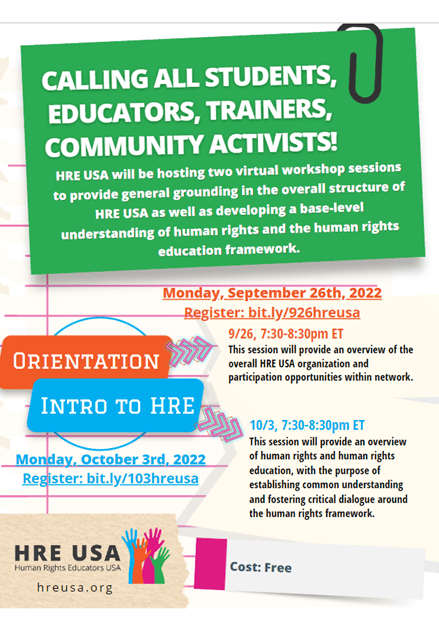
Don’t miss this opportunity! Fall 2022 HRE USA Members Orientation Session

HRE USA Orientation 
HRE USA will be hosting virtual workshop sessions to provide general grounding in the overall structure of HRE USA as well as developing a base-level understanding of human rights and the human rights education framework. 

  • Introduction to Human Rights Education: Monday, October 3rd, 2022 7:30-8:30pm ET: This session will provide an overview of human rights and human rights education, with the purpose of establishing common understanding and fostering critical dialogue around the human rights framework.

Cost: Free

>> Register

Indigenous Peoples’ Day Curriculum Teach-In

October 1 | 12:00 PM – 3:00 PM ET (9:00 AM – 12:00 PM PT)

Learn more and register

The Smithsonian’s National Museum of the American Indian (NMAI) and Teaching for Change will host an online teach-in with a series of workshops and keynote speaker, Rebecca Nagle.

Workshop on Indigenous Central America

Teaching Central America program specialist Jonathan Peraza Campos will lead a workshop that will provide teachers with strategies and resources for introducing the Quiche Maya ancestral story in their classrooms. Participants will explore the Popol Vuh, the Maya origin story, which highlights the importance of corn and nature to the Maya and other Indigenous communities throughout Central America. Connections will be made to Indigenous communities and the challenges they face today.

New Resource: The Constitution EXPLAINED


In celebration of Constitution Day, iCivics and the Center for Civic Education proudly launched an exciting new resource led by iCivics’ Senior Director of Partnerships and Constitutional Scholar in Residence Julie Silverbrook in collaboration with Constitutional scholar and author Linda R. Monk and Christopher R. Riano, the President of the Center for Civic Education. Funded by Kenneth C. Griffin, The Constitution EXPLAINED is an engaging new video series exploring the U.S. Constitution and reflecting on the rights and responsibilities enshrined in this seminal document. The 35 short videos dig deep into every article and amendment in straightforward and easily digestible 2–4-minute segments that provide both context and modern relevance. While the videos are geared toward middle and high school students, they can also be used by the general population as an engaging refresher. Plans for these videos include integrating them into future exhibits and other learning experiences.  Explore the Videos