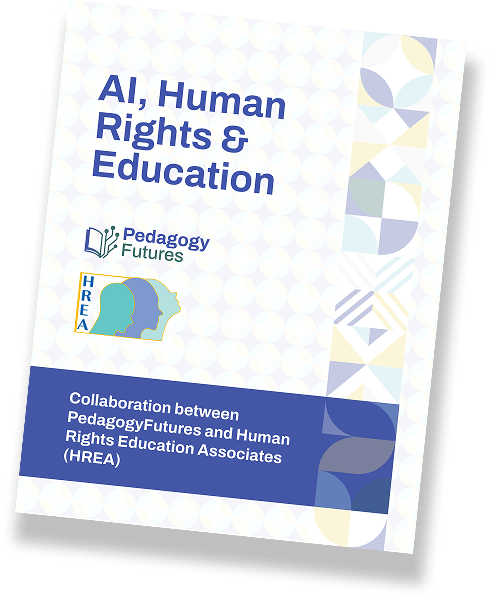
HREA and Pedagogy Futures release AI and Human Rights module

HREA, in collaboration with Pedagogy Futures, has just released a six-lesson module addressing AI Human Rights and Education! The curriculum empowers educators and students to critically engage with how AI shapes society, from education to governance, public services, and civil liberties. Through interactive lessons and real-world case studies, participants build essential literacy around AI’s potential and risks, all grounded in a commitment to dignity and human rights.

The curriculum is free and can be downloaded here: https://lnkd.in/etAJzB2D

Online course on Monitoring & Evaluation in the NGO Sector

HREA is offering an online course “Monitoring, Evaluation and Learning in the NGO Sector from October 1 – November 11. There are still spots available!

This course will introduce key M&E concepts, methods and strategies, including theories of change, logical frameworks, measurement and preparation of research findings. Learners will explore participatory methods and the human rights-based approach and develop an initial M&E plan.

The course will be taught by Dr. Felisa Tibbitts who has over 30 years’ experience as an evaluation specialist and done studies for the UNOHCHR, UNDP, UNICEF and the OSCE/ODIHR as well as for civil society organizations such as Amnesty International. She has taught monitoring and evaluation at Columbia University and trained adult learners in development, humanitarian and human rights organizations throughout the world.

For more information, including fees and how to register visit https://www.hrea.org/courses. The enrollment deadline is September 22nd. Queries can be directed to learning@hrea.org.

With best wishes

HREA: Online course Implementing Human Rights Locally

HREA is offering a new online course Implementing Human Rights at the Local Level from September 10 -October 21. A half hour information session with course instructor Corey Barr will take place on Wednesday, June 25th at 9:30 am EDT. Register here for a Zoom link or to have future access to the recording. 

The course is designed to equip municipal leaders, local human rights commissions, CSOs and community advocates with knowledge and tools to implement international human rights law and a human rights-based approach at the local level. Learners will develop an action plan for advancing human rights in their own community.

For more information, including fees and how to register, visit here. Queries can be directed to learning@hrea.org.

The HREA Team

HREA: AI, Human Rights & Education

HREA in collaboration with Pedagogy Futures has just released a six-lesson module addressing AI Human Rights and Education! The curriculum empowers educators and students to critically engage with how AI shapes society, from education to governance, public services, and civil liberties. Through interactive lessons and real-world case studies, participants build essential literacy around AI’s potential and risks, all grounded in a commitment to dignity and human rights. Download this free curriculum here.

HRE Resources on the Right to Protest

Recognized in international human rights law, including the Universal Declaration of Human Rights and the International Covenant on Civil and Political Rights, the right to peaceful assembly and the freedom of expression together empower both individuals and communities to advocate for justice and systemic change.

HREA offers more than 40 resources on freedom of assembly and associationand 80 resources on freedom of opinion and expression, all of which can be used to support educators, activists, and policymakers. These include lesson plans, toolkits, fictional stories, and other materials designed to promote civic participation and human rights education. 

In preparation for educational activities supporting human rights throughout the year, you are welcome to explore HREA’s Online Resource Center.

HREA: Online course Implementing Human Rights Locally

HREA is offering a new online course Implementing Human Rights at the Local Level from September 10 -October 21. A half hour information session with course instructor Corey Barr will take place on Wednesday, June 25th at 9:30 am EDT. Register here for a Zoom link or to have future access to the recording. 

The course is designed to equip municipal leaders, local human rights commissions, CSOs and community advocates with knowledge and tools to implement international human rights law and a human rights-based approach at the local level. Learners will develop an action plan for advancing human rights in their own community.

For more information, including fees and how to register, visit here. The enrollment deadline is September 1st. Queries can be directed to learning@hrea.org. You are warmly welcomed to participate!

The HREA Team

HREA Updates: Essay and Proposals for Digital Learning Week

From Felisa Tibbitts, HREA Director:

Many of us are struggling with how to understand AI from the human rights lens – both the risks and opportunities.

I am delighted to share my essay on AI, Human Rights and Education, developed with Saah Agyemang-Badu and Sage Phillips. I will shortly announce the open access six-lesson module that has been developed on this topic in cooperation with PedagogyFutures. 

Those of you who are interested in digital literacy from an ethics perspective may want to register for UNESCO’s upcoming Digital Learning Week, which will take place in Paris September 2-5. The deadline for proposals is May 26.

HRE Resources for Living Together in Peace

The UN recognizes May 16 as the International Day of Living Together in Peace to promote peace, tolerance, inclusion, understanding and solidarity – both inside and across borders. Sustainable peace is possible only when human rights are respected.

The Day promotes reconciliation to help ensure peace and sustainable development, including through education, by working with communities, faith leaders and other relevant actors, through reconciliatory measures and acts of service, and be encouraging forgiveness and compassion among individuals.

HREA has over 20 resources addressing peace education, including lesson plans, toolkits, teacher training manuals and multimedia materials.

In preparation for educational activities for peace and throughout the year, you are welcome to explore HREA’s Online Resource Center for HRE resources on topics at the intersection human and children’s rights.

2025 Online HREA Course: Introduction to Human Rights Education

HREA is once again offering the online course Introduction to Human Rights Education!  This course will be taught by HREA Director Felisa Tibbitts from May 14- June 24 and will introduce the international field of human rights education (HRE), including programming approaches, pedagogical practices, teaching and learning resources and evaluation techniques. Participants will be exposed to “the basics” of curriculum design and develop an applied product. 

Additional details about the course and other forthcoming HREA courses can be found here.

Call for papers: Special Issue 2026 Human Rights Education in Latin America

Guest editors: Melina Porto and Leonel Pérez Expósito

Human Rights Education Review invites submissions for a Special Issue on Human Rights Education (HRE) in Latin America. We welcome conceptual and empirical studies and expect this Special Issue to illuminate the specificities of HRE in the region and to contribute to a dialogue within and beyond Latin American countries. Our aspiration is to enhance human rights education research globally through such dialogue.

An overarching goal of human rights education is to enable a culture of human rights and support freedom, justice and peace in the world (United Nations, 1948; preamble) through pedagogies and approaches that meet the needs of diverse learners, and which resonate with the needs and experiences of their communities (Osler, 2016).

The Guest Editors of this Special Issue welcome papers that address HRE across all phases of formal education, to include primary, secondary and higher education, and which help identify the curricula spaces in which HRE can occur, such as those within the language curriculum. Moreover, they recognise that HRE takes place in community settings and through engagement in activism and social movements, and therefore they also encourage contributions that examine human rights learning in these contexts.

Latin America, in common with other regions, is frequently characterized by scenarios of poverty and inequality (Lustig, 2020), violence (Briceño-León, 2008), authoritarianism, and corruption (Pastrana Valls, 2019), as well as being impacted severely by climate change (Uribe Botero, 2015). These challenges create significant obstacles to the realization of greater equality and the consolidation of democracy, key elements in building societies that respect and promote human rights. However, Latin America can be considered a beacon of hope for democratic alternatives displayed in a range of vibrant social movements, progressive governments, new forms of participatory politics, and innovative responses to social challenges. This sociopolitical dynamic echoes the development of theoretical frameworks such as critical pedagogy, decolonization, emancipatory education, and intercultural education (Freire, 2002 [1970]; Walsh, 2010), which may illuminate local, regional and international thinking in the field of education for rights and greater societal justice.

Human rights education is a tool that can make a significant contribution in tackling societal challenges. Each society must necessarily address its specific history in responding to the HRE imperative. Thus, veteran Chilean human rights educator, Abraham Magendzo (2011), writes powerfully of how his personal and professional journey was shaped by his experiences of growing up Jewish under Pinochet’s military dictatorship and his awareness of concurrent human rights violations in other Latin American countries. These histories have helped shape HRE in the region.

HRE is critical to human development and societal transformation in Latin America but, as in other regions, it still faces relevant challenges and has not yet fulfilled its full potential (Magendzo & Pavéz, 2015). A wider holistic application is needed, so learning becomes a transformative force which empowers youth and develops solidarity, tolerance, and respect for social justice (Lakshminarayanan & Thomas, 2022). For example, creative pedagogies that draw on art and activism (see, for instance, Bittar, 2020 for a case study in Brazil) may support human rights education more widely as would a focus on the knowledge, experiences and rights of indigenous and marginalized populations. The exploration of these dimensions, and others such as the link between HRE and environmental concerns, contributes to providing HRE with a sensitive and historically responsive foundation as historical and other injustices in the region are addressed, as well as supporting an analysis of their ongoing impacts. 

Accordingly, the Guest Editors invite contributions that address, but are not limited to, the following subjects:

  • Human rights education through the curriculum.
  • Human rights learning in informal settings
  • Analysis of public policies in human rights education: possibilities, challenges and hindrances.
  • The conceptualization of human rights and human rights education in the Latin American context, addressing inter alia, decoloniality and interculturalism.
  • The intersection of human rights education and environmental protection.
  • Human rights education and the rights of indigenous and other marginalized groups.
  • History, contextualizing rights and building democracy.
  • Peace and human rights education as elements in transitional justice.

This Special Issue aims to illustrate the particularities and commonalities in HRE across the Latin American region, highlighting various lenses and pedagogical strategies in place. It aims to create a space in which human rights educators may reflect on the past, consider the present and imagine a future in which HRE contributes to a more just and peaceful region and planet.

If you would like to make a submission in response to the Call for Papers send an extended abstract of no more than 300 words to Human Rights Education Review Managing Editor Kalpani Dambagolla to kalpanidambagolla@gmail.com by 3 March 2025. Your abstract should include a short list of indicative literature on which you expect to draw. Please ensure you use the subject line HRER: Human rights education in Latin America in your email. You will hear back from us by 17 March 2025. All invited manuscripts will be subject to double-blind peer review. For invited papers for this special issue, submission of the full paper to HRER will be via ScholarOne by 31 August 2025. We expect to publish the Special Issue in Volume 9, 2026. 

Human Rights Education Review

Human Rights Education Review is an award-winning journal that publishes original research and scholarship. It is the scholarly journal of the International Association for Human Rights Education and published by Routledge/Taylor & Francis.  By publishing in HRER you will have the opportunity of reaching the widest possible international readership. You can view previous issues of the journal here and learn more about HRER editorial policies.  From mid-December 2025, you can find the journal on our new site:

Guest editors

Melina Porto is a researcher at the National Research Council (CONICET) and Professor of language education at Universidad Nacional de La Plata in Argentina. Her interests include intercultural language education, human rights education, and social justice.

Leonel Pérez Expósito is Professor of sociology and education at Univesidad Autónoma Metropolitana in Mexico City. His interests include civic and political education, education and equity, human rights education, and learning assessment.

References

Bittar, E. C.  (2020). Art, human rights activism and a pedagogy of sensibility: the São Paulo Human Rights Short Films Festival-Entretodos. Human Rights Education Review3(1), 69–90. https://doi.org/10.7577/hrer.3743.

Briceño-León, R. (2008). La violencia homicida en América Latina. América Latina Hoy50, 103-116.

Freire, P. (2002 [1970]). La pedagogía del oprimido (54 ed.). Siglo XXI.

Lakshminarayanan, R., & Thomas, D. (2022). From vision to transformation: integrating human rights courses in higher education in India. Human Rights Education Review5(3), 21–47. https://doi.org/10.7577/hrer.4546.

Lustig, N. (2020). Desigualdad y política social. In Carranza et al., El desafío del desarrollo en América Latina. Políticas para una región más productiva, integrada e inclusiva. CAF. Retrieved from https://scioteca.caf.com/handle/123456789/1659

Magendzo Kolstrein, A. (2011). Why are we involved in human rights and moral education? Educators as constructors of our own history. Journal of Moral Education40(3), 289–297. https://doi.org/10.1080/03057240.2011.596327

Magendzo Kolstrein, A., & Pavéz, J. (2015). Educación en derechos humanos: una propuesta para educar desde la perspectiva controversial. Comisión de Derechos Humanos del Distrito Federal de México.

Osler, A. (2016). Human rights and schooling: An ethical framework for teaching for social justice.  Teachers College Press.

Pastrana Valls, A. (2019). Estudio sobre la corrupción en América Latina. Revista mexicana de opinión pública27, 13-40.

United Nations. (1948). Universal Declaration of Human Rights.  https://www.ohchr.org/en/human-rights/universal-declaration/translations/english

Uribe Botero, E. (2015). El cambio climático y sus efectos en la biodiversidad en América Latina. Comisión Económica para América Latina.

Walsh, C. (2010). Interculturalidad crítica y educación intercultural. In J. Viaña Uzieda, L. Tapia Mealla, & C. E. Walsh (Eds.), Construyendo interculturalidad crítica (pp. 167-181). Instituto Internacional de Integración, Convenio Andrés Bello.