Monday, September 26th, 2022: Register: bit.ly/926hreusa
Monday, October 3rd, 2022: Register: bit.ly/103hreusa
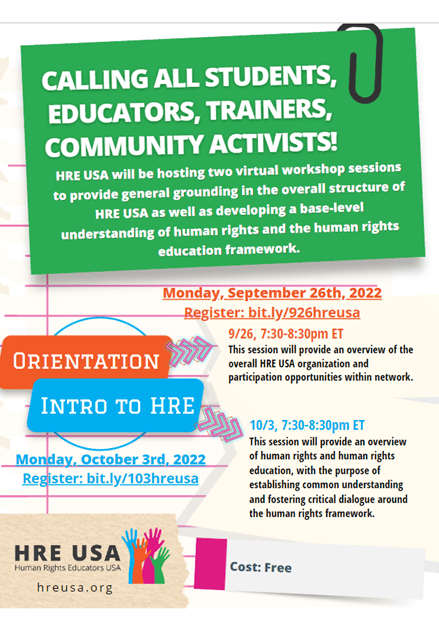


Monday, September 26th, 2022: Register: bit.ly/926hreusa
Monday, October 3rd, 2022: Register: bit.ly/103hreusa

Presented by Susie Wise
Moderated by Marcie Bianco
Date October 19 & October 26, 2022
Time 11 a.m.-12:30 p.m. PT / 2-3:30 p.m. ET
FOR MORE INFORMAION AND TO REGISTER VISIT THIS PAGE
A Two-part 180-minute Live e-Certification Series:
Part I: Exploring Belonging [October 19]
Part II: Designing for Belonging and Inclusion [October 26]
We Will Explore:

| Stay up to date on the strategies that are being used to spread disinformation. While climate denial was once the champion of those attempting to muddy the waters of the climate change conversation, now false information about potential climate change solutions is rampant Identify fake news with your students. Try the Factitous Game created by American University Game Lab in Washington, DC. The game asks players to read a short article to determine whether it is fact or fake and provides tips for recognizing false information and untrustworthy sources. Dive into a great resource on climate misinformation from NCSE on the scientific consensus around climate change, and why there seems to be so much misunderstanding among youth, and adults, around it. Practice the elements of The Stink Test to support students in building background knowledge and the skills necessary to be a discerning consumer of information. Empower your students to know what is and isn’t factual information in today’s digital world using this digital literacy framework! Assist students in exploring what a reliable source looks like, and how to stop the spread of disinformation online. Combat disinformation by using accurate, trusted sources. Visit the Climate Literacy and Energy Awareness Network (CLEAN) to search for K-12 lesson plans, activities, videos, and more. All 700+ resources have been reviewed by both scientists and educators and evaluated for scientific accuracy and educational quality. Fact check like a scientist using this great video from Raven the Science Maven. We know the spread of disinformation is not only rampant within our student body, but also with our peers, our families, and sometimes, ourselves! Check out this great resource for making sure the news and information we share and digest is legit. |

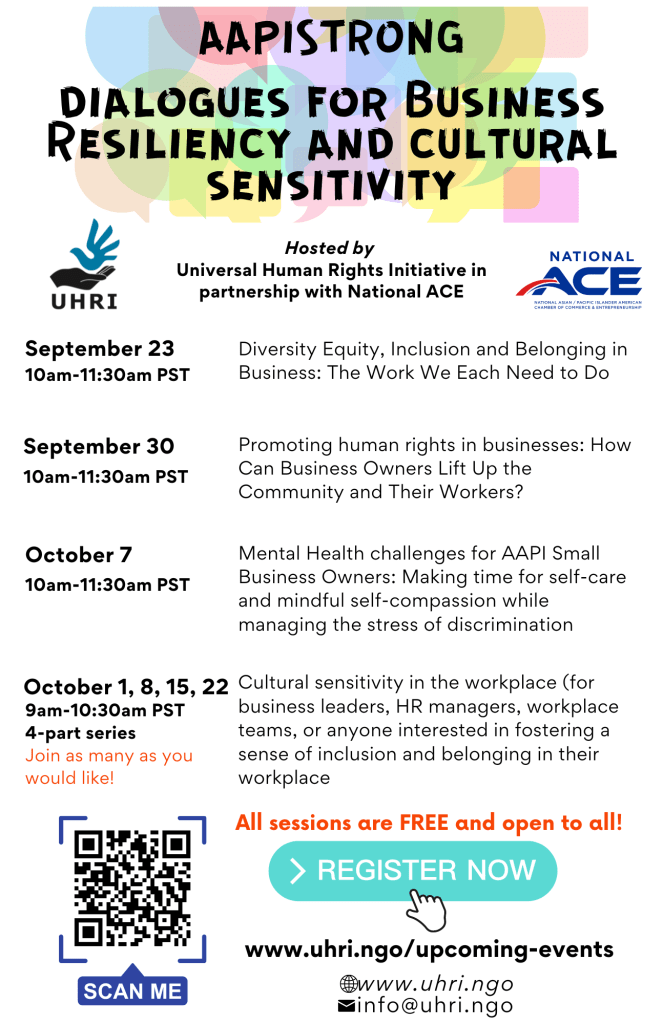
| Are you someone who owns a business, or wants to one day? Maybe you’re in a leadership position, or you work alongside businesses as a consultant. Do you want to strengthen diversity and equity in your circles, explore inclusion and belonging, and gain skills along the way? Register for the events below! Register for AAPISTRONG |

Social justice education is essential in the current hostile learning environment created by censorship laws and policies aimed at prohibiting the teaching of honest history and further marginalizing LGBTQ+ students and educators. Helping children understand their own identities without devaluing others; encouraging them as they find the ways we’re all connected and deserving of respect; teaching them to recognize injustice and showing them how to act against it—this is the work of social justice education.
The Learning for Justice Social Justice Standards are designed to guide in the development of inclusive curricula to make schools safer and more just and equitable. The standards are divided into four domains: identity, diversity, justice and action. Walking through each domain one at a time can help you understand and apply each standard in practice so young people develop the skills they need to reduce bias and prejudice to make schools and communities safer places for all.

Top Stories This Week:
1. What’s happening at Woodhull;
2. Abortion and censorship;
3. America’s censored classrooms;
4. Our right to privacy;
5. Censorship legislation in Florida;
6. Anti-CRT efforts’ impact on teachers;
7. Why we must fight classroom censorship; and
8. Tess’ take on “Don’t Say Trans.”

The Feminist Majority Foundation (FMF) seeks a full-time Chapter Development Associate for the GLI program based in the Los Angeles office. The Chapter Development Associate will guide the development and progress of more than 215 middle and high school-based Chapters in six regional areas, across 28 U.S. states and 13 countries.
GLI educates and energizes middle and high school students to boldly take action for human rights, gender equity and access to education. Together with student leaders, including the Student Advisory Board, GLI is building a movement of informed advocates and a new generation of leaders and activists for social change. The GLI program provides a student club framework and educational materials for students to learn about human rights, with a focus on the obstacles that girls and gender expansive youth face in realizing their full rights, both in the U.S. and globally. GLI teaches leadership skills, and provides opportunities for students to connect with a network of student advocates and leaders locally, nationally and globally. Learn more: www.girlslearn.org.
Main Responsibilities – The majority of the Chapter Development Associate’s time will be spent providing support and direction to GLI high school and middle school Chapters in GLI’s six regional areas. These responsibilities include:
Additional Responsibilities
Qualifications
Compensation and Benefits
This is a full-time non-exempt position. The salary range for this position is $45,000 – $55,000 annually commensurate with skills and experience. Benefits include generous health and dental plans, two weeks of paid vacation plus paid time off between December 24th and January 1st of each year.
How to Apply
Please email a pdf cover letter, resume, and writing sample with Chapter Development Associate in the subject line to Ashley Steimer-King, asteimerking@feminist.org no later than October 2, 2022. No phone calls please. We will contact candidates that we would like to interview.

September 20, 2022
12:00 PM – 1:20 PM EDT
Online event
Facilitated by: Leslie Dwyer, Associate Professor, Carter School
In the aftermath of the Supreme Court’s decision to overturn Roe vs. Wade, how can we still talk about “peace” in the United States? Does this moment demand a critique of hegemonic framings of conflict resolution as consensus, common ground, or shared narrative? For the first time in over a century a constitutional right has been taken away from a class of Americans, with a disproportionate impact on communities of color and marginalized groups. Post-Roe includes living under the threat that more rights might be stripped away.
Speakers:
Leslie Dwyer, Associate Professor, Jimmy and Rosalynn Carter School for Peace and Conflict Resolution
Susan Hirsch, Professor and Vernon and Minnie Lynch Chair of Conflict Analysis and Anthropology, Jimmy and Rosalynn Carter School for Peace and Conflict Resolution
Tehama Lopez Bunyasi, Associate Professor, Jimmy and Rosalynn Carter School for Peace and Conflict Resolution
Agnieszka Paczynska, Associate Professor, Jimmy and Rosalynn Carter School for Peace and Conflict Resolution
*Sessions may be recorded for documentation purposes and shared on public platforms

Mon, September 26, 2022
1:00 PM – 2:00 PM CDT
Although housing is a human right, we are far from everyone having access to safe and adequate housing. Large inequities in housing affordability and quality persist in the U.S. and policies continue to perpetuate those injustices. Cross-sector efforts are needed to ensure fair housing for all. In this webinar, we will learn from cross-sector leaders about efforts at the community-, state-, and national-level to address housing equity.
About the Speakers:
Thomas LaVeist (Host/Moderator) is Dean of the Tulane School of Public Health and Tropical Medicine, and Weatherhead Presidential Chair in Health Equity. Dr. LaVeist’s research and writing has focused on three broad thematic research questions: 1) What are the social and behavioral factors that predict the timing of various related health outcomes (e.g. access and utilization of health services, mortality, entrance into nursing home?); 2) What are the social and behavioral factors that explain race differences in health outcomes?; and 3) What has been the impact of social policy on the health and quality of life of African Americans? His work includes both qualitative and quantitative analysis. LaVeist seeks to develop an orienting framework in the development of policy and interventions to address race disparities in health-related outcomes. Specific areas of expertise include: U.S. health and social policy, the role of race in health research, social factors contributing to mortality, longevity and life expectancy, quantitative and demographic analysis and access, and utilization of health services.
Ana Rausch has more than 22 years of experience in project management and system change implementation. Ana currently serves as Vice President of Program Operations for the Coalition for the Homeless, the lead agency for the TX-700 Continuum of Care (aka The Way Home). In this role, she leads the agency’s HMIS & Program Ops Teams and has led in the development and operations management of The Way Home’s Coordinated Access system. In addition, Ana has spearheaded the revised and improved methodology used during the CoC’s Homeless Count. Ana is originally from Brazil and lives in the northwest Houston area. She has presented at conferences at both state and national levels and holds both a bachelor’s and master’s degree in psychology.
Sydney Shivers serves as Deputy Director for the Mayor’s Office of Community Assets and Investment (OCAI). Following several years coordinating affordable housing initiatives in the nonprofit sector and serving as a Planner with the New Orleans Planning Commission, Sydney now leads cross departmental and cross agency projects aimed at creating equitable, inclusive, amenity rich neighborhoods. She has led successful zoning-reform initiatives to increase the diversity of housing opportunities developed city-wide, and she supported the launch of the Redevelopment Framework, a tool for driving public benefits by leveraging underutilized City-owned properties. Sydney earned her Bachelor’s and Master’s Degrees in Urban and Environmental Planning from the University of Virginia, and she is a candidate for a Master’s of Public Administration from the University of Pennsylvania.
Y. Frank Southall is the Organizing and Community Engagement Manager at the Jane Place Neighborhood Sustainability Initiative (JPNSI) in New Orleans, LA. At JPNSI, he coordinates campaign, organizing, communications, and community engagement strategies for the organization. He has over twenty years of organizing in the labor, environmental, student organizing, racial justice, and housing justice movements.

by Business & Human Rights Resource Centre
Thu, 15 September 2022
14:00 – 15:30 BST
Free online event
Ahead of COP27, we will explore why a human rights-centred approach is essential to an equitable clean energy transition in Africa.
French & Spanish interpretation will be available at this event
Speakers
We are delighted to be joined once again by Mary Robinson (former President of Ireland, former UN High Commissioner for Human Rights, and Chair of The Elders) who will host our discussion.
This year’s keynote speaker will be Mali Ole Kaunga, Executive Director, IMPACT (Indigenous Movement for Peace Advancement & Conflict Transformation).
Mali Ole Kaunga is a Laikipia Maasai and pioneered strategic litigation for Indigenous Peoples in a case against the British Government for using Maasai and Samburu lands for military training. He and has been involved in lobbying for and advancing the interests of Indigenous Peoples affected by the Lake Turkana Wind Power Project and the Isiolo Mega Dam at national and international levels.
Panel speakers
Ikal Angelei – Founder & Director, Friends of Lake Turkana
Ikal is the founder of Friends of Lake Turkana (FoLT), which has worked to stop the construction of the Ethiopian Gilgel Gibe III Dam on the Omo River, Lake Turkana’s primary source of water. Due to FoLT and other partner’s advocacy work on saving Lake Turkana, the Lake was added to the list of world Heritage sites in Danger by UNESSCO in June 2018. Ikal was awarded the Goldman Environmental Prize in 2012.
Francess Piagie Alghali – Sierra Leonne Minister of State in the Office of the Vice-President, EITI board member
Francess is the Principal Assistant to the Vice-President of Sierra Leone and supervises Sierra Leone Extractives Transparency Initiative Unit (SLEITI). She was Executive Secretary of the Human Rights Commission of Sierra Leone, the National Human Rights Institution from 2010 to 2015 and has substantial experience in human rights.
Dr Hubert Danso, CEO & Chairman, Africa investor (Ai) Group
Dr Danso is the Chair of the African Green Infrastructure Investment Bank Advisory Board (AfGIIB). Dr Danso also serves on HRH The Prince of Wales Accounting for Sustainability (A4S) Advisory Council, the World Benchmarking Alliance Just Transition Advisory Group, and the UNDP High-Level Project Steering Committee, advising on the Sustainable Development Goals (SDG) Investor Map.
Joseph Kibugu – African Regional Manager, Business & Human Rights Resource Centre
Joseph has been involved in the National Action Plan processes in Kenya and Uganda & was the author of the recently published briefing on renewable energy in Africa. He is currently leading a project to support communities impacted by renewable energy companies in Kenya, Mozambique and South Africa claim accountability.
 HRE USA