Visit this page to get up to date on the latest HRE USA news.


Visit this page to get up to date on the latest HRE USA news.

World leaders are coming together this November at the international climate negotiations (COP27), and Climate Generation is here to help you stay in-the-know with the Window into COP delegation.
Follow the COP27 conference through the eyes of eleven everyday climate leaders on the ground in Egypt — because international climate policy should be accessible to everyone.
⭐ Understand climate change action on a global scale
⭐ First access to videos, blogs, and interviews with leaders around the world
⭐ Gain the language and tools to talk about climate change with your community or students
Sign up for our free Window into COP27 newsletter, hitting your inbox from November 6–18, 2022.

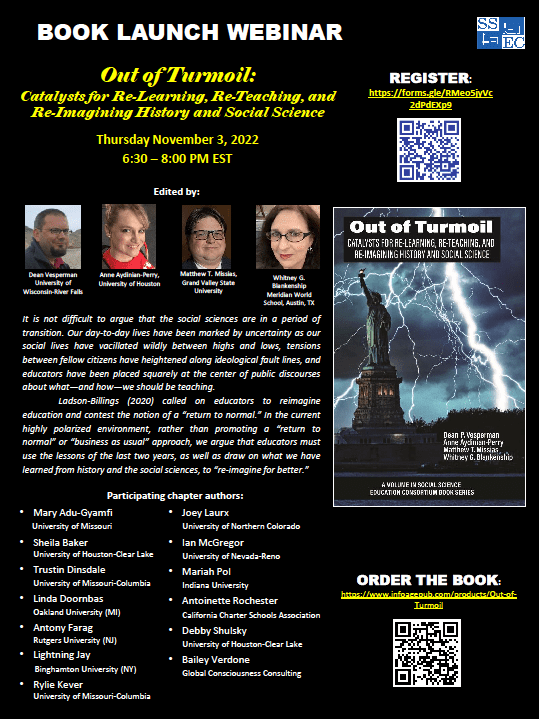
November 3 (6:30 – 8:00 PM ET)
Book Launch Webinar: the latest addition to the SSEC Book Series (Information Age Publishing) entitled Out of Turmoil: Catalysts for Re-Learning, Re-Teaching, and Re-Imagining History and Social Science (in press 2022). Click here to register

Saturday, 10/29/22
11am-1pm ET
REGISTRATION: bit.ly/hreusa-taas2022
During this session, you will workshop best practices and effective techniques for facilitation, conflict management, and inquiry-based questioning, focusing on current social issues being debated in society.

The HRE USA community would like to thank our 2022 Edmonds Fellows, Veronica Bido, Hallie McRae, and Natalie Roach, for their time and talents interviewing HRE USA members and regional representatives. We will be adding additional interviews to this platform in the future and appreciate our members’ time and efforts to meet with our Edmonds Fellows to not only share their experiences, but also provide feedback on ways to strengthen our Network overall and our Regional chapters. Click here to watch the interview profiles of some of our members or watch a playlist of all videos on our YouTube channel! |

Gloria T. Alter and Bill Fernekes are very pleased to announce the publication of The Human Rights Imperative in Teacher Education: Developing Compassion, Understanding and Advocacy (Lanham MD: Rowman and Littlefield, 2022). This edited volume contains contributions by a distinguished set of authors from the USA, Canada, Chile, Nigeria, and the United Kingdom, all leaders in the field of human rights education. The book combines theory and practice to help educators make human rights education (HRE) a central focus of daily educational practice and includes sample HRE units on the rights of global migrants, Indigenous peoples and LGBTQ+ communities. A comprehensive bibliography and set of appendices provide many resources for further study and research.
Contributors to the book include current and former HRE USA Steering Committee members Gloria T. Alter (co-editor), Bill Fernekes (co-editor), Nancy Flowers, Page Hersey, Glenn Mitoma, Kristi-Rudelius-Palmer and Felisa Tibbitts as well as HRE USA Advisory Board members Abraham Magendzo and Audrey Osler.
A poster session on the book’s development and content will be presented at the National Council for the Social Studies annual meeting in Philadelphia on Friday, Dec. 2 from 11:30 am-12:30 pm at the Philadelphia Convention Center—Convention Center Reg Bridge West. A discount flyer is attached to this email and we encourage you to consider adoption of the book for courses in teacher education programs, inclusion in college/university and school library collections, and purchase by school administrators and classroom teachers.

October 10, 2022
Download full press release here
Human Rights Educators USA (HRE USA) announced today its first Human Rights Educators USA Impact Award honoring the nearly 50 years of extraordinary contribution of the International Indian Treaty Council (IITC) to human rights education in the United States and around the world.
The IITC, an organization of Indigenous Peoples from North, Central, South America, the Caribbean, and the Pacific, works for the sovereignty and self-determination of Indigenous Peoples and the recognition and protection of their human rights, treaties, traditional cultures, and sacred lands. The IITC brings Indigenous Peoples together to share information and develop collective strategies to defend their rights, and ways of life at International Indian Treaty Conferences hosted by Indigenous Nations in South Dakota, Oklahoma, California, Arizona, Minnesota, Florida, Alaska, Hawaii, Canada, Panama, Mexico, Guatemala, and Aotearoa/New Zealand.
Since its foundation in 1974, the IITC and its many leaders have worked in numerous capacities to further human rights training and education throughout the United States and in global arenas, including at the United Nations. In 1977, the IITC was the first Indigenous organization to receive Consultative Status with the United Nations Economic and Social Council (ECOSOC). In recognition of its long-standing and wide-ranging work within the UN system on behalf of Indigenous Peoples January, in 2011, the IITC became the first Indigenous organization to be granted full General Consultative Status at the UN.
IITC provides training, capacity-building, and access for Indigenous Peoples to utilize a human rights framework to advance the struggles of their Nations and communities and to engage effectively in UN human rights bodies and mechanisms, especially after the Declaration on the Rights of Indigenous peoples (UNDRIP) was adopted by the UN in 2007. Key human rights focus areas for IITC include cultural rights and protection of sacred sites, prisoners’ rights, access to justice, right to health, racial discrimination, rights of Indigenous women and children, water and land rights, Free Prior and Informed Consent, Truth in History, decolonization and protection for Human, Treaty and Environmental rights defenders.
IITC will be recognized at the HRE USA Training As Action Series workshop on “Indigenous Peoples’ Human Rights & Climate Change” session on Monday, October 24, 2022 at 7:00 pm ET. On behalf of IITC, IITC Executive Director Andrea Carmen and IITC Board members, Bill Means and Lisa Bellanger, will share words about its founding and current human rights education initiatives. In addition, IITC will be recognized at the formal HRE USA Human Rights Day Celebration virtual event on Friday, December 9, 2022, at 4 pm ET.
For more information on IITC see https://www.iitc.org or contact Andrea Carmen at andrea@treatycouncil.org.
REGISTRATION: bit.ly/hreusa-taas2022
Monday, October 24, 2022
7pm–9pm ET
Virtual Zoom Session
This session will explore Indigenous Peoples’ and environmental rights as human rights. Indigenous leaders from the International Indian Treaty Council (IITC) will share current initiatives in policy, advocacy, education, and practice. IITC will be honored with the first 2022 Human Rights Educators USA Impact Award.
Today Indigenous Peoples are facing a compounding and multi-level urgent threat, specifically the Climate Crisis. The loss and damage we are already experiencing to our food systems, cultures, and ways of life, combined with the threats we see coming, require a multi-faceted, rights based response. We know that some reservations were already identified as “food deserts” even before the climate crisis came upon us. Effective response to climate change requires taking urgent steps to protect and revitalize our ancestral practices, knowledge, and food sources such as buffalo and original seed varieties for corn, beans, and squash. It also requires that we defend our rights to Free, Prior and Informed Consent, Self-determination and Treaties in order to oppose fossil fuel development that produces greenhouse gas emissions such as pipelines, drilling. and mining in our homelands. We must also assert our recognized right to participate in decision-making that would affect our rights at the tribal, state, national, and international levels where our contributions as knowledge and rights holders are essential for building effective solutions. Our ancestors left us the warnings about what we as humans would face during these times. But they also left us with solutions that we can put into practice today, in response to these challenges.
IITC was founded on the Standing Rock Reservation in South Dakota in 1974 to be an international voice and advocate for the Rights of Indigenous Peoples. In 1977 IITC was the first Indigenous Peoples organization to receive Consultative Status from the UN Economic and Social Council and in 2011 it was the first to be upgraded to “General Consultative Status.”
Speakers and Facilitators
Lisa Bellanger, Board member, International Indian Treaty Council and District American Indian Specialist, St. Paul Schools, Minnesota
Andrea Carmen, Executive Director, the International Indian Treaty Council
William Means, a Founder and Board member, the International Indian Treaty Council

REGISTRATION: bit.ly/hreusa-taas2022
Monday, 10/17/22 7pm–9pm ET: Action for Human Rights
Taking Action for Human Rights
During this workshop, participants will explore various tactics for human rights action. Paying particular attention to youth action for human rights, we will explore how to design a plan of action, the right to protest, and student walk-outs as human rights action. This interactive workshop will be facilitated by Ben Fleming and Kristina Eberbach.
Ben Fleming is Adjunct Professor of International Human Rights Law and Adjunct Professor of the International Human Rights of Women Seminar at South Texas College of Law Houston. He was Associate Adjunct Professor of International Human Rights Law at the Graduate School of International and Public Affairs (SIPA) at Columbia University. He is also the co-founder and co-lead of the University Human Rights Education in Myanmar Project for the Institute for the Study of Human Rights (ISHR) at Columbia University. He was a visiting lecturer in International Human Rights and Public International Law at Mandalay University School of Law in January and February 2014. Mr. Fleming was a Legal Officer in the Office of the Co-Investigating Judges at the United Nations Khmer Rouge Tribunal (UNAKRT/ECCC) in Phnom Penh (2006-2009), and has worked in the anti-corruption and litigation offices of Open Society Justice Initiative.
Kristina Eberbach specializes in human rights and human rights education. She is currently Strategy and Curriculum Specialist for the Human Rights Close to Home (Human Rights Institute, University of Connecticut) and an Adjunct Assistant Professor of International and Public Affairs at Columbia University. She served as Deputy Director at the Institute for the Study of Human Rights at Columbia University from 2019-2021 and as Director of Education from 2010-2019. She has developed and facilitated human rights programs, courses and workshops for university students, members of civil society and government officials in Colombia, Iraq, Myanmar, and the U.S. and has undertaken research, reporting, and advocacy work in Kenya (International Crisis Group), Myanmar, The Netherlands (ICTY/ICTR), South Africa, Uganda (Charity for Peace Foundation), and the U.S. She is co-chair of Human Rights Educators USA and is a co-founder and co-chair of the University and College Consortium for Human Rights Education. Her research focuses on human rights education and human rights in transitional contexts and she is completing her PhD at the University of Utrecht. Kristina holds a Master of International Affairs from Columbia University’s School of International and Public Affairs and a Bachelor of Science in Foreign Service from Georgetown University.

 HRE USA