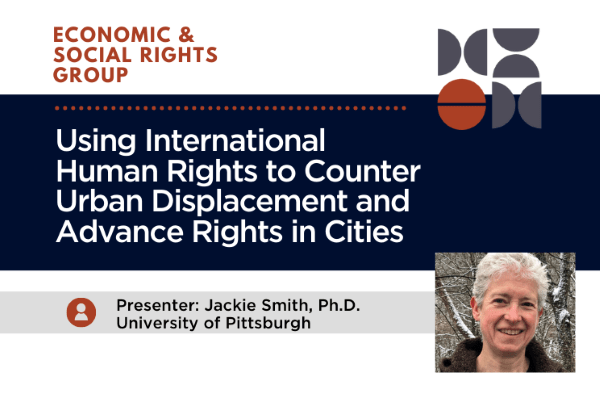
Using International Human Rights to Counter Urban Displacement and Advance Rights in Cities

Friday, March 4, 2022
12:30 – 2:00 p.m.
Virtual Event
, Register here

Overview:
In the second meeting of the Economic & Social Rights Group for Spring 2022, we welcome Jackie Smith, Professor of Sociology at the University of Pittsburgh.

Smith will discuss a new white paper, Pittsburgh’s Affordable Housing Crisis: Is Privatization the Solution?, written with colleagues involved in Pittsburgh’s Human Rights City Alliance. She will discuss how the project emerged from the work of a diverse alliance of human rights organizers and how it contributes to ongoing local and translocal movement-building to advance housing as a human right. It also demonstrates important roles for networks of university- and neighborhood-based activists to play in advancing human rights in cities and communities. The white paper is available to read in advance, courtesy of Smith and her colleagues.

Presenter: 
Jackie Smith’s research focuses on how globalization impacts people and communities, and how social movements for the environment, health, and economic justice have advanced transformative struggles. She has documented long-term trends in transnational social movement organizations and coalitions, in addition to research on connections between global politics and activism in cities and communities. Smith is currently engaged in participatory research with Pittsburgh and with national human rights organizers and engaged in work to connect municipalities with United Nations human rights work.

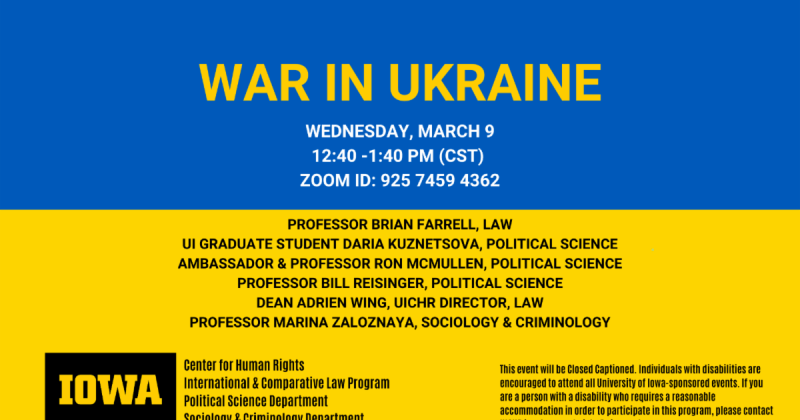
Webinar: War in Ukraine


Join UICHR for a webinar panel exploring the current crisis and war in Ukraine. Panelists include: Professor Brian Farrell, Law UI graduate student Daria Kuznetsova, Political Science Ambassador & Professor Ron McMullen, Political Science Professor Bill Reisinger, Political Science Dean Adrien Wing, UICHR Director, Law Professor Marina Zaloznaya, Sociology & Criminology 

Wednesday, March 9, 12:40 pm – 1:40 pm (CST)
Zoom ID: 925 7459 4362

For more information on all our upcoming events, please visit the UI Center For Human Rights Website All are welcome to attend; prior registration is not required. This event will be closed captioned. 

Human Rights Education Review and the Convenors of the WERA International Research Network announce 2022 Research Webinars

The Editors of Human Rights Education Review and the Convenors of the WERA International Research Network on Human Rights Education are pleased to announce that our 2022 Research Webinars will run from March – June 2022 on Wednesdays 17.30-18.30 (Berlin CET); 16.30 – 17.30 (London/Dublin). 

UPCOMING WEBINAR 1 

16 March 2022 

17.30-18.30 (Berlin CET); 16.30 – 17.30 (London/Dublin) 

Register here  

The rhetoric and reality of human rights education: policy frameworks and teacher perspectives  

Audrey Osler, University of South-Eastern Norway, Norway and University of Leeds, UK  

Jon Arne Skarra, University of South-Eastern Norway, Norway 

What happens when school curricula equate human rights principles with a particular religious or cultural tradition? Audrey Osler and Jon Arne Skarra consider education policy discourses in Norway, noting human rights as a key feature of national identity, said to underpin schooling. They illustrate how education policy maintains distinctions between those who embody national values and migrant others who need to learn them. They look closely at the human rights-related competences students are expected to have on completing 10th grade, examining social studies and religious education curricula and teacher interview data. Teachers have a lot of autonomy in selecting the knowledge though which these competences will be taught. The presenters consider whether the curriculum supports transformative human rights education (HRE), empowering learners to defend others’ rights and build solidarity across difference. Data suggest that HRE is frequently implicit, restricted, and dependent on teachers’ individual perceptions of rights. Teachers may lack legal knowledge and are unsure how to tackle everyday injustice or racism. Osler and Skarra conclude that a multicultural society and curriculum that equates Christian and humanist values with human rights denies pluralism, placing human rights culture at risk. They recommend education policy explicitly address shared HRE principles and recognise racial injustice. The authors’ full paper can be read here 

Webinar recordings can be viewed on the YouTube Channel 

GLOBAL SURVEY TO UPDATE THE 1974 RECOMMENDATION CONCERNING EDUCATION FOR INTERNATIONAL UNDERSTANDING

Take a 10-minute survey to help shape global policy on human rights education. https://survey.unesco.org/3/index.php?r=survey/index&sid=486334&lang=en Available in ENGLISH / FRENCH / SPANISH on this website.

The deadline for responding is 1 March 2022.

UNESCO is conducting a global survey to collect information that will help revise a landmark legal instrument on education for international understanding, cooperation, peace, human rights and environmental sustainability, known as the #1974Recommendation.

UNESCO invites you to participate in the revision process by taking the 10-minute survey. Share it with your networks and help shape global policy on education! Now is the time to ensure your voice is heard and counted.

For more information on how UNESCO is supporting the revision of the #1974Recommendation visit their dedicated website. https://en.unesco.org/themes/gced/1974recommendation

Secretariat for the Review of the 1974 Recommendation: 1974recommendation@unesco.org

Woodhull’s Human Rights Commission Releases “Fact or Fiction: Sex Trafficking, Sex Work, and Human Rights at the Super Bowls”

Woodhull Freedom Foundation, as part of its Human Rights Commissions program, has released its findings on the facts – and fictions – behind the oft-repeated warnings of a dangerous spike in sex trafficking at the Super Bowl.

After partnering with SOAR Institute to conduct a careful analysis of the situation, Woodhull concludes that the dangerous uptick in sex trafficking is a myth, long encouraged, about a dangerous uptick in sex trafficking, long-encouraged by law enforcement, state/national governments and the media, has been continually disproven but continues to circulate – leading to confusion on all sides of the issue.

With Super Bowl LVI set to take place on February 13 in Los Angeles, California, experts are highlighting how this debate interacts with the broader socio-political landscape, the conflation between sex work and human trafficking, and the fulfillment of sex worker rights.

The report’s findings have found:

While ads for sex may increase during the Super Bowl, instances of commercial sex and trafficking do not.

Researchers from the University of Texas, Austin, and the University of Minnesota, Twin Cities, found that claims about increases in sex trafficking during the event are false and may reflect false socio-cultural fears “about sexuality and sexual exploitation that depict men as aggressive and autonomous, and women as victims in need of rescue or as criminals who should be arrested.”

– The myth helps serve as a narrative to benefit nonprofits and NGOs fighting trafficking around these events, virtual signaling national/state/local governments, media and those who want to justify their social control measures such as increased policing and migration controls based on anti-prostitution ideology.

The true victims of the ‘Super Bowl sex trafficking myth’ are human trafficking victims themselves. 80% of cases are in labor sectors outside of commercial sex.

Trafficking hysteria around the Super Bowl causes host cities to increase police surveillance, and thanks to the conflation between adult consensual sex work and human trafficking, much of these resources are used to police and arrest sex workers rather than engaging in prevention at the expense of those experiencing exploitation.

Criminalization prevents those participating in commercial sex from reporting crimes committed against them for fear of arrest.

Even trafficking survivors participating in commercial sex because of force, fraud or coercion fear criminal justice penalties if they come forward as a result of the massive stigma and risk of arrest surrounding sex work. In a criminalized environment, sex workers also have less agency to engage in safe sexual practices and less access to medical care.

 Increased policing has disproportionate consequences for communities with intersecting vulnerabilities. Members of LGBTQ communities, communities of color, the unhoused, and immigrants are among those disproportionately targeted by law enforcement as sex workers. 

Black adults make up over half of the people arrested for loitering for the purpose of prostitution in Los Angeles, even though they are only 8.9% of the city’s population.

Human trafficking is a problem that persists year-round

As the Polaris Project pointed out in 2019, encouraging hysteria around specific events detracts from the need to establish effective, holistic policy responses rather than sensationalized rhetoric.

Woodhull Freedom Foundation exists to fight back against laws that suppress sexual freedom and to advance sexual rights. Woodhull works at the intersection of many movements and campaigns, often in coalition with other organizations and communities, in order to achieve political, cultural, and social change. From #BlackLivesMatter to #MeToo, from reproductive justice to racial justice, from free speech to sex worker rights, Woodhull stands at the intersection of many movements and campaigns in order to affirm, protect, and advance sexual freedom as a fundamental human right.

To learn more about the facts and myths about ‘Sex Trafficking at the Super Bowl’, visit WoodhullFoundation.org.

ABOUT THE WOODHULL FREEDOM FOUNDATION:

Headquartered in Washington DC, the Woodhull Freedom Foundation is a non-profit organization that works to change laws, policies, and practices across a range of issues that deny or threaten people’s fundamental human right to sexual freedom.

Founded in 2003 and named for Victoria Woodhull, the 19th-century feminist, activist, and suffragette who fought for the right for women to vote in public elections, the Foundation is the preeminent voice at the intersection of sexual rights and human rights that continues to fight against the tyranny of widespread sexual repression in America. To learn more, visit WoodhullFoundation.org.