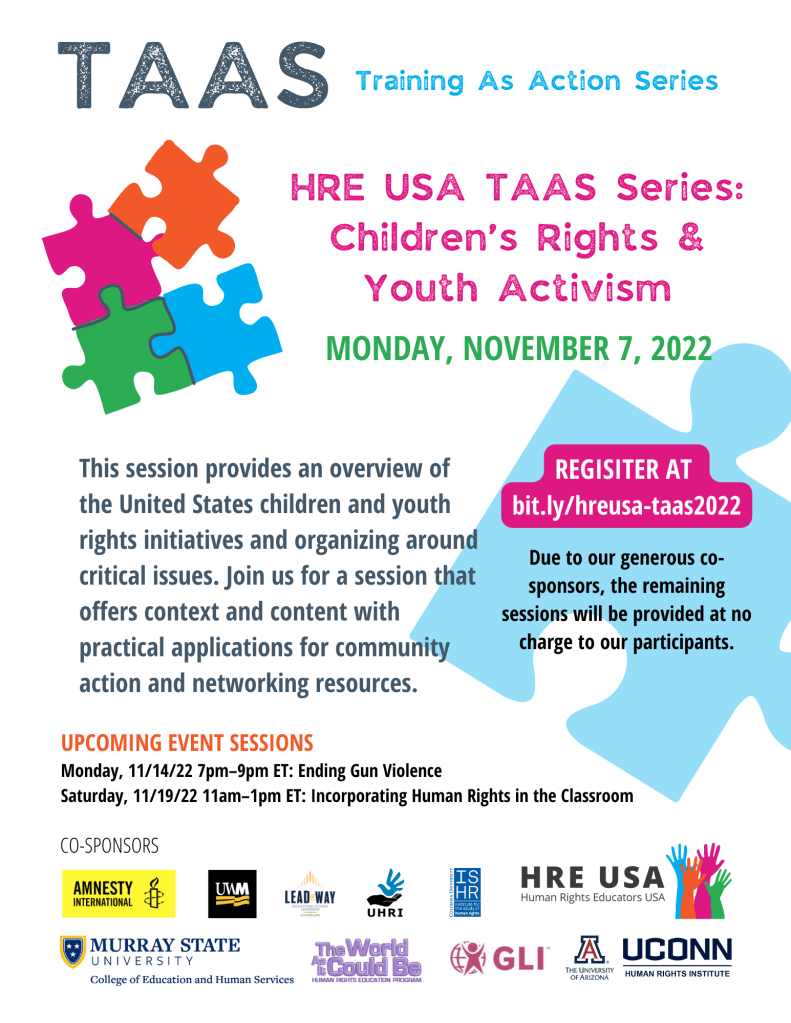
HRE USA TAAS Series: Children’s Rights & Youth Activism

REGISTRATION: bit.ly/hreusa-taas2022

Monday, November 7, 2022

7pm–9pm ET

Virtual Zoom Session

Speakers and Facilitators:

Hallie McRae is a rising junior studying Political Science and Public Policy at the University of California, Berkeley. She is passionate about human rights and social justice advocacy, participating in programs and organizations dedicated to each. On campus, she is involved in UC Berkeley’s ACLU club, leading the Know Your Rights project team under the Criminal Justice Reform committee. Here, students inform the community about the rights they hold surrounding police and immigration forces through the creation of handouts, presentations to local high schools, and general education campaigns. She is also involved in student government, coordinating educational outreach and support for survivors of sexual violence and sexual harassment, and is a member of the Repair The World Campus Corps, targeting food insecurity by mobilizing community members each week to pack and deliver bags with essentials to unhoused folks. Engaging with Human Rights Watch Student Task Force throughout high school, Hallie benefitted largely from human rights education and advocacy in academic settings, and is thrilled to continue the work of expanding human rights education and organizational work in schools and communities nationwide with HRE USA. 

Maddy Wegner is an educator and communications specialist who enjoys building teams, developing new approaches to and resources on education issues, and engaging others — especially young people — in these processes. She has served as the National Youth Leadership Council’s (NYLC’s) Director of Content and Engagement, developing resources for service- learning practitioners that bring research to practice and integrating human and child rights frameworks, for the past five years. She also has served as NYLC’s Director of Communications, overseeing strategic communications including policy, marketing, research, and curriculum development.

While the roots of her teaching trace back to teaching middle and high school English Language Arts, her interests in peace-building and conflict resolution have led her to more informal education settings. Through work with a number of nonprofits she has helped inspire young people to action through the lives and work of Nobel Peace Prize laureates by co-developing a series of iBooks entitled Being the Change as well as another series rooted in the United Nations Sustainable Development Goals.

A member of the Executive Committee for Minneapolis’ Child Friendly Cities designation, she is a recipient of the Stellar Service-learning Award and an “Outstanding Contributions to Service-Learning” award from the Minnesota Department of Education. She received her B.A. from Mount Holyoke College, her teacher training through the University of California, Berkeley’s Bay Area Writing Project and an M.S.J. from Northwestern University.

Adrianna Zhang (she/her) is a first-year student at Stanford University. She is the Founder & Executive Director of San Francisco Communities who Help Advance the New Generation of Education, or SF CHANGE, a nationwide organization that has presented free educational workshops to over 30,000 students around the United States. Passionate about education equity, she has spearheaded children’s rights workshops for thousands of students in partnership with UNICEF’s international Child-Friendly Cities initiative, brought children’s rights workshops to 200+ classrooms, and integrated rights education into school curriculums around the nation. 

Adrianna also serves as the Chair of the San Francisco Youth Commission where she led the Vote16SF ballot measure to 207k+ votes, secured free public transportation for youth in San Francisco, and wrote legislation on affordable housing, Title IX reform, and more. She is also an active member of the National Vote16 Advisory Board.

Adrianna was a speaker at TEDxCity of San Francisco 2021 where she discussed youth civic engagement to an audience of 10k+ people. She was a guest panelist at the University of Warwick’s panel on Children’s Rights in Literature and a speaker at the Children’s Rights in the USA conference hosted by Salem State University.

HRE USA TAAS Series: Indigenous Peoples’ Human Rights and Climate Change

REGISTRATION: bit.ly/hreusa-taas2022

Monday, October 24, 2022

7pm–9pm ET

Virtual Zoom Session

This session will explore Indigenous Peoples’ and environmental rights as human rights. Indigenous leaders from the International Indian Treaty Council (IITC) will share current initiatives in policy, advocacy, education, and practice. IITC will be honored with the first 2022 Human Rights Educators USA Impact Award.

Today Indigenous Peoples are facing a compounding and multi-level urgent threat, specifically the Climate Crisis. The loss and damage we are already experiencing to our food systems, cultures, and ways of life, combined with the threats we see coming, require a multi-faceted, rights based response. We know that some reservations were already identified as “food deserts” even before the climate crisis came upon us.  Effective response to climate change requires taking urgent steps to protect and revitalize our ancestral practices, knowledge, and food sources such as buffalo and original seed varieties for corn, beans, and squash. It also requires that we defend our rights to Free, Prior and Informed Consent, Self-determination and Treaties in order to oppose fossil fuel development that produces greenhouse gas emissions such as pipelines, drilling. and mining in our homelands. We must also assert our recognized right to participate in decision-making that would affect our rights at the tribal, state, national, and international levels where our contributions as knowledge and rights holders are essential for building effective solutions. Our ancestors left us the warnings about what we as humans would face during these times. But they also left us with solutions that we can put into practice today, in response to these challenges.

IITC was founded on the Standing Rock Reservation in South Dakota in 1974 to be an international voice and advocate for the Rights of Indigenous Peoples. In 1977 IITC was the first Indigenous Peoples organization to receive Consultative Status from the UN Economic and Social Council and in 2011 it was the first to be upgraded to “General Consultative Status.”

Speakers and Facilitators

Lisa Bellanger, Board member, International Indian Treaty Council and District American Indian Specialist, St. Paul Schools, Minnesota

Andrea Carmen, Executive Director, the International Indian Treaty Council

William Means, a Founder and Board member, the International Indian Treaty Council

HRE USA TAAS Series:  Action for Human Rights

REGISTRATION: bit.ly/hreusa-taas2022

Monday, 10/17/22 7pm–9pm ET: Action for Human Rights

Taking Action for Human Rights

During this workshop, participants will explore various tactics for human rights action. Paying particular attention to youth action for human rights, we will explore how to design a plan of action, the right to protest, and student walk-outs as human rights action. This interactive workshop will be facilitated by Ben Fleming and Kristina Eberbach.

Ben Fleming is Adjunct Professor of International Human Rights Law and Adjunct Professor of the International Human Rights of Women Seminar at South Texas College of Law Houston. He was Associate Adjunct Professor of International Human Rights Law at the Graduate School of International and Public Affairs (SIPA) at Columbia University. He is also the co-founder and co-lead of the University Human Rights Education in Myanmar Project for the Institute for the Study of Human Rights (ISHR) at Columbia University. He was a visiting lecturer in International Human Rights and Public International Law at Mandalay University School of Law in January and February 2014. Mr. Fleming was a Legal Officer in the Office of the Co-Investigating Judges at the United Nations Khmer Rouge Tribunal (UNAKRT/ECCC) in Phnom Penh (2006-2009), and has worked in the anti-corruption and litigation offices of Open Society Justice Initiative. 

Kristina Eberbach specializes in human rights and human rights education. She is currently Strategy and Curriculum Specialist for the Human Rights Close to Home (Human Rights Institute, University of Connecticut) and an Adjunct Assistant Professor of International and Public Affairs at Columbia University. She served as Deputy Director at the Institute for the Study of Human Rights at Columbia University from 2019-2021 and as Director of Education from 2010-2019. She has developed and facilitated human rights programs, courses and workshops for university students, members of civil society and government officials in Colombia, Iraq, Myanmar, and the U.S. and has undertaken research, reporting, and advocacy work in Kenya (International Crisis Group), Myanmar, The Netherlands (ICTY/ICTR), South Africa, Uganda (Charity for Peace Foundation), and the U.S. She is co-chair of Human Rights Educators USA and is a co-founder and co-chair of the University and College Consortium for Human Rights Education. Her research focuses on human rights education and human rights in transitional contexts and she is completing her PhD at the University of Utrecht. Kristina holds a Master of International Affairs from Columbia University’s School of International and Public Affairs and a Bachelor of Science in Foreign Service from Georgetown University.

Come join us as we engage in dialogue regarding gun violence, youth action Indigenous rights, and much more!

Don’t miss this opportunity! Fall 2022 HRE USA Members Orientation Session

HRE USA Orientation 
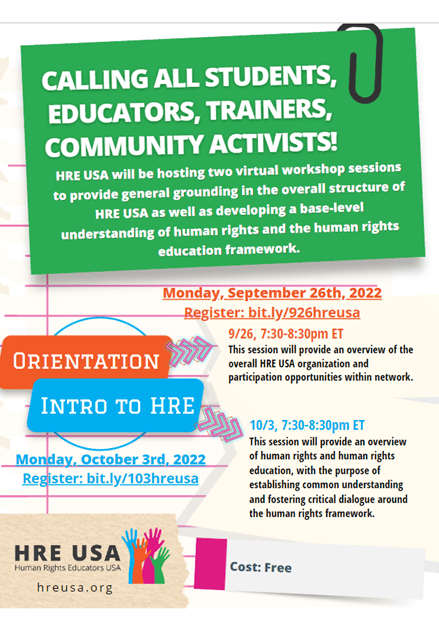
HRE USA will be hosting virtual workshop sessions to provide general grounding in the overall structure of HRE USA as well as developing a base-level understanding of human rights and the human rights education framework. 

  • Introduction to Human Rights Education: Monday, October 3rd, 2022 7:30-8:30pm ET: This session will provide an overview of human rights and human rights education, with the purpose of establishing common understanding and fostering critical dialogue around the human rights framework.

Cost: Free

>> Register

Children’s Human Rights in the USA: Virtual conference

REGISTER HERE!

The registration is open for the June 22-24, 2022 conference on Children’s Human Rights in the USA.  It is a virtual zoom conference with over 50 speakers that is sponsored by the Center for Childhood & Youth Studies at Salem State University, with co-sponsors such as Human Rights Educators USA, the Hope for Children CRC Policy Center, UNICEF USA, Child Fund Alliance, Child Welfare League of America, and others. This is a free conference via zoom but you must register.

Topics include safety, trauma, resilience, participation, health, education, law, mental health, gun control, special needs children, environment, and much more. For more information on the speakers and schedule: https://www.salemstate.edu/academics/centers/center-childhood-and-youth-studies/childrens-human-rights-usa

Continuing Education Credits are available.

To learn more about the importance of children’s human rights, please review the Children’s Human Rights Resource, Networking, and Learning Library: https://canvas.instructure.com/enroll/GLKDXX

International Seminar series: Access to Social and Cultural Rights


Date and time

Wed, 25 May 2022, 06:00 – 08:00 CDT

REGISTER HERE

This seminar is part of the School for Policy Studies – International Seminar Series 2021-2022

Access to Social and Cultural Rights, will focus on children’s, young people and family’s access to social and cultural rights including to family life, cultural activities, play and inclusion into a national community.

Professor Zsuzsa Millei, Reflections on methodological nationalism in migration research concerning children

Professor Debbie WatsonVR Dance: young people at risk of criminalisation accessing cultural rights

Dr Jon SymondsNegotiating rights to family life when parents separate

________________________________________

Reflections on methodological nationalism in migration research concerning children

This presentation considers the intersections of migration research in early childhood /education, and nationalism. I analyse selected articles addressing migration and inclusion in the Nordic states from the perspective of methodological nationalism. The aim is to demonstrate why migration researchers need to apply a critical lens to evaluate the inherent methodological nationalism some migration research can be ‘guilty’ of. I especially highlight the need to rethink the categorizations migration research operates with that keep reifying exclusions based on national grounds and which, with an extension, antithetical to children’s right to non-discrimination and right to identity.

Professor Zsuzsa Millei, University of Tampere, Finland

Zsuzsa is a Professor of Early Childhood Education at the Faculty of Education and Culture, Tampere University, Finland. Her research addresses child politics by exploring how politics (power, government, nationalism, and ideology) intertwine with childhood and children’s everyday life in child institutions, and more recently reconfigured within the Anthropocene. Her comparative studies of nationalism and explorations of childhood memories of (post)socialist societies use post-qualitative and artistic methods and reveal complex matrices of power and seek to decolonize the research imagination and knowledge production. Her special issue on ‘Banal and Everyday Nationalisms in children’s mundane and institutional lives’ is published in 2021 in the journal of Children’s Geographies.

VR Dance: young people at risk of criminalisation accessing cultural rights

In this presentation Debbie will present a current funded project working in partnership with East London Dance company. This is a project working with vulnerable young people in two East London Boroughs where we have combined intensive hip hop workshops with avatar creation and virtual reality to enable alternative narratives of risk and resilience and hopefully have impacts on their overall subjective wellbeing. The programme enables access to cultural activities for young people and provides an experimental methodological space to reimagine their identity in a low-risk virtual world. The presentation will include some film outputs from the project to date.

Professor Debbie Watson, School for Policy Studies, University of Bristol

Debbie is Professor of Child and Family Welfare in the School for Policy Studies, University of Bristol and the School Research Director. Her research interests focus on identity and wellbeing for children and families in adverse circumstances including poverty and where children are in state care or adopted. All her research is interdisciplinary, co-produced and she engages with a wide range of creative, arts based and digital research approaches.

Negotiating rights to family life when parents separate

In this presentation, Jon will present current research he is conducting with colleagues that focuses on the experiences of family members when parents have separated. The project draws on ethnographic methods by providing family members with digital cameras to create their own accounts of the separation and of the support they received from services. Combined with interviews, this data will help to build a rich picture of the ways that families navigate their ways towards family life beyond separation and the findings will feed into policy developments to improve both family support services in both the community and the family courts in England and Wales.

Dr Jon Symonds, School for Policy Studies, University of Bristol

Jon is a Senior Lecturer in Social Work with Children and Families in the School for Policy Studies. His research interests focus on social work with parents, particularly with fathers, and where there are concerns related to children’s welfare. He uses a variety of qualitative research methods including the analysis of audio and video recordings of professional practice, and videos made by members of families where the parents have separated.