Teach Reconstruction

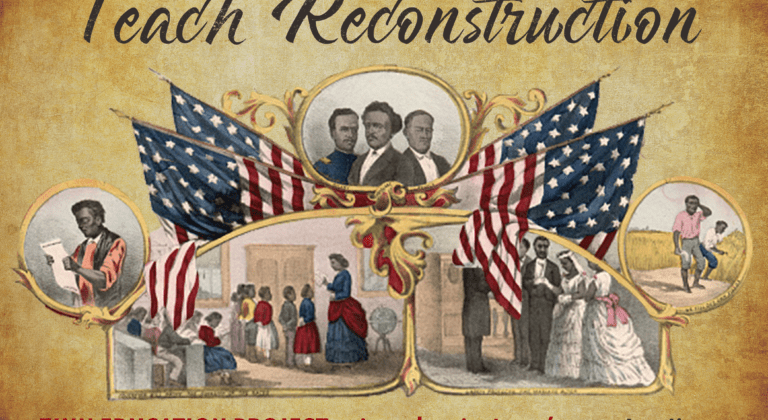
Reconstruction, the era immediately following the Civil War and emancipation, is full of stories that help us see the possibility of a future defined by racial equity. Yet the possibilities and achievements of this era are too often overshadowed by the violent white supremacist backlash.

The Zinn Education Project offers lessons for middle and high school, a student campaign to make Reconstruction history visible in their communities, and an annotated list of recommended teaching guides, student-friendly books, primary document collections, and films.

>> Learn more

Teach the SDGs

EOTO World is an official partner of MyWorld2030 that is working to educate global youth about the Sustainable Development Goals (SDGs) and amplify citizen voices in the monitoring and evaluation of SDG progress. The 17 SDGs are focused on eradicating poverty, ensuring sustainable development, building peaceful, inclusive societies and leaving no one behind. Want to do more for SDGs? Work with EOTO World to educate others and expand the dialogue.
Start by taking this 5 min survey in your language: www.myworld2030.org/partner/TeamEW.
Get youth involved and have them share their perspective here:
https://goo.gl/forms/BEFqUbc6xiiHCpcr1
Follow along with #EOTOWorld4SDGs. Your story could be featured!

>> Learn more

Counter Hate in Schools

Since Teaching Tolerance began tracking hate and bias incidents at school in October 2017, they’ve recorded 496 reports spanning 47 states and Washington, D.C.  A recent UCLA study found that teachers are seeing increased incivility, intolerance and polarization in classrooms.

“Back to school” shouldn’t mean “back to hate.” 

To counter this rise of discrimination, hatred, and bigotry in our society and in our schools, the Southern Poverty Law Center has joined forces with 20 other education advocacy groups, including HRE USA, to counter hate in American schools. This coalition is committed to providing resources and support so schools may effectively respond to hateful acts and create learning environments where every student feels welcome.

Read the full statement and add your name* to the list of supporters who believe hate has no place in schools. If you represent an education organization that would like to add your group’s name to this statement, please email againsthate@tolerance.org.

>> Sign on to the Join Statement
>> Learn more

To counter hate in your school, Teaching Tolerance suggests the following: 

  1. Be prepared. Use our Responding to Hate and Bias at School guide to learn what to do before, during and after a crisis. Having protocols in place at the beginning of the school year helps increase administrators’ and teachers’ confidence that they’ll be able to effectively address incidents and alleviate tension.
  2. Develop a zero intolerance policy. Follow our Speak Up at School guide to help respond to prejudice, bias, and stereotypes every day in the classroom.
  3. Take on controversial topics and encourage civil discourse. Civil Discourse in the Classroom lays the groundwork. Let’s Talk! provides strategies to facilitate discussions that might elicit strong emotions.
  4. Create a community where all students can thrive. Use our Social Justice Standards to guide you in the engagement of anti-bias education. Critical Practices for Anti-bias Education ensures teachers can improve academic outcomes by building intergroup awareness, encouraging students to speak out against bias and injustice.

Study Human Rights in Norway

DETAILS:

When: September 21, 24, & 25, 2018
Where: University of South-Eastern Norway, Drammen campus
Cost: NO FEES. Successful candidates are responsible for travel and living costs.

Education for Social Justice in Education: Human Rights and Intersectionality

Course description
Participants examine how the concepts of human rights and intersectionality inform educational theory and praxis to enable social justice. The course is open to Norwegian and international participants researching educational inequalities in diverse contexts, from a range of disciplinary perspectives. The starting point is that learning communities are not neutral places and educators and other professionals have a choice about whether to work to interrupt or ignore systemic injustice. Human rights present a utopian vision, recognizing multiple identities and offering a moral and legal framework for justice. Intersectionality offers researchers a tool to examine how multiple and interwoven inequalities (related to gender, ethnicity, sexuality, migration status and so on) impact on achievement, citizenship and participation. Through formal presentations, discussions, workshops, guided reading, and preparation for a written paper, participants will have opportunities to discuss research and share experiences in a supportive environment.

Registration Deadline: August 10

Applications are invited from registered students in the Arts, Social Sciences, and Education. Applications should be made as soon as possible as we anticipate a lot of interest. Completed applications should be sent to Liv-Anne Halderaker: liv-anne.halderaker@usn.no who can also answer inquiries on application procedures and accreditation (Tel: +47 31 00 93 59)

>> Learn more and apply

Human Rights Education Review – New Open Access Journal

The editors of Human Rights Education Review are delighted to announce the publication of the journal’s inaugural issueHRER is an open-access scholarly journal published by the University of South-Eastern Norway. It provides a forum for research and critical scholarship on human rights as they are practiced, taught, learned and developed in education, law, politics, and in human rights organizations. The journal is dedicated to an examination of human rights in theory, philosophy, policy, and praxis. HRER aims to be global in its reach and this is reflected in the composition of our International Editorial Board.

The first issue includes challenging articles by Walter C. Parker on HRE’s curriculum problem, and by Marta Bivand Erdal  Mette Strømsø on child rights and national belonging; plus Alicia Muñoz Ramírez’s analysis of the recent struggle to remove HRE from the Spanish school curriculum; and a discussion by Sonja Grover on how legal cases brought by children might enhance human rights advocacy among youth. You will also find reviews of several recent books. This issue will be of particular interest to policy-makers, teacher educators, and NGOs concerned with rights and social justice in schooling.

To receive notification of upcoming articles, visit the journal’s online platform and click on the ‘register’ button in the top right-hand corner.

>> Visit online journal

New Lessons and UN Recognition of HRE USA Curriculum Guide 

Two new lessons have been added to the HRE USA Curriculum Integration Guide.  Jamie Warner, a middle school social studies teacher at Orange Avenue School in Cranford NJ, created the multi-lesson project Going Global—Investigating Issues of Interest and Importance and Semira Markos, a high school social studies teacher at Hunterdon Central Regional HS in Flemington NJ, created the lesson Human Rights in National Memory  Both teachers piloted their lessons after receiving expert feedback from HRE USA educators and her students. The lessons are available in Word and PDF formats for use by educators worldwide.

The Curriculum Integration Guide project was recently contacted by the United Nations Office on Drugs and Crime, who requested permission to place 9 lessons of the 15 currently on the HRE USA website on their agency website for use by educators around the world.  This UN agency website will go live in mid-June 2018, and authors of the lessons have expressed their gratitude at having their lessons recognized by an office of the United Nations.

Phase four of the Curriculum Integration Guide project will commence this summer.  Interested educators who wish to develop lessons focusing on human rights education and who are able to have their lessons piloted with students during the 2018-19 school year, should contract Bill Fernekes for further information about details and timelines.

Teaching Black Lives

New from Rethinking Schools is Teaching for Black Lives, a classroom resource grown directly out of the movement for Black lives. Edited by Dyan Watson, Jesse Hagopian, and Wayne Au, this book provides articles and lessons that demonstrate how teachers can connect curriculum to young people’s lives. Teaching for Black Lives highlights the hope and beauty of student activism and collective action.

Opel Tometi, co-founder of #BlackLivesMatter and executive director of the Black Alliance for Just Immigration states, “this book is not just for teachers in the classroom, but also for those of us who care about making Black lives matter in the community.  It should be required reading for all who care about the future of black youth.”

>> Learn more and purchase

Teach for Environmental Justice

At the heart of our environmental crisis is the idea that nature is a thing to be used for profit. That’s the bad news. The good news is that social movements across the world are challenging this profit-first orientation, and proposing alternatives. And educators are a part of these movements.

The Zinn Education Project (ZEP) has posted five teaching articles that grew out of a writing retreat sponsored by ZEP and This Changes Everything, the project launched by Naomi Klein’s brilliant book. These articles include role plays, stories of activism and resistance, and ideas for how to implement concepts from This Changes Everything: Capitalism vs. the Climate in our classrooms.

>> Learn more

SPLC’s Whose Heritage? Report: A Teaching Opportunity

Schools, monuments and statues across the country pay homage to the Confederacy. Educators can use a new report from the Southern Poverty Law Center to help teach the history behind these public fixtures—and how they spread throughout the South and beyond.  The report, entitled “Whose Heritage?”offers data and context that should inform and supplement any lessons on the Civil War, its legacy and the through-line of white supremacist ideology in the United States. A timeline, for example, illustrates the spike in Confederate-dedicated monuments that occurs in tandem with civil rights advancements for black people, or during moments of intense racial strife throughout recent U.S. history. An interactive map points to the geographic locations of these public homages, with monuments and schools in Union states like New York, Pennsylvania and California begging the titular question: Whose heritage is this, really? And what purpose were these symbols of the Confederacy meant to serve?

The data and brief history lessons in this report help answer these questions and counter Lost Cause myths—myths commonly held by, and passed down to, students. As calls to remove or rename symbols of the Confederacy continue to stir controversy, educators can resist the urge to avoid this topic and, instead, teach the hard history and motivation behind these monuments and public symbols. This report supplies a foundation for learning and fodder for lessons.

>> Learn more

Dilemmas and Hopes for Human Rights Education

A special issue entitled “Dilemmas and Hopes for Human Rights Education” has been published by Prospects: Comparative Review of Comparative Education – UNESCO’s journal of educational policies and practices. The issue presents examples from the Global South and Global North, reviewing recent theories, challenges and solutions for enabling a transformative approach to HRE through and against the lens of state power. Drawing on examples from Chile, China, Greece, Pakistan, India, the Netherlands, South Africa, Switzerland, and the US. The articles explore the gap between the emancipatory roots of HRE and the lived educational policies and practices of states and schools.

>> Read online