Human Rights Education Review – International Conference on Education and Democratic Citizenship

The latest edition of HRER highlights new efforts to develop a sustainable community of global human rights education research. Human rights education (HRE) developed in many forms as a field of practice in the second half of the twentieth century, promoted by non-governmental organizations, various UN initiatives, and other intergovernmental organizations, such as the Council of Europe. The first purpose of HRE was to promote human rights as a ‘common language of humanity’, as expressed by United Nations Secretary-General Kofi Annan (UN, 1998). The UN Secretary-General’s address made nearly 50 years after the Universal Declaration of Human Rights (UN, 1948), celebrated the lives of human rights leaders Mahatma Gandhi and Dr. Martin Luther King, Jnr., for whom a guiding principle of struggle was non-violence.
>> Read journal

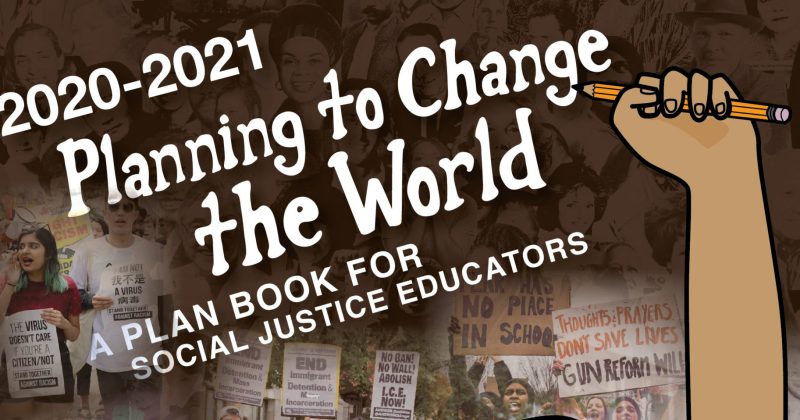
Lesson Plan Book: Planning to Change the World

This is a plan book for school-based, home-based, and community-based educators who believe that young people can, will, and already do change the world. It is designed to help educators translate their vision of a just education into concrete activities.

This year’s calendar features all-new historical anniversaries and birthdays. The newest edition has all the things you would expect in a lesson plan book, plus:

  • Weekly planning pages packed with important social justice birthdays and historical events 
  • References to online activities, resources, and lesson plans related to those dates
  • Tips from social justice educators across the country
  • Inspirational quotes to share with young people
  • Thought-provoking essential questions to spark discussion on critical issues
  • Reproducible social justice awards 
  • and much more

Planning to Change the World is created by the Education for Liberation Network with the support of Rethinking Schools. All proceeds from the sale of the plan book support the work of these two organizations.

>> View resource

University of Dayton Human Rights Conference Call for Proposals

The Human Rights Center at the University of Dayton will convene the 2021 Social Practice of Human Rights Conference in December 2021 and will focus on the challenges and opportunities the pandemic has created for human rights advocacy. 

The Call for Proposals states that submissions are welcome on the following:

  • New or refined tools, methods, and strategies for advocacy emerging during the pandemic, including in transnational advocacy and international institutions;
  • Confronting historical legacies of abuse in moments of flux and transition, including reshaping public spaces (eg. memorials, schools) to advance justice;
  • New forms of public-private partnerships in human rights and corporate-sector advocacy, including by labor and employee movements; and
  • The emergence of intersectional advocacy groups, movements, and networks building relationships across borders and connecting issue areas that leverage this particular political moment.

Submission Deadline: June 1, 2021

>> Learn more and submit

Educating for American Democracy – Student Design Contest

Educating for American Democracy (EAD) invites students to submit their original artwork to their K-12 Student Design Challenge Contest to illustrate their interpretation of EAD’s Roadmap for a chance to win a cash prize of up to $350. 

There are Five Design Challenges that will require students and educators to grapple with complex questions in civics and history—those that most would agree do not have a clear or right answer. While deep classroom conversations on the Five Design Challenges included in the Roadmap will require scaffolding and the support of carefully chosen content and instruction, we think students will have ideas or personal experiences that speak to these Design Challenges and want to offer them the ability to create original artwork to share their ideas for a chance to win a cash prize and have their original artwork featured on the Educating for American Democracy website.

Application Deadline: May 31, 2021

>> Learn more and submit artwork

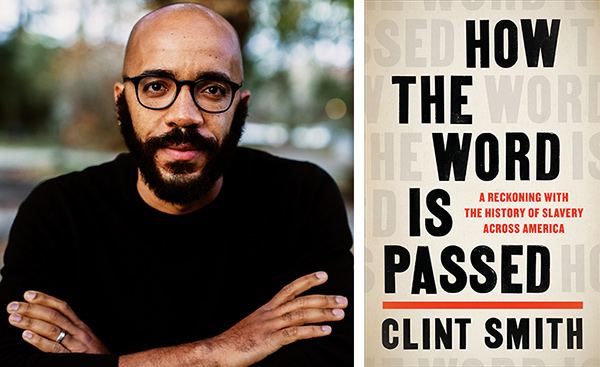
How the Word Is Passed: A Reckoning with the History of Slavery Across America

EVENT DETAILS: 
When: Monday, May 10, 2021
Time: 7:00 pm– 8:30 pm ET
Where:  Virtual Webinar
Cost: FREE

Presenters: Clint Smith and Cierra Kaler-Jones 

Description:
Clint Smith is a poet, staff writer at The Atlantic, and teaches writing and literature in the D.C. Central Detention Facility. Smith, in conversation with Cierra Kaler-Jones, will talk about his new book, How the Word Is Passed, an examination of how monuments and landmarks represent — and misrepresent — the central role of slavery in U.S. history and its legacy today.

This event is part of the ongoing series, ” Teach the Black Freedom Struggle,” from the Zinn Education Project.

Brief – Human Rights Education: What Works?

Human rights education is increasingly acknowledged as an essential part of building a human rights culture. But does it work? This brief by the Danish Institute for Human Rights reviews existing literature on human rights education for children, presenting an overview of findings on the outcomes of human rights education.

The studies include academic articles, book chapters and evaluation reports from the period 2000-2020. Methods for measuring human rights education outcomes include quantitative surveys; qualitative interviews, focus groups; observations; and document collection. The studies vary from small-scale ethnographic studies involving a few dozen people to large-scale surveys including 100,000 respondents.

White Supremacy in Education

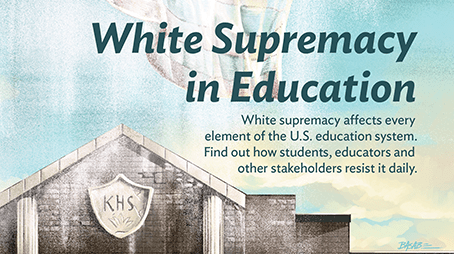
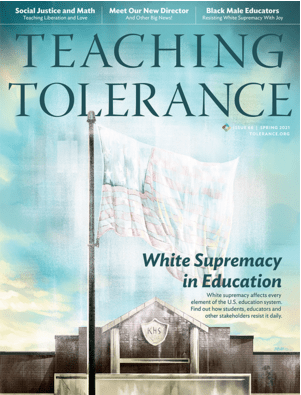
We know white supremacy is woven into the fabric of American culture and society. It’s also woven into our education system. The Spring 2021 issue of Teaching Tolerance magazine, traces some of the threads of white supremacy through classrooms and schools—and how students, educators, and others are working to break those threads. 

Read this issue for stories about how white supremacy appears in curricula and policies, even in teacher training programs. Learn how educators and students are working to dismantle it in their communities. 

Seizing Freedom Podcast

Ending slavery in America required so much more than official declarations and battlefield victories.

Freedom gets built up over time—through a billion tiny, everyday acts. It’s there in the chance to enlist and fight for a cause. It’s there in the effort to reunite families torn apart by the cruelty of slave trading. It’s there in the right to learn to read or found a church or decide how you want to make a living. And it’s there in the insistence on the legal recognition of the right to do all these things.

That’s the freedom you’ll hear about on this podcast, and you’ll hear about it directly from the people who seized it. All of the stories on this show are drawn from archives of voices from American history that have been muted time and time again.

Guide on Ensuring Access to Education During the Pandemic

The Inter-American Commission on Human Rights (IACHR) has published a new practical guide on access to education in the context of COVID-19, the latest in a string of recent thematic publications and its second practical guide on the pandemic. [IACHR Press Release] The IACHR Rapid and Integrated Response Coordination Unit (SACROI) produced the guide in collaboration with the IACHR special rapporteurships on economic, social, cultural, and environmental rights and on freedom of expression. See IACHR, How to Ensure Access to the Right to Education for Children and Adolescents during the COVID-19 Pandemic? (2020).