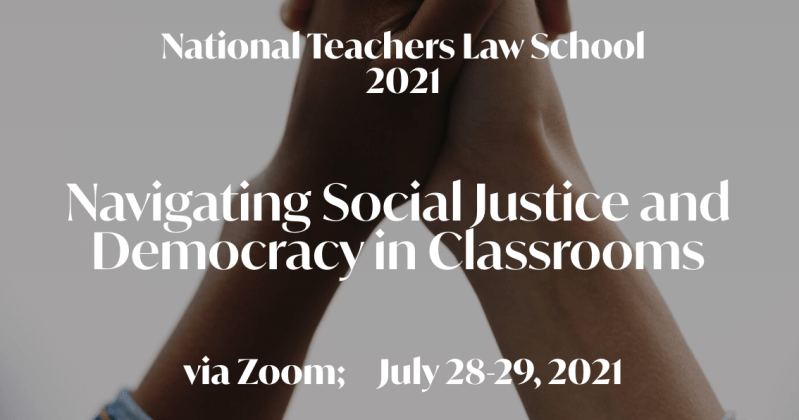
EVENT DETAILS: When: July 28-29, 2021 Where: Live Stream Cost: FREE
Description: The National Teachers Law School is a crash course in civics for teachers, led by experienced lawyers, law professors, and members of the judiciary. The ultimate goal of the program is to equip teachers with the knowledge and tools to foster an appreciation among their students for the value of the American civil and criminal legal systems. This is a free two-day webinar.
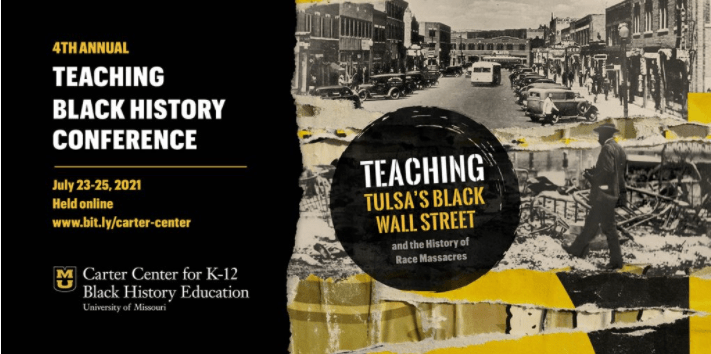
EVENT DETAILS: When: July 23-25 Time: 8 am – 4 pm CT Where: Live Stream Cost: $99
Description: Over 60 presentations from K-12 educators around the world! Mark your calendars for the virtual 2021 Teaching Black History Conference! This year’s conference will honor the men and women of Tulsa’s Black Wall Street (coined by Booker T. Washington) as well as other Black communities that gained economic independence along with those who were victimized by racial violence.
Carter Center’s Annual Teaching Black History Conference brings together educators who seek transformative and engaging ways to teach PK-12 Black history in both history and humanities courses. Teachers gain tangible strategies to incorporate in their classrooms that focus on content and pedagogy, active learning, support and collaboration, and instructional approaches.
EVENT DETAILS: When: July 13-15 Time: 11:30 – 4:30 ET Where: Live Stream Cost: $50
Description: This summit organized by Facing History and Ourselves aims to support educators and school leaders both individually and collectively as they move to culturally inclusive and equitable practices where all students can find their voice, become critical thinkers, and are fully engaged in their education.
Across the country, educators and administrators are acknowledging that schools themselves—both the practice of schooling and the outcomes students are achieving—are not equitable across lines of race and class. Facing History and Ourselves has designed a professional development model to help educators address these troubling and historically rooted disparities.
Through interactive and critically conscious pedagogy, educators will examine the history of American education, current systems of inequity, and gain the tools necessary to address these barriers to equity. This summit will feature a live keynote presentation by Dr. Gholdy Muhammad, author of Cultivating Genius, focusing on culturally and historically responsive literacy.
Participants will receive 15 professional development hours.
Nominate yourself or a colleague to join our Steering Committee. Our rules call for the election every summer of new Steering Committee members to replace retiring members. This year there are 2 open seats to be filled, and we invite all members to make nominations for their replacements. You may nominate anyone who fits the criteria for membership and can fulfill the responsibilities of Steering Committee members, including nominating yourself!
Brief biographies of current Steering Committee members can be viewed here. A ballot will be sent to all HRE USA members in July.
Elected Steering Committee members will serve a three-year term beginning in August 2021.
EVENT DETAILS: When: Tuesdays, July 20, July 27, and August 3, 2021 Time: 12pm – 2pm Where: Online Cost: FREE
Description: The free weekly workshops, led by Cymone Fuller and Sia Henry of the Restorative Justice Project at Impact Justice, will explore how educators can bring restorative justice practices and human rights principles into the classroom—modeling alternatives to punishment, including mediation and agreement, that allow students to develop deeper empathy, patience, active listening skills, ownership over their learning environment, and responsible decision making to support their social-emotional wellbeing for years and decades to come.
The three-part training series will feature local community leaders and human rights defenders who have put these principles into practice in their work to combat racial and ethnic disparities inside the classroom and in their communities. Educators will learn how restorative justice practices can be applied to end the school-to-prison pipeline and improve community well-being.
You can choose to attend one or more of the upcoming sessions:
July 20, 2021: 1st session – Restorative Justice Frameworks and Paradigms July 27, 2021: 2nd session – Building a Restorative Space in Your Community and School August 3, 2021: 3rd Session – Stories of Human Rights Defenders Impacted by Restorative Justice
For more information on the restorative justice training series, visit RFKHumanRights.org or email osterndorf@rfkhumanrights.org.
This new open access book from IEA (the International Association for the Evaluation of Educational Achievement), entitled, Influences of the IEA Civic and Citizenship Education Studies: Practice, Policy, and Research Across Countries and Regions, identifies the multiple ways that IEA’s studies of civic and citizenship education have contributed to national and international educational discourse, research, policymaking, and practice. The IEA International Civic and Citizenship Education Study (ICCS), first conducted in 2009, was followed by a second cycle in 2016. The project was linked to the earlier IEA Civic Education Study (CIVED 1999, 2000). IEA’s ICCS remains the only large-scale international study dedicated to formal and informal civic and citizenship education in school. It continues to make substantial contributions to understanding the nature of the acquired civic knowledge, attitudes, and participatory skills. It also discusses in-depth how a wide range of countries prepare their young people for citizenship in changing political, social, and economic circumstances. The next cycle of ICCS is planned for 2022.
In this book, more than 20 national representatives and international scholars from Europe, Latin America, Asia, and North America assess how the processes and findings of the 2009 and 2016 cycles of ICCS and CIVED 1999/2000 have been used to improve nations’ understanding of their students’ civic knowledge, beliefs, attitudes, current civic-related behaviors, and intentions for future participation in a comparative context. There are also chapters summarizing the secondary analysis of those studies’ results indicating their usefulness for educational improvement and reflecting on policy issues.
The analyses and reflections in this book provide timely insight into international educational discourse, policy, practice, and research in an area of education that is becoming increasingly important for many societies.
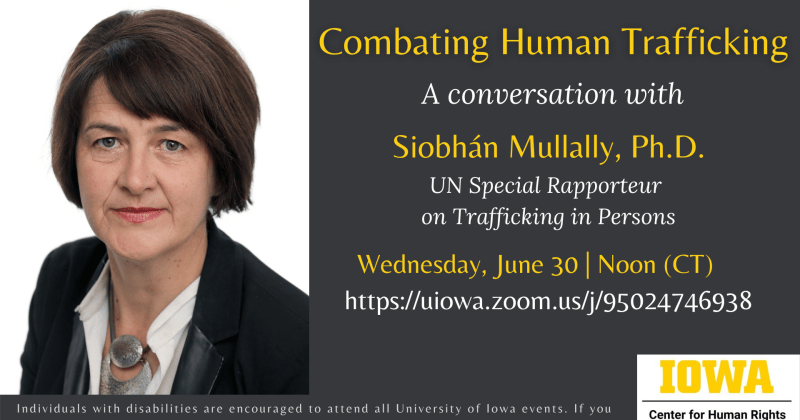
EVENT DETAILS: When: Wednesday June 30, 2021 Time: 12:00 pm – 1:00 pm ET Where: Live Stream on Zoom Cost: FREE
Description: Human trafficking is a widespread, global issue impacting millions. It’s victims – nearly 75% of whom are female – are most often trafficked for sexual exploitation or forced labor. Over the past two decades, the United Nations has taken important steps to define and counter trafficking. Join us for a conversation with current UN Special Rapporteur Siobhán Mullally about the nature of trafficking, the global response, and the emerging issues she sees in her work.
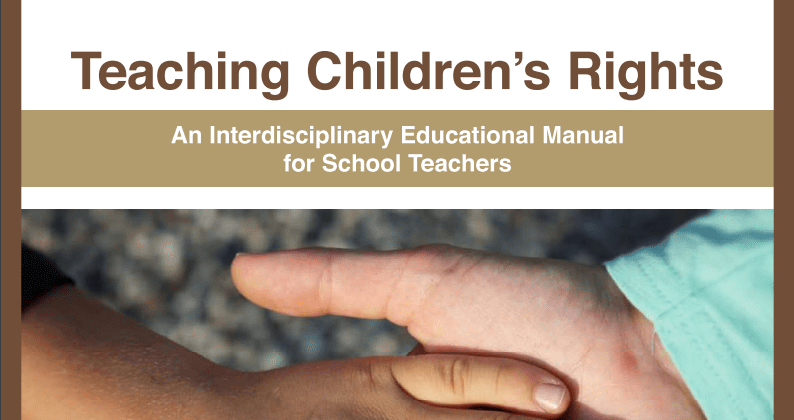
LEARN | RIGHT has developed a manual with tools, planning sheets, and activities for teachers to plan learning programs on children’s rights and create a learning environment that respects and promotes children’s rights in class and society.
The manual is generic allowing it to be applied to different national and cultural contexts, languages, and school systems as well as age groups.
We developed the manual to give a broad audience access to the approach and resources developed in the authors’ two previous manuals on teaching children’s rights in Greenland and Belarus, respectively, and in The Human Rights Education Toolbox.
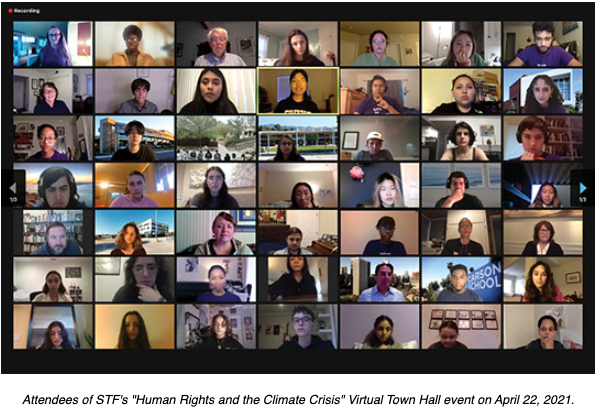
As part of HRW Student Task Force’s (STF) advocacy to transition high schools across Southern California to 100% renewable energy, commit to energy efficiency plans, and engage in climate justice education, the STF hosted over 150 students, teachers, administrators, and community members at the “Human Rights and the Climate Crisis” Virtual Town Hall on Earth Day 2021.
“The climate crisis is the defining issue of our generation and we are at a monumental moment,” said one STF representative. “We are protecting our human rights to life, liberty, and personal security, to survival and development, and our right to health, to clean water – and a future! We are demanding public officials take action to protect our human rights and fight climate change.”
Students representing 18 high schools shared their personal climate stories, illustrating how climate change is impacting their lives. Several had experienced fire-threat evacuations and pollution-induced asthma, which further motivates them to take action. STF leaders also described using HRW’s methodology “Investigate, Expose, Change” to frame their advocacy as they engage school administrators and public officials.
Featured speaker, Christos Chrysiliou, LAUSD’s Director of Architectural and Engineering Services for the Facilities Division, discussed LAUSD’s steps to increase its energy and water efficiency, improve sustainability, and engage students in the decision-making process. “We cannot achieve all the things that we’re doing without your [students’] help… We need you in the process,” Mr. Chrysiliou said, “because that’s the only way to fight climate change.” Afterward, attendees participated in a spirited Q&A session with Mr. Chrysiliou. (Listen at 47:43 on the recording.)
Closing STF student speaker, Nathalia Wyss, quoted Greta Thunberg: “Act like your house is on fire, because it is – continue to take action against climate change and inform others, and please, keep fighting to turn our schools green.”






 HRE USA