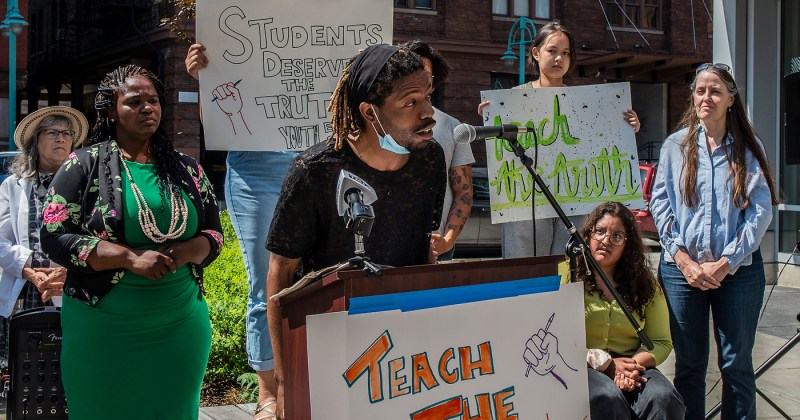
Don’t Stop Talking About Gun Violence  

“Over the last two decades, discourse about gun violence has always ebbed and flowed. But for change to happen, anti-gun violence advocacy has to stay top of mind,” LFJ Senior Writer Coshandra Dillard outlines in our newest article. Including statements from young activists who spoke during the recent March for Our Lives event, Dillard highlights the need for unrelenting efforts to end gun violence, arguing that the mass shooting on July 4 adds even more impetus for us all to act. These LFJ resources offer strategies to do just that. 

We Are Once Again Reeling From Grief and Outrage (2022)

To Counter Racist Violence, Teach Honest History (2022) 

5 Courses on Indigenous Peoples’ Activism, Culture and Worldviews

EXPLORE NOW
In 2007 the UN General Assembly adopted the Declaration on the Rights of Indigenous Peoples, setting minimum standards for the survival, dignity and well-being of indigenous peoples and communities. Until today the document is the most comprehensive international instrument for the protection of indigenous peoples’ rights.Despite these efforts, indigenous communities are continuing to face countless issues including lack of political representation, economic exclusion, racism and discrimination and the violation of their resource and land rights.To help defend and promote the human rights of indigenous peoples, it is essential to understand the issues they are facing, their unique history, culture and worldviews.We have compiled a list of 5 courses to learn more about indigenous peoples. All courses in this list can be audited for free. You can opt-in for a paid certificate for an extra fee. Financial aid is available for those who qualify through the course providers.

Indigenous Canada (University of Alberta)
Aboriginal Worldviews and Education (University of Toronto)
Climate Change and Indigenous People and local communities (University of Barcelona)
Indigenous Religions & Ecology (Yale University)
Artic Development (University of Alberta)

Global Youth-Led Training Webinar

Youth activists are invited to participate in a virtual conversation on Saturday, July 30th from 1 – 4 p.m. EDT.

This event will provide the opportunity to meet, share, listen and learn from other youth. We have some topics in mind, such as links with human rights, use of artistic mediums, lobbying and how to survive setbacks, but tell us what you would like to talk about! If you have not already done so, please complete the online Registration Survey and feel free to pass along this invitation to other youth activists you know.
Take the survey and RSVP here: https://docs.google.com/…/1YNdQ5u4sMFU6HcW4…/viewform… 

Researching Human Rights & Social Justice with HeinOnline

Discover how your institution can receive free, perpetual access to our Social Justice Suite, included in all Core package subscriptions!

Wed, July 27, 2022

2:00 PM – 2:30 PM EDT

REGISTER HERE

Last month, in honor of Pride Month, HeinOnline added a new database, LGBTQ+ Rights, to our complimentary Social Justice Suite. Join our research specialists as they dive into HeinOnline and explore how Human Rights and Social Justice have continued to evolve over the course of history and how much farther we still have to go.

Human Rights Education Review: Call for papers: Language learning and human rights education 

Guest editors: Tony Burner and Melina Porto

Human Rights Education Review invites papers for a Special Issue on the intersection of language learning and human rights education. We invite submissions that explore this intersection, considering, in particular:

  • What is the role of language education in enabling students to address and challenge the injustices (linguistic and otherwise) they face in their lives on a daily basis?
  • What is the role of language education in contributing to building democratic, peaceful, just, and sustainable societies where human rights are respected?

In other words, how are language education and human rights education interconnected?

The last 20 years has witnessed a rise of nationalism in which linguistic diversity and multilingualism are presented as a threat to nationhood and the status quo, with a frequent emphasis on one-nation-one-language, and a denial of ethnic roots. Yet language education may play an essential role in realizing human rights, and human rights serve to protect language education. The term linguistic human rights (LHR) is frequently used today, yet we observe there is surprisingly little in international human rights instruments addressing LHR, compared to other rights such as those relating to gender, race, and religion.

Language learning raises a range of ethical issues. What gets represented in and through the languages used, valued, welcomed, and fostered in and outside classrooms, and what is hidden? Whose rights are denied, whose freedom of expression is quashed? What can language learners express? What can they not express? These questions invite analysis of language learners’ rights, freedom of expression (for example, creative, artistic, performative, embodied) and freedom of belief, as experienced in and outside of formal language learning arenas. They also invite reflection on the ultimate aim of language education and language learning.

For this special issue of Human Rights Education Review, we encourage papers from a range of perspectives and from different international contexts. We welcome papers that focus, in the words of the 2011 UN Declaration on Education and Training, on education aboutthrough and/or for human rights. Education about rights might explore, for example, opportunities in the language learning classroom to enhance and strengthen human rights knowledge and understanding. Education through rights might consider the degree to which language learning methodologies are in keeping with human rights principles. Education for rights might look at language learning as a means of enabling learners to claim their rights or act to defend the rights of others.   

We invite papers that address the intersection of language learning and human rights education, including, but not limited to the following topics:

  • Human rights education through the language curriculum
  • Language learning as an antidote to ethno-nationalism and rights denial
  • Language learning and education for global/ cosmopolitan citizenship
  • Human rights and language learning methodologies
  • Minority language use in education as a human rights issue
  • Developing language skills to defend human rights
  • Language learning and students’ freedom of expression
  • Language learning and the recognition of complex identities

If you would like to make a submission in response to the CfP please send an extended abstract of no more than 300 words to the Managing Editor of Human Rights Education Review Marta Stachurska-Kounta: marta.m.stachurska-kounta@usn.no by 24 October 2022. Your abstract should include a short list of indicative literature on which you expect to draw, from the fields of both language learning and human rights education. Please ensure you use the subject line: HRER: Language learning and human rights education in your email. You will hear back from us by 7 November 2022. All invited manuscripts will be subject to double-blind peer review. Submission of the full paper is due by 6 March 2023. We expect to publish the Special Issue in Volume 7(1) in January 2024.

Human Rights Education Review is an award winning, open access journal, that publishes original research and scholarship. Authors retain the copyright of their own work, and no charges are made to authors or readers. By publishing in HRER you have the opportunity of reaching the widest possible international readership. You can view previous issues of the journal here and learn more about HRER editorial policies. 

Tony Burner is Professor of English Language Education in the Department of Languages and Literature Studies, University of South-Eastern Norway, Norway

Melina Porto is Professor of English Language Education at Universidad Nacional de La Plata (UNLP), Argentina
Join HRE USA Steering Committee!

Help shape the future of human rights education. Nominate yourself or a colleague to join our Steering Committee.

Our rules call for the election every summer of new Steering Committee members to replace retiring members. This year there are 2 open seats to be filled, and we invite all members to make nominations for their replacements. You may nominate anyone who fits the criteria for membership and can fulfill the responsibilities of Steering Committee members, including nominating yourself!

Brief biographies of current Steering Committee members can be viewed here. A ballot will be sent to all HRE USA members in July.

Elected Steering Committee members will serve a three-year term beginning in August 2022.

DEADLINE: TUESDAY, JULY 15, 2022

>> Learn more

>> Nomination Form

For further inquiries, please contact Kristi Rudelius-Palmer

Summer Leadership Institute: Navigating the Political Landscape of Social Studies

July 19-20, 2022

 Learn more and register

National Council for the Social Studies (NCSS) invites you to its Summer Leadership Institute (SLI), Navigating the Political Landscape of Social Studies! 

Currently, social studies, social studies educators, and education as a whole are in a defensive stance as we have become pawns in a misinformation campaign about our content, our methods, and our mission. This year’s two-day SLI event will focus on how we as social studies educators can recapture the narrative of social studies and promote social studies as a central component of preparing all students for civic life.

During this two-day virtual event, NCSS members will learn about the current legal and political challenges confronting teaching social studies and work collaboratively on approaches, tools, and structures that we can put in place at the classroom, local, state, and national levels to navigate the current political landscape.

75th Anniversary of the Universal Declaration of Human Rights: Launch Event

by John Humphrey Centre for Peace and Human Rights

Thu, 21 Jul 2022, 9:00 AM MDT

REGISTER HERE

2023 marks an important year for us at the John Humphrey Centre for Peace and Human Rights, as well as for all humankind. Seventy five years ago, in 1948, the Universal Declaration of Human Rights came into force as an international framework for human rights at the United Nations’ following the atrocities of the second world war. Our namesake, John Peters Humphrey, worked with representatives from around the world to draft and bring forward this important document and work to enshrine human rights into international law.

Coming into the 75th Anniversary, we see there are many struggles that continue to confront our local and global communities. While we have international human rights laws and foundations to guide us, we have a long way to go to actualize these rights and bring peace to our communities and world. The rates of hate and intolerance are growing, poverty is deepening, and Canadians are only now beginning to reckon with our deep history of genocide.

Please join us on July 21st at 9 am MST as we share with you our vision for commemorating and creating action for the 75th Anniversary of the United Nations’ Universal Declaration of Human Rights. We will share a draft plan and framework with you for an international conference in 2023 where we hope to provide space for reflection on the state of human rights, provide opportunities for growth and mentorship, and facilitate a strengthened network of an intergenerational community committed to building stronger, more resilient and inclusive communities. Our hopes that this launch will provide a framework for collaboration on this important event.

We thank you for considering our invitation and would be honored to have you with us. Together, we can create a vision and plan forward for a continued, and strengthened, effort to advance a culture of peace and human rights.

Using human rights as a tool for social justice

An interactive online workshop for organisations and activists to explore social justice as a human rights issue.

Mon, 18 July 2022

13:00 – 14:00 BST

REGISTER HERE

Just Fair will host a free interactive online workshop for organisations and activists to explore social justice as a human rights issue and how a human rights – specifically economic, social and cultural rights – based approach can be a powerful tool in your campaigning.

The workshop will:

  • Explore social justice as a human rights issue, with a particular focus on economic, social, and cultural rights
  • Examine international examples of human rights-based campaigning on social justice issues
  • Introduce the five key principles of a human rights-based approach (Participation, Accountability, Non-discrimination, Empowerment and Legality)
  • Identify ways to apply these principles to your work.

We like to use Zoom as it has some great accessibility features. So that we can make the training as accessible as possible for you, please let us know as soon as possible if you have any other communication or access needs. Please email helen.flynn@justfair.org.uk to discuss.

Note: if you would like a bespoke workshop tailored to your organisation’s needs, please contact helen.flynn@justfair.org.uk to discuss options (there will be a charge for bespoke sessions).

Twitter: Just Fair