New Status Report on Human Rights in the United States

From US Human Rights Network

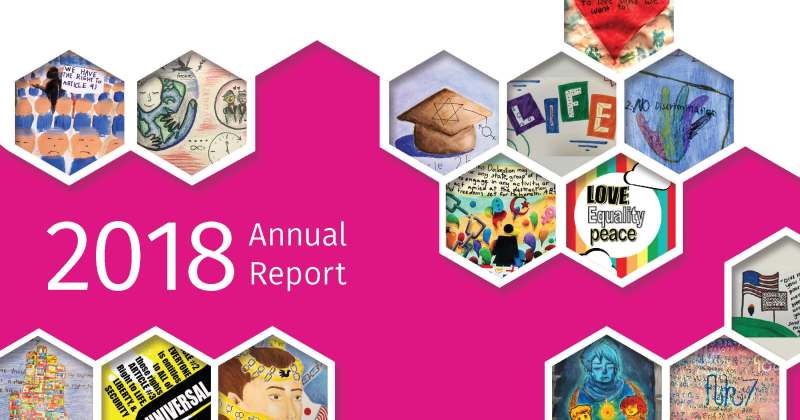
The US Human Rights Network (USHRN) is pleased to release its seventh annual report on the status of human rights in the United States on December 10th in honor of Human Rights Day. On this day 70 years ago, the Universal Declaration of Human Rights (UDHR) the first global expression of the rights to which all human beings are inherently entitled—was adopted by the General Assembly of the United Nations on December 10, 1948.

This human rights report is a tool to provide advocates on the ground in the United States with a human rights framework to address their issues on the front lines.

>> Learn more and download report

Black Lives Matter at School

Mark your calendars! The Black Lives Matter at School week of action will be held from February 4-8, 2019.

Black Lives Matter At School is a national committee of educators organizing for racial justice in education.  BLM at School encourage all educators, parents, students, unions, and community organizations to join the annual week of action during the first week of February each year.

There are many ways to participate in Black Lives Matter at School week. Some educators teach BLM lessons every day of the week, wear their Black Lives Matter At School t-shirt, organize after-school rallies, facilitate their students entering the creative challenge, develop curriculum, post on social media, and rally at the school board meeting. One easy way for everyone to participate is to sign the petition endorsing the week of action

The important thing is that you act in some way to join this movement to bring down the structures of anti-Blackness in education and affirm the lives of Black students in your classroom. 

Email BlackLivesMatterAtSchool If you or your organization would like to support or endorse the week of action.

>> Learn more 
>> More Teach BLM Resources


The Power of Human Rights Education Website

The Power of Human Rights Education is open web resource on human rights education recently launched on 18 September 2018 at a side event to the HRC session, to commemorate the 70th anniversary of the UDHR and to contribute to the goals of the World Programme for Human Rights Education. The website promotes human rights education through a visual exhibition and a series of films (Path to Dignity), as well as inspirations to take action. The site was developed by HRE 2020, Soka Gakkai International, NGO Working Group on HRE and Learning, and the Platform of member states for Human Rights Education and Training, with thanks to the OHCHR. 

>> Learn more

International Journal of Human Rights Education

The International Journal of Human Rights Education (IJHRE) is a peer-reviewed, online, open-access journal that was launched in 2017 with its inaugural issue. 

Volume 2 of the journal is now available.  

Hosted by the University of San Francisco’s Gleeson Library and Geschke Resource Center, the IJHRE provides the global movement for human rights education with a dynamic and democratic platform for debates, ideas, and lessons from engaged scholarship and practice. The IJHRE is an independent journal dedicated to the examination of the theory, research, and practice central to the field of human rights education. The aim of this journal is to serve as a central location for critical thought in the field and to energize new efforts in research and praxis.

>> Read journal

Happy Human Rights Day

Today, Monday, December 10th marks the 70th ANNIVERSARY of the Universal Declaration of Human Rights. A milestone document in the global history of human rights that is as relevant today as it was when drafted seven decades ago.  

Although the UDHR is not in itself legally binding, it has become the procreator of modern international human rights law, providing safeguards – and sometimes lifelines – for thousands of people from all walks of life when national laws fail them. It has parented 16UN human rights treaties that are legally binding, including the twin UN Covenants spanning economic, social and cultural and civil and political rights respectively, plus a host of regional treaties in Africa, the Americas, and Europe.

We now take for granted that such human rights standards can be used to hold our governments to account, but just 70 years ago there were no internationally recognized human rights norms at all. The very fact that the UDHR has stood the test of time is a testament to the enduring universality of its perennial values of equality, justice, and human dignity.

The promise of the UDHR, however, has yet to be fulfilled because, as all advocates know, human rights are not a given but rather require a continuous struggle to get and once that has been achieved to keep. In other words, it is down to us to promote its ethical vision as new forms of nationalism and populism threaten to challenge our world.  

At HRE USA we believe human rights education is key to ensuring a future in which all people’s rights are respected, protected, and fulfilled. Please consider supporting HRE-USA by making a tax-deductible contribution on our behalf to our fiscal sponsor, the Center for Transformative Action, a 501(c)3organization. Your donation will allow us to continue to advocate for and further develop programming that supports human rights education across the United States.

In honor of the 70th Anniversary and to help everyone celebrate the gift of the UDHR, HRE USA has created this online resource kit. You can also join the international campaign to #Standup4humanrights. 

 HAPPY HUMAN RIGHTS DAY

Tips for Making Classrooms More Inclusive

By the Human Rights Campaign (HRC)

Back to School is a busy time for educators as they set up their students for success — laminating name tags, creating bulletin boards and writing lesson plans. They know that for many children, the first few days back to school can make or break their year. As educators sharpen their pencils, the HRC Foundation’s Welcoming Schools program is working to ensure that schools also take the time to make classrooms a welcoming place for all by cultivating an LGBTQ and gender-inclusive learning environment.


Don’t know where to start? HRC is here to help with these tips for developing LGBTQ and gender-inclusive classrooms and schools.


  1. Use inclusive language on all forms. Back to school means paperwork for families. Educators can make the process welcoming by ensuring all handbooks, forms and other communications are inclusive of all family structures and gender identities (e.g., using phrases such as “families and caring adults” in place of “moms and dads”).
  2. Stock your library shelves with diverse books. Make sure students have access to books that reflect not only their lives but also identities and perspectives outside their experiences. Challenge stereotypes by featuring a Welcoming Schools recommended book as a first-day read-aloud.
  3. Create a welcoming bulletin board. We know displays are important features in every classroom, so why not switch out the apples and school buses for a display that shows diverse family structures and people of different races, gender expressions, and abilities? Use slogans that encourage respect for all people. For an easy visual, print a Welcoming Schools safe school sign.
  4. Develop clear classroom and/or school agreements. Educators must ensure that bullying policies specifically name groups that are disproportionately bullied or harassed, and then make it clear to students that this means no put-downs about who someone is or who their family is. Preventing bias-based bullying starts on day one.
  5. Prepare for teachable moments. Educators can practice how to respond when they hear students say things like “That’s gay!” or “You act like a girl!” or “You’re not a real family because you don’t have a dad!” Be prepared to interrupt mean teasing about a child’s identity or their family.
  6. Model inclusive language. Instead of addressing classes as “boys and girls,” try using non-gendered words like “students,” “scholars,” or “friends” to be more inclusive of all identities.
  7. Group students according to something other than gender. There’s no need to have boys’ closets and girls’ cubbies. Divide children by number or line them up by birth month, the color of clothing or alphabetically by name.
  8. Try a new lesson plan. Educators can give one of the Welcoming Schools lessons a try and start the year by teaching students how to be allies and learning about what makes each child special.
  9. Plan a family night. Hold an evening event to celebrate all families. Provide information for families and caring adults to help them talk with their children about LGBTQ and gender topics.

>> Learn more about the Welcoming Schools Program

Never Forget – Teaching 9/11

Each September brings a flurry of excitement and anxiety for parents, teachers, and students. Beginning in September 2002 another factor was added to the list: how and what to teach about 9/11.

“Never forget” became a national rallying cry after the attacks of Sept. 11, 2001.

Yet America’s schools — where collective memory is shaped — are now full of students who never knew. Because they weren’t alive 17 years ago.  In fact, most individuals under the age of 30 have limited or no memories of the world before the attacks of September 11,2001 and were certainly not old enough to fully understand how the subsequent U.S. response, including the so-called “War on Terror” and its resulting policies, impacted human rights.

As such, many teachers struggle with whether and how to teach the attacks and their aftermath, but, in order to never forget, our children need to be taught about 9/11. More importantly, they need to understand how changes in U.S. national security policy post-9/11 continue to manifest themselves in new and different ways today, even as public and media attention wanes. These trends are especially apparent among young people, who reportedly demonstrate low rates of awareness of issues such as indefinite detention or drone strikes, and often exhibit lower levels of civic participation around national security and human rights issues.

That’s where Human Rights in National Security: An Educator’s Toolkit comes in. The events of the past seventeen years are highly relevant in a number of academic disciplines: civics, political science, law, literature, film, religious studies, international relations, and more. This toolkit provides educators with lesson plans and resources to address these issues in the classroom and to empower students to assess their developments through a human rights lens. It also aims to increase participation among high school and college students in activism and advocacy around torture, surveillance, anti-Muslim hate, indefinite detention, and other common human rights violations associated with post-9/11 U.S. policy.

>> Download Toolkit

Need support? If so, please email us. Human Rights Educators USA has teamed up with Amnesty International USA to gather feedback and improve this resource.

Teach Reconstruction

Reconstruction, the era immediately following the Civil War and emancipation, is full of stories that help us see the possibility of a future defined by racial equity. Yet the possibilities and achievements of this era are too often overshadowed by the violent white supremacist backlash.

The Zinn Education Project offers lessons for middle and high school, a student campaign to make Reconstruction history visible in their communities, and an annotated list of recommended teaching guides, student-friendly books, primary document collections, and films.

>> Learn more

Teach the SDGs

EOTO World is an official partner of MyWorld2030 that is working to educate global youth about the Sustainable Development Goals (SDGs) and amplify citizen voices in the monitoring and evaluation of SDG progress. The 17 SDGs are focused on eradicating poverty, ensuring sustainable development, building peaceful, inclusive societies and leaving no one behind. Want to do more for SDGs? Work with EOTO World to educate others and expand the dialogue.
Start by taking this 5 min survey in your language: www.myworld2030.org/partner/TeamEW.
Get youth involved and have them share their perspective here:
https://goo.gl/forms/BEFqUbc6xiiHCpcr1
Follow along with #EOTOWorld4SDGs. Your story could be featured!

>> Learn more

Counter Hate in Schools

Since Teaching Tolerance began tracking hate and bias incidents at school in October 2017, they’ve recorded 496 reports spanning 47 states and Washington, D.C.  A recent UCLA study found that teachers are seeing increased incivility, intolerance and polarization in classrooms.

“Back to school” shouldn’t mean “back to hate.” 

To counter this rise of discrimination, hatred, and bigotry in our society and in our schools, the Southern Poverty Law Center has joined forces with 20 other education advocacy groups, including HRE USA, to counter hate in American schools. This coalition is committed to providing resources and support so schools may effectively respond to hateful acts and create learning environments where every student feels welcome.

Read the full statement and add your name* to the list of supporters who believe hate has no place in schools. If you represent an education organization that would like to add your group’s name to this statement, please email againsthate@tolerance.org.

>> Sign on to the Join Statement
>> Learn more

To counter hate in your school, Teaching Tolerance suggests the following: 

  1. Be prepared. Use our Responding to Hate and Bias at School guide to learn what to do before, during and after a crisis. Having protocols in place at the beginning of the school year helps increase administrators’ and teachers’ confidence that they’ll be able to effectively address incidents and alleviate tension.
  2. Develop a zero intolerance policy. Follow our Speak Up at School guide to help respond to prejudice, bias, and stereotypes every day in the classroom.
  3. Take on controversial topics and encourage civil discourse. Civil Discourse in the Classroom lays the groundwork. Let’s Talk! provides strategies to facilitate discussions that might elicit strong emotions.
  4. Create a community where all students can thrive. Use our Social Justice Standards to guide you in the engagement of anti-bias education. Critical Practices for Anti-bias Education ensures teachers can improve academic outcomes by building intergroup awareness, encouraging students to speak out against bias and injustice.