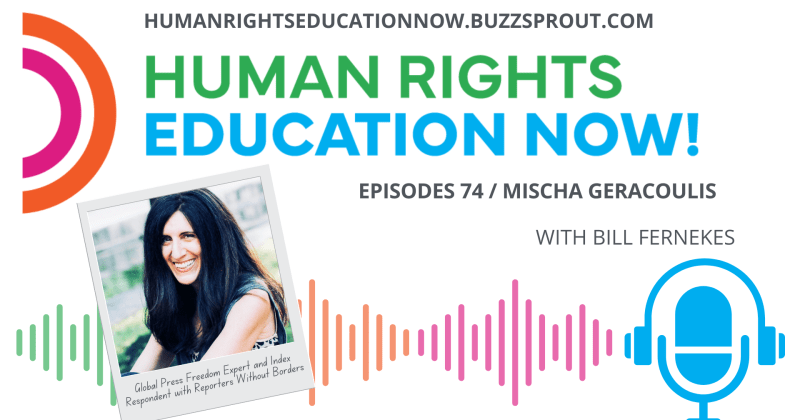

Mischa Geracoulis is Outreach and Engagement Officer at Project Censored and Production Lead at The Censored Press. She contributes to the State of the Free Press yearbook, serves as a Project Judge, and authored Media Framing and the Destruction of Cultural Heritage (Routledge, 2025).Mischa is also a Global Press Freedom Expert and Index Respondent with Reporters Without Borders. Her work focuses on human rights, journalistic ethics, press freedom, and the preservation of cultural heritage. She holds an M.A. in Education and Media Studies and a B.A. in International Development with a concentration on the Southwest Asia and North Africa (SWANA) region. Her journalistic portfolio can be found at: https://muckrack.com/mischa-geracoulis/portfolio.
Episode 74 Summary
In this episode of Human Rights Education Now!, Mischa Geracoulis examines how human rights, journalism, and the preservation of cultural heritage intersect, focusing on the legacy of the Armenian genocide. She discusses how cultural erasure and historical silences cause ongoing human rights violations and how journalism documents these histories to resist erasure.
The conversation centers on cultural heritage as a human rights issue, focusing on Rafael Lemkin’s work and media narratives. Mischa’s discussion of “change-centered” journalism and the role of microhistories in amplifying marginalized voices links to Edward Said’s Orientalism and critiques of media and power.
Mischa describes her work with Project Censored, focusing on promoting critical media literacy and defending freedom of expression under Articles 19 and 26 of the Universal Declaration of Human Rights. The episode centers on contemporary censorship, particularly political pressures on academic and journalistic freedom, and how media institutions shape or suppress truth.
The discussion concludes with a global perspective on the destruction of cultural heritage, including the case of Nagorno-Karabakh, and a call for educators to integrate critical media literacy and cultural heritage into human rights education. Mischa emphasizes that empowering individuals to critically analyze media and recognize whose voices are included or excluded is essential for advancing human rights in the modern world.
Topics discussed:
· Origins of Mischa Geracoulis’ work in human rights and journalism
· Armenian genocide and cultural erasure
· Journalism’s role in documenting human rights abuses
· Cultural heritage as a human rights issue
· Microhistories and change-centered journalism
· Edward Said’s Orientalism and media analysis
· Project Censored and media accountability
· Critical media literacy in human rights education
· Censorship, propaganda, and academic freedom
· Cultural destruction in Nagorno-Karabakh
· Educators’ role in preserving cultural heritage
Tags:
Human rights; Human rights education; Cultural heritage; Armenian genocide; Microhistories; Rafael Lemkin; Change-centered journalism; Edward Said; Orientalism; Project Censored; Critical media literacy; Armenian SSR; Nagorno-Karabakh; Journalism education; Daniel Ellsberg; Ben Bagdikian; Nelson Mandela; Gandhi
Full topic listing available for PDF download HERE.
Listen on our Buzzsprout podcast website HERE.
All episodes of Human Rights Education Now! are available on:
Buzzsprout, Spotify, Apple Podcasts, Google Podcasts, Deezer, PlayerFM, Pocket Casts, and the HRE USA website,
Thank you for supporting the Human Rights Education NOW! podcast!
HRE USA is a project of the Center for Transformative Action.

 HRE USA