
Deadline to submit applications has been extended to Friday April 3rd at 11:59 PST
Click here to learn about the the Edmonds Summer Fellowship program.
Summer Fellowship Project Summaries can be found HERE
In August of 2020, Human Rights Educators USA (HRE USA) lost one of its sustaining sources of inspiration and committed leadership – Kirby Edmonds. As a founding member of HRE USA, Kirby was instrumental in the establishment of HRE USA, directly shaping our mission statement, organizational structure, and most importantly our values framework and the consensus-based policy for decision-making. He served as Co-Chair of HRE USA for nearly a decade.
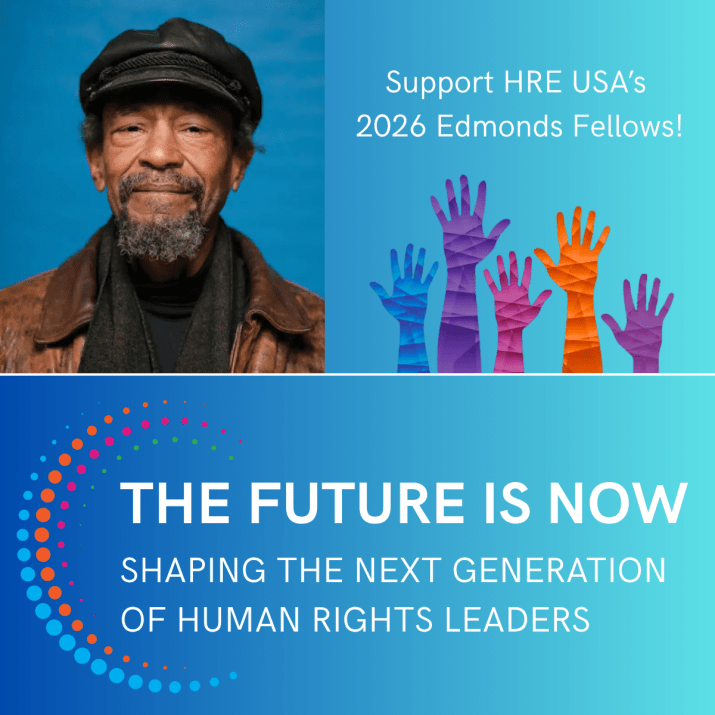
In honor of his legacy, HRE USA has created the Edmonds Summer Fellowship program to support hands-on leadership experience in human rights education and further Kirby’s work to engage young people in building human rights-friendly schools and communities. Fellows are supported with ongoing mentoring, guidance, and human rights learning opportunities throughout the summer.
The Edmonds Summer Fellowship program is supported in partnership with the Dorothy Cotton Institute (DCI) which carries on the legacy of civil rights legend Dorothy F. Cotton. Kirby served DCI as a Senior Fellow and Program Coordinator. DCI’s vision is a just and peaceful beloved community in which all people understand, protect and exercise full human rights. Their mission is to develop and train leaders for a global human rights movement and build a network of civil and human rights leadership. DCI’s Project Director, Laura Branca, said “Our Steering Committee proudly supports the Edmonds Fellowship to nurture young leaders and promote practices that transform individuals, schools and communities, opening new pathways to peace, justice and healing. What a fine way to honor Kirby’s legacy!”
Eligibility & Compensation
- Ability to commit 100 hours between June 1-August 28, 2026
- 18 years old or older
- $1500 stipend
- Reside in the United States
- Commitment to vision and mission of HRE USA
Donations to support the Edmonds Summer Fellowship can be made online or checks can be made out to the Center for Transformative Action with “HRE USA Edmonds Fellowship” in the memo line and mailed to the Center for Transformative Action, P.O. Box 760, Ithaca, NY 14851
HRE USA is a project of the Center for Transformative Action.


 HRE USA