Join HRER author Dr Khadidja Kelalech for our next research webinar addressing how media misrepresentations impact women’s right to access education in Algeria. Khadidja reflects on how social media posts, on channels such as Facebook and YouTube, impact women’s right to access higher education in Algeria. She will consider changes needed to foster an equitable environment where women can safely study and participate in university life.
Thank you to everyone who joined us in celebrating the 35th anniversary of the CRC through our Training As Action Series!
The theme of the 2024-2025 virtual training series was: “Youth Power, Defending Human Rights: Learnings and Actions for the 35th Anniversary of the Convention on the Rights of the Child (CRC).”
If you were unable to attend sessions, recordings are available at our YouTube channel and on our website!
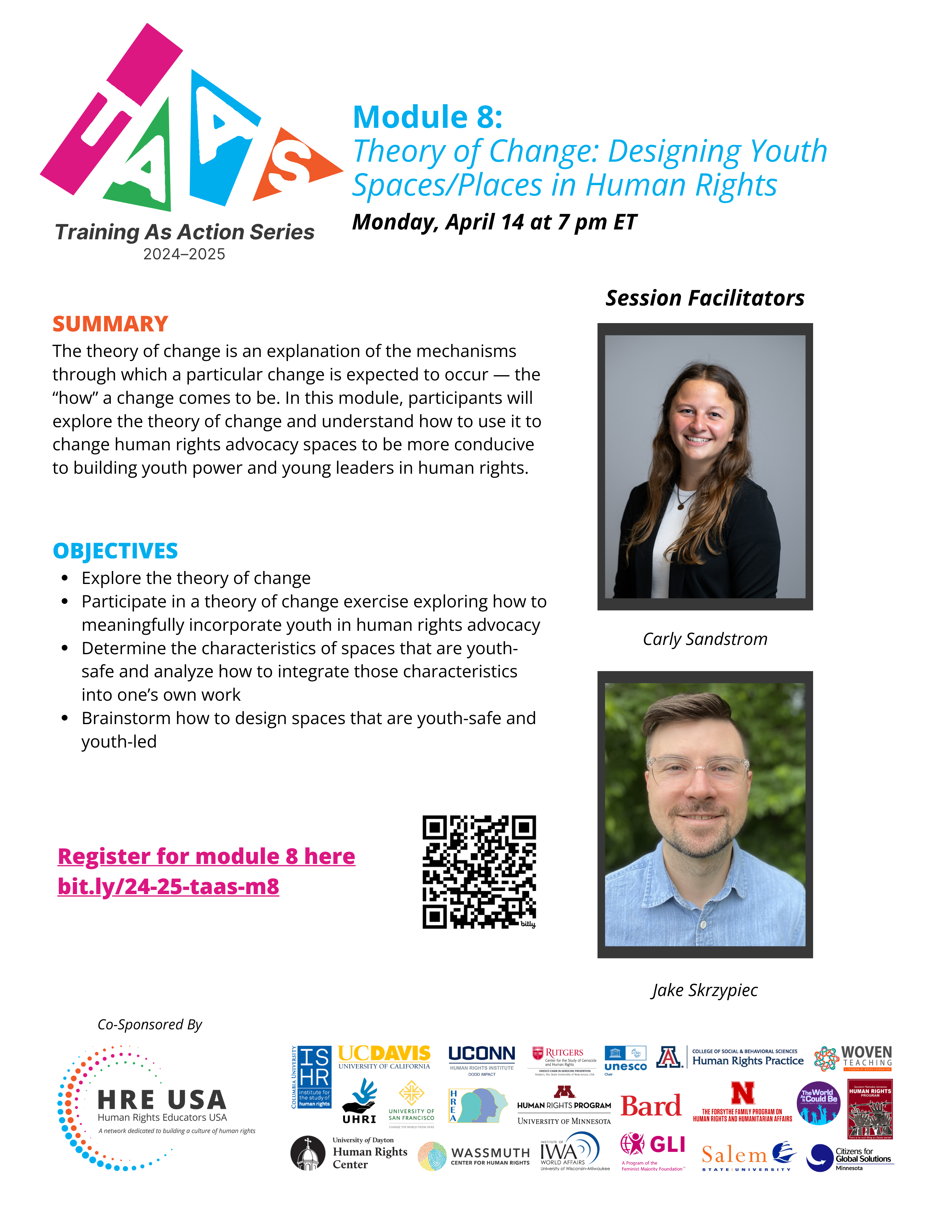
Introduction to Human Rights Educators USA >>Session recording Module 1: Youth Power, Defending Human Rights >>Session recording Module 2: Know Your (Human) Rights: Education for Youth Empowerment >>Session recording Module 3: Trust Kids! Dismantling Hierarchy in Human Rights Advocacy >>Session recording Module 4: A Children’s Rights-Lens to Youth Human Rights Advocacy >> Session recording Module 5: Digital Citizenship & Human Rights in the Age of Disinformation>> Session recording Module 6: Challenging U.S.-Centric Models, Building International Youth Solidarity>> Session recording Module 7: Big Actions, Big Feelings: Practical Empathy in Human Rights >> Session recording Module 8: Theory of Change: Designing Youth Spaces/Places in Human Rights >> Session recording
In human rights work, it is a challenge to navigate the difficult and complex emotions one experiences as a professional while maintaining one’s humanity and empathy. In this module, participants will better understand methods to avoid becoming burnt out or emotionally drained in their human rights work by exploring different wellness strategies and opportunities for community support.
As one of the five permanent members of the United Nations Security Council, the United States of America can often find itself at the center of human rights spaces and discussion. This module seeks to dismantle U.S.-centric models of understanding human rights in favor of a model that uplifts international solidarity. Participants will analyze comparative case studies of human rights issues in the U.S. and globally and will examine what international solidarity looks and feels like.
Carrie Booth Walling is Director of the Human Rights Program at the University of Minnesota – a hub of interdisciplinary research, teaching, and community outreach in the field of human rights in the College of Liberal Arts. She is Director of Graduate Studies for the Graduate Minor in Human Rights, a faculty member in the Institute for Global Studies and affiliated faculty at the Hubert H. Humphrey School for Public Affairs. Walling specializes in human rights, human security, transitional justice, the United Nations Security Council and mass atrocity crimes. Passionate about everything human rights, Walling’s recent book, Human Rights and Justice for All: Demanding Dignity in the United States and Around the World encourages readers to see the human rights issues in their neighborhoods and equips them to engage in human rights advocacy to promote policy change. Walling is also author of All Necessary Measures: the United Nations and Humanitarian Intervention.
Elizabeth Schwab is an undergraduate at Boston College studying Communication and International Studies with a concentration in Social Justice and Ethics. She is a Gabelli Presidential Scholar at Boston College, a National Stamps Scholar, and a McGillycuddy-Logue Fellow at Boston College. She has researched ethical volunteering with vulnerable groups while teaching English to Syrian and Ukrainian refugees in Germany. With experience working with The New York Times, she specializes in the intersection between journalism and human rights education.
This module aims to support participants in navigating the intersection between human rights and technology. Participants will understand digital citizenship and using technology for human rights defense, be prepared to hold difficult conversations about the use of technology with youth, and strategize how to combat misinformation.
Felisa Tibbitts (www.FelisaTibbitts.com) is Chair in Human Rights Education in the Department of Law, Economics, and Governance at Utrecht University in the Netherlands, where she also serves as UNESCO Chair in Human Rights and Higher Education. In addition, Felisa is Human Rights Education Associates (www.hrea.org) Executive Director and co-editor with André Keet of Emancipatory Human Rights and the University: Promoting Social Justice in Higher Education (2024). Human Rights Education Now! Podcast 12 and 13
Our Empower Youth, Secure the Futurecampaign, coinciding with the 35th anniversary of the Convention on the Rights of the Child (CRC), is still on and we would greatly appreciate your contributions!
The CRC has been a cornerstone in advocating for children’s rights worldwide. This campaign is dedicated to empowering youth and fostering a committed community of human rights learners and educators. The principles of the CRC guide our mission to ensure that every child knows and can defend their rights, which will be ever-crucial in the coming year(s).
Your involvement and support are crucial to the success of this campaign! Here’s how you can help our campaign flourish:
Donate: Your generous contributions will significantly impact our ability to achieve our goals. Every donation counts and brings us closer to empowering the next generation of human rights advocates.
Share: Spread the word about our campaign with your esteemed networks. Your influence can help us reach a broader audience and garner the support we need to make this campaign a success.
Advocate: Continue to advocate for human rights education within your communities and beyond. Your leadership and dedication inspire others to join our mission and work, which is as crucial as ever as we move into 2025.
Our Empower Youth, Secure the Futurecampaign, coinciding with the 35th anniversary of the Convention on the Rights of the Child (CRC), is still on and we would greatly appreciate your contributions!
The CRC has been a cornerstone in advocating for children’s rights worldwide. This campaign is dedicated to empowering youth and fostering a committed community of human rights learners and educators. The principles of the CRC guide our mission to ensure that every child knows and can defend their rights, which will be ever-crucial in the coming year(s).
Your involvement and support are crucial to the success of this campaign! Here’s how you can help our campaign flourish:
Donate: Your generous contributions will significantly impact our ability to achieve our goals. Every donation counts and brings us closer to empowering the next generation of human rights advocates.
Share: Spread the word about our campaign with your esteemed networks. Your influence can help us reach a broader audience and garner the support we need to make this campaign a success.
Advocate: Continue to advocate for human rights education within your communities and beyond. Your leadership and dedication inspire others to join our mission and work, which is as crucial as ever as we move into 2025.
Under the Convention on the Rights of the Child (CRC), youth “have the right to freedom of expression” (Article 13). This module will analyze youth-led advocacy initiatives by evaluating and contextualizing the human rights that youth advocates have. Participants will develop skills in power-sharing and collaboration.
The Human Rights Educators USA’s virtual Training As Action Series (TAAS) focuses on bridging personal and collective action on some of the most critical human rights issues of today. The annual series is offered each year between September and April.
The theme of the 2024-2025 training series is: “Youth Power, Defending Human Rights: Learnings and Actions for the 35th Anniversary of the Convention on the Rights of the Child (CRC).” Sessions will discuss topics such as youth rights, the CRC, education as a tool for empowerment, international youth solidarity, the theory of change, digital citizenship, and mental wellness.
You can register for individual sessions or you can register for the entire series. Participants that attend at least six sessions over the course of the 2024-2025 TAAS program (including the introductory session) will receive a certification from HRE USA.
We’re excited to announce the launch of our Empower Youth, Secure the Futurecampaign, coinciding with the 35th anniversary of the Convention on the Rights of the Child (CRC)!
The CRC has been a cornerstone in advocating for children’s rights worldwide. This campaign is dedicated to empowering youth and fostering a committed community of human rights learners and educators. The principles of the CRC guide our mission to ensure that every child knows and can defend their rights, which will be ever-crucial in the coming year(s).
Your involvement and support are crucial to the success of this campaign! Here’s how you can help our campaign flourish:
Donate: Your generous contributions will significantly impact our ability to achieve our goals. Every donation counts and brings us closer to empowering the next generation of human rights advocates.
Share: Spread the word about our campaign with your esteemed networks. Your influence can help us reach a broader audience and garner the support we need to make this campaign a success.
Advocate: Continue to advocate for human rights education within your communities and beyond. Your leadership and dedication inspire others to join our mission and work, which is as crucial as ever as we move into 2025.


 Donate: Your generous contributions will significantly impact our ability to achieve our goals. Every donation counts and brings us closer to empowering the next generation of human rights advocates.
 Share: Spread the word about our campaign with your esteemed networks. Your influence can help us reach a broader audience and garner the support we need to make this campaign a success.
  Advocate: Continue to advocate for human rights education within your communities and beyond. Your leadership and dedication inspire others to join our mission and work, which is as crucial as ever as we move into 2025.