New podcast episodes in Human Rights Education NOW! are available

We are pleased to announce the availability of our latest installment of podcast episodes in Human Rights Education NOW!. Episodes 17 & 18 feature conversations with Sociologist Yvonne Vissing, PhD, is Professor of Healthcare Studies and Director of the Center for Childhood & Youth Studies and the Center for Human Rights Education at Salem State University.  Author of 20 books, including Children’s Human Rights in the USA, she is US policy chair for the Hope for Children CRC Policy Center in Cyprus and on committees of HRE USA and the American Association for the Advancement of Science, and a former NIMH Post-doctoral research fellow.

Webinar: Elections, Then and Now: A Journey through Democracy

Join the Center for Civic Education and the Bob and Marion Wilson Teacher Institute of Colonial Williamsburg this Wednesday, November 1, at 7 p.m. ET for Elections, Then and Now: A Journey through Democracy.

REGISTER FOR THE WEBINAR

You will discover the fascinating stories of elections in early America through unique 18th-century sources. As a bonus, you will also explore the Center’s newest resources and acquire practical strategies for engaging students in discussions about electoral processes, analyzing campaign rhetoric, and encouraging critical thinking skills. Don’t miss this opportunity for unique and engaging professional learning!

2023 SIMA Changemaker Award 

Applications open until November 15, 2023

Winners are announced on November 29, 2023

The annual global SIMA Changemaker Award celebrates educators and youth using SIMA films to catalyze transformative change in their communities.

We honor students and young leaders who have utilized SIMA’s social impact films as an inspiration for their own creative impact projects, and recognize the outstanding achievements of educators using SIMA resources to foster global competencies and inspire the next generation of changemakers.

Award winners are selected by the SIMA Academy Jury and select Partners consisting of renowned experts in the fields of global education, media and social innovation.

AWARDS + CATEGORIES

Educator Changemaker Award

Two Educators Will Be Awarded: One Winner and One Special Mention

Student Changemaker Award

Two Students Will Be Awarded: One Winner and One Special Mention

ELIGIBILITY

You must be an educator, student or leader who has been inspired by a SIMA Academy film to implement an impact project in your community or school. Candidates may apply once annually.

ENTRY CATEGORIES include: community and outreach projects, local and global campaigns, as well as media and mixed media projects (visual, literal and audio).


TIMELINE

Call for entries are open and rolling annually until November 15, 2023

WINNERS will be announced on November 29, 2023

READY? LET’S GET STARTED

Submit your General Application Form Here:

SUBMIT

PRIZES

  • Featured Impact Story on SIMA Academy platform and social media
  • Mentorship and Professional Development opportunities
  • Sponsored Jury Prizes:
  • > The winning educator will receive a GEEO Teacher Travel Program Jury Prize: A $500 grant to travel on the GEEO program of their choice and then share that experience with their classroom.
  • > The winning student will receive a SIMA Studios Mentorship Jury Prize: A 3-session 1:1 virtual mentorship about the power of purpose, authenticity and global impact storytelling to create positive change in the world.
  • Custom Jury Prize from participating partners (where applicable)
  • > Global Lighthouse Studio Jury Prize*: Full scholarship for one teacher and their classroom to attend the 8-week Storytelling Course. *For Global Lighthouse Studios Participants Only.
Online Teach-In on Native American Classroom Resources

Saturday, November 4, 2023

12:00 PM – 3:00 PM EST / 9:00 AM – 12:00 PM PST

Join the Smithsonian’s National Museum of the American Indian (NMAI) and Teaching for Change for a day of online conversation, curriculum highlights, workshops, and idea exchange — preceded by a short keynote presentation by Assistant Secretary of Indian Affairs Bryan Newland. The teach-in will be held virtually via Zoom. Registration cost is $15.

Teachers select two 50-minute workshop sessions that include relevant and resource-rich training experiences to support effective use of American Indian-focused classroom lessons, and resources from Teaching for Change and NMAI. Teaching for Change and NMAI museum educators will share key concepts from NMAI’s Essential Understandings Framework, children’s literature from Social Justice Books, and classroom materials from NMAI’s Native Knowledge 360° education initiative.

Learn More and Register

Training as Action Series (TAAS): Communicating with Decision Makers: How to Contact Influential Figures

Human Rights Educators USA’s annual Training as Action Series (TAAS) is a virtual training series focused on bridging personal and collective action on some of the most critical human rights issues of today. TAAS creates an educational space to connect and collaborate with others in human rights education and training. It also gives participants the skills and information needed to take action on rights issues in their communities. The 2023-2024 training series will celebrate the 75th anniversary of the Universal Declaration of Human Rights (UDHR) and center on the theme, “Protecting Democracy, Promoting Human Rights.” Sessions will discuss topics such as voting rights, facilitating difficult conversations, organizing an advocacy campaign, communicating with decision makers, protesting, and mental wellness.

Summary
Communicating with decision makers such as elected officials is key to enacting change. This module will explore the different ways to contact those in positions of power and equip participants with the skills needed to do so effectively.

Objectives

  • Identify the role of communicating with decision makers in a democracy and its importance for protecting rights
  • Discuss the primary ways to contact decision makers: letters/emails, phone calls, and meetings
  • Develop the knowledge and skills needed to communicate with decision makers
  • Explore how to use collective action when contacting decision makers, such as through letter writing campaigns, and how these actions can be incorporated into a classroom/educational environment
  • Role play advocacy meetings and the Dos and Don’ts of an advocacy meeting

TAAS Sessions:

  • Communicating with Decision Makers: How to Contact Influential Figures (Thursday, November 2nd, 7-9 pm ET)
  • Protest and Beyond: Powerful Ways to Promote Your Message(Thursday, November 9th, 7-9 pm ET)
  • Finding Joy: Integrating Mental Wellness into Your Advocacy Strategies (Thursday, November 16th, 7-9 pm ET)

>> Learn more

>> Register

Human Rights Careers: Master of Science in Humanitarian Action (MSHA)

Apply now

The Master of Science in Humanitarian Action is a online advanced degree within the University of San Diego’s Joan B. Kroc School of Peace Studies. This program is designed for both recent graduates and experienced professionals and provides the opportunity for students to learn from executive-level directors, experienced consultants and regional coordinators who work directly for humanitarian-related organizations.

This master’s program takes a multidisciplinary approach to prepare students to become the type of critical thinkers and humanitarian leaders who will help solve some of the world’s biggest challenges. Blending conflict analysis, transformation and social innovation with peacebuilding practices, the M.S. in Humanitarian Action intentionally dissolves the barriers between international humanitarian and domestic emergency management.

The 20-month program admits candidates throughout the year to begin their degree in either the Spring, Summer or Fall. Students will take two courses during each 14-week term, focusing on one 7-week course at a time. Course curriculum includes topics such as assessing humanitarian needs, aid delivery, management and logistics, leadership, effective communication, and more. The program culminates in a capstone simulation exercise where students will tackle a complex humanitarian emergency demonstrating their learned skills and knowledge in order to design, implement and evaluate creative solutions in a real-time scenario.

Spring 2024 Application Deadline: 1 December 2023

Duration: 20 months

Admission Requirements

  • Bachelor’s degree from an accredited college or university with a cumulative GPA of 3.0 or higher on a 4.0 scale (official transcripts required).
    • Candidates with a GPA under 3.0 will be asked to provide an essay in support of their candidacy. It is recommended that candidates with a GPA under 3.0 complete a standardized test such as the GRE or GMAT, but it is not required.
  • One personal statement comprised of four short essays each addressing a different prompt provided in the application
  • Resume or CV
  • One letter of recommendation from the candidate’s professional supervisor or professor or two letters of reference
  • For international applicants:
    • A TOEFL exam score of 83 or higher
    • A course-by-course transcript evaluation and report by an approved agency

Zinn Education Project: The Climate Crisis Has a History

Climate emergencies surround us today. The gap between the severity of the climate crisis and the inadequate response in schools threatens students’ lives and the future of the planet. Young people deserve tools that help them understand who shaped the warming world they inherited and how to meet the crises in front of them.

Timelines can be useful tools for distilling long, complex histories, and timelines of climate change are nothing new. A simple Google search can reveal dozens of sites or articles that claim to document its development. But the stories most timelines tell about the climate crisis misleadingly cast it as a product of the “natural” world — not as a consequence of human history, of choices, of systems through which profit and injustice flow. These accounts often laser-focus on the steady buildup of CO₂ in the atmosphere and climbing temperatures with little-to-no attention to the authors of global warming, movements to curb it, and populations that bear the brunt of its effects. They promote a sense of inevitability, fueling a dangerous mix of despair and inaction. We have developed a different timeline of the crisis at hand.

The Climate Crisis Timeline is a brand new resource, and we’re eager to hear how you use it in your classrooms and curricula. Experiment with it, send us your teaching stories, and spread the word on social media (#TeachClimateJustice).

>> Access resource

Submissions now open for the 2024 STTP Video Contest

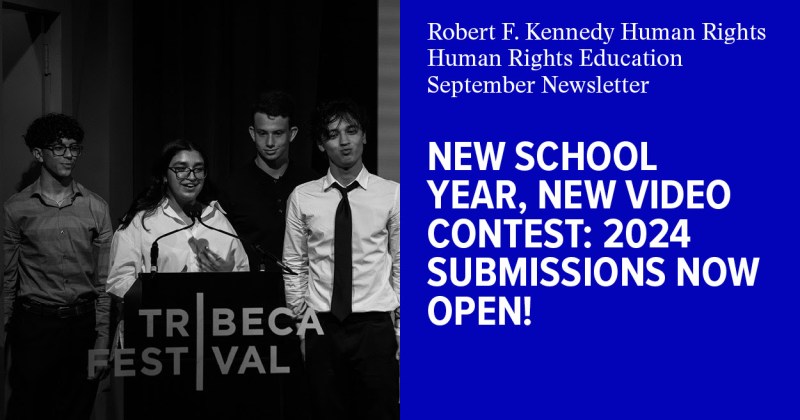
For more than ten years, students from around the world have submitted films that address the full spectrum of human rights issues through our Speak Truth to Power video contest. This year’s competition, in addition to the high school and middle school categories, will include a new category for post-secondary students. Contest submissions will close on April 26, 2024 at 11:59 p.m. EDT, and films will be judged by a panel of film industry experts, actors, and educators. Winning films will be featured at a special showcase in conjunction with the annual Tribeca Festival event in New York City.

LEARN MORE AND SUBMIT

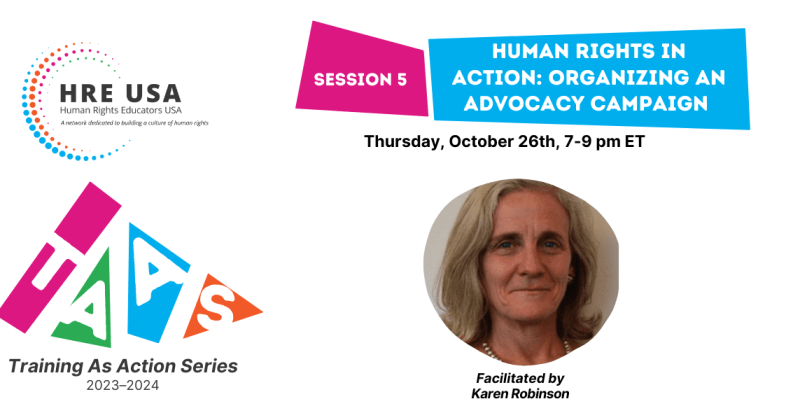
Training as Action Series (TAAS): Human Rights in Action: Organizing an Advocacy Campaign

Human Rights Educators USA’s annual Training as Action Series (TAAS) is a virtual training series focused on bridging personal and collective action on some of the most critical human rights issues of today. TAAS creates an educational space to connect and collaborate with others in human rights education and training. It also gives participants the skills and information needed to take action on rights issues in their communities. The 2023-2024 training series will celebrate the 75th anniversary of the Universal Declaration of Human Rights (UDHR) and center on the theme, “Protecting Democracy, Promoting Human Rights.” Sessions will discuss topics such as voting rights, facilitating difficult conversations, organizing an advocacy campaign, communicating with decision makers, protesting, and mental wellness.

Summary
Advocacy campaigns have the power to enact monumental human rights change. This module will help participants better understand the core elements of successful advocacy campaigns and better prepare them to start their own campaigns.

Objectives

  • Explore the role of advocacy campaigns in democracy and promoting human rights
  • Examine what an advocacy campaign is and prominent examples
  • Understand the key components of a successful advocacy campaign
  • Draft a bare-bones campaign plan on a chosen advocacy issue

TAAS Sessions:

  • Human Rights in Action: Organizing an Advocacy Campaign (Thursday, October 26th, 7-9 pm ET)
  • Communicating with Decision Makers: How to Contact Influential Figures (Thursday, November 2nd, 7-9 pm ET)
  • Protest and Beyond: Powerful Ways to Promote Your Message(Thursday, November 9th, 7-9 pm ET)
  • Finding Joy: Integrating Mental Wellness into Your Advocacy Strategies (Thursday, November 16th, 7-9 pm ET)

>> Learn more

>> Register