Do you know someone who has made a difference through Human Rights Education?
Do you know someone who has made a difference through Human Rights Education?


At HRE USA we believe human rights education is key to ensuring a future in which all people’s rights are respected, protected, and fulfilled.
Please consider supporting HRE USA today by becoming a member and joining the hundreds of individuals and organizations across the country who are united in the common mission to promote human dignity, justice, and peace through human rights education (HRE) within the United States.
Your tax-deductible annual membership contribution enables us to advocate for and further develop programming that supports human rights education across the United States. As an individual or organizational member, you have access to exclusive benefits including a FREE HRE Resource Pack, discounts, webinars, professional development, and more.
Join today and receive an extra two months of membership for free!
EVERYONE HAS THE RIGHT TO KNOW THEIR RIGHTS.
Already a member? Consider making a 100% tax-deductible donation today to help us ensure that everyone has the opportunity to develop the knowledge, skills, and values to fully exercise and protect the human rights of themselves and others.
We cannot do this work without YOU!
Thank you for all that you do to support human rights education and on behalf of everyone here at HRE USA, HAPPY HUMAN RIGHTS DAY!
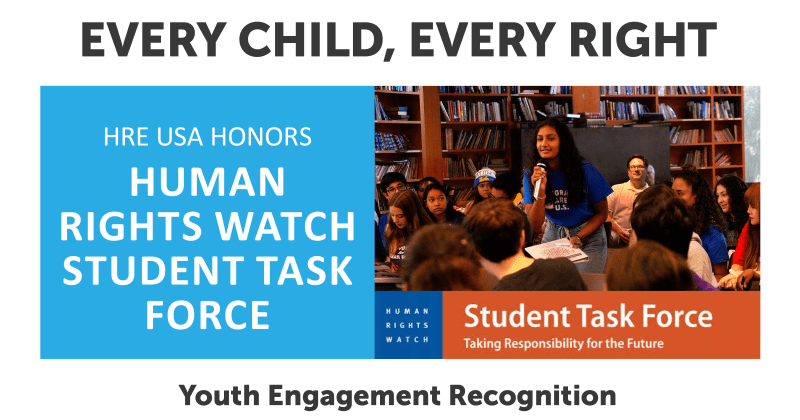
Human Rights Educators USA honors Human Right Watch’s LA-based Student Task Force (STF) with a special Youth Engagement Recognition. The youth leadership-training program, which engages high school students and educators from the Los Angeles area and empowers them to advocate for human rights issues, celebrates its 20th anniversary this year.
Human Rights Educators USA (HRE USA), a national network promoting human rights education in the United States, makes this award in commemoration of the 30th anniversary of the UN Convention on the Rights of the Child. HRE USA recognizes STF’s leadership in the promotion of children’s rights and its youth activism locally, nationally, and internationally. As STF Founder and Executive Director Pam Bruns said, “This recognition will mean so much to our teachers and students. It is a strong affirmation of our mission and the dedicated work by our LA youth.”
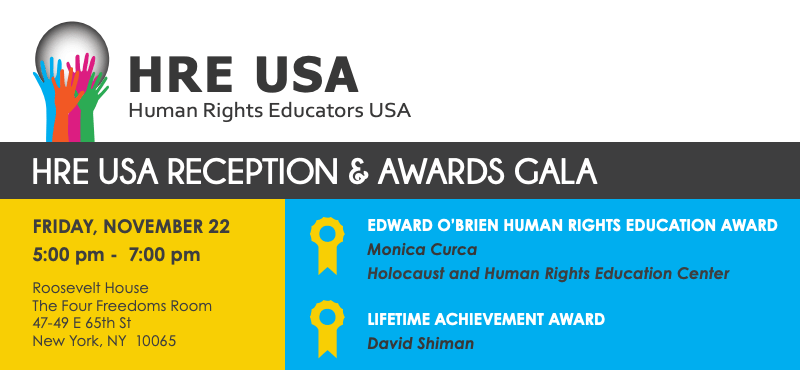
EVENT DETAILS:
When: Friday, November 22
Time: 5:00 pm – 7:00 pm
Where: Roosevelt House, The Four Freedoms Room, 47-49 E 65th St, New York, NY 10065
Cost: FREE
Human Rights Educators USA (HRE USA) cordially invites you to a reception to celebrate the 2019 winners of the Edward O’Brien Award for Human Rights Education: Monica Curca of Activate Labs and the Holocaust and Human Rights Education Center (HHREC). HRE USA will also recognize David Shiman with a Lifetime Achievement Award for his decades of dedication, innovation, and mentorship in advancing human rights education. >> Learn more about the 2019 O’Brien award winners
The program will begin at 6 pm. Please RSVP by November 20th
>> RSVP to the event
>> Download Invitation
This event is co-hosted by the University and College Consortium for Human Rights Education and the Roosevelt House Human Rights Education Program at Hunter College
The O’Brien Award was established in 2015 in memory of Edward O’Brien, pioneer human rights educator, to recognize both an individual and an organization that has made an outstanding contribution to human rights education in the United States.

As part of the Every Child, Every Right Campaign in celebration of the 30th anniversary of the Convention on the Rights of the Child (CRC), HRE USA invites you to upload and share a short video answering the question:
Please share any thoughts, actions, or ideas that will inspire others to promote children’s rights! Videos should be no longer than 2 minutes.
Every year, the Flowers Fund provides small grants to support innovation and mentorship in human rights education (HRE) in the United States.
>> Learn more
HRE USA is pleased to announce this year’s Grantees:
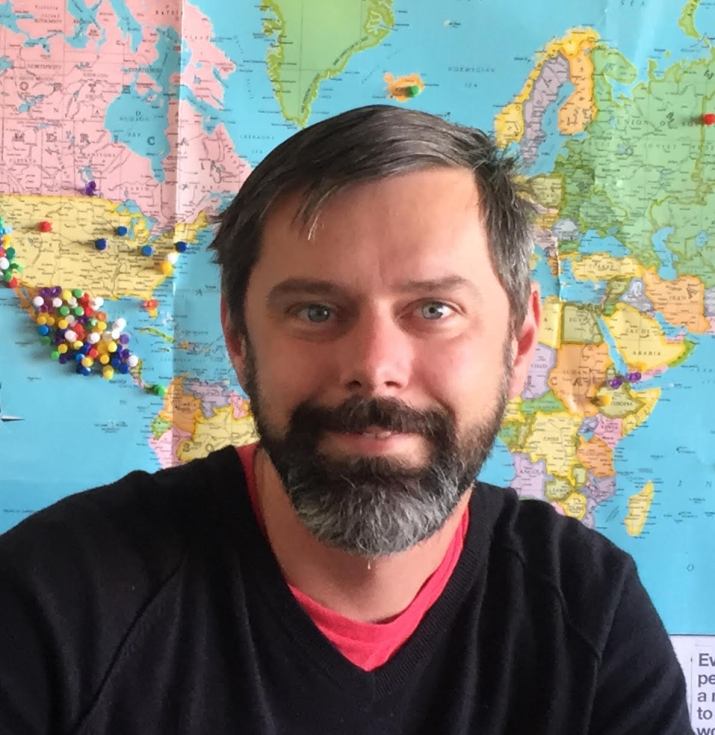
NATHAN EMBRETSON
Arroyo High School, San Lorenzo, CA
Project: Podcasting for Social Justice” with ELL students exploring issues of immigration, education, and child rights through personal narratives and interviews with community members and families.

BRIAN FARRELL
The University of Iowa, College of Law
Project: Workshop for college/university teachers from across the state of Iowa focused on integrating human rights into their curricula.

BAYARD NIELSEN
Notre Dame High School, San Jose, CA
Project: Transformation of interviews with day workers into bilingual narratives and superhero comic strips to be used to teach cultural differences and empathy.

SABRINA SANCHEZ,
Human Rights Connected, Washington, DC
Project: A youth-centered human rights podcast that will explore the intersections of civil resistance, artivism and the role of youth in movements.

We are excited to welcome Angelica Brooks as the new Regional Representative for HRE USA in Alabama

As the Founder and Director of The Silent Voices Project in Montgomery, Alabama, Angelica has significant experience with Criminal Justice and Human Rights. She focuses on missing persons cases, cold cases, advocating for Human Rights, and raising Human Trafficking Awareness. She currently is working on her first novel, Deeper than the Crime, which focuses on criminology and victimology within the African American Culture. Angelica also participates and is an active member of Rapid Response Teams that conduct immediate searches of missing children in the area. Her hope is that with all of these organizations working together that we will get that much closer to making this world a better place.
HRE USA is pleased to announce the winners of the 2020 Edward O’Brien Award for HRE.

The Convention on the Rights of the Child is 30! Find ways to celebrate, advocate, teach, and more!
Thirty years ago, on November 20th, world leaders adopted the UN Convention on the Rights of the Child (CRC) an international agreement on childhood. Now the most ratified of all international treaties, this historic commitment to the world’s children has radically transformed young lives across the globe. It sets out the rights that must be realized for children to develop to their full potential.
But still not every child gets to enjoy a full childhood. Still, too many childhoods are cut short. It is up to our generation to demand that leaders from government, business and communities fulfill their commitments and take action for child rights now, once and for all.

In honor of the 30th Anniversary, HRE USA has dedicated its latest edition of Human Rights Here and Now to the Convention on the Rights of the Child (CRC). We have also created an online toolkit of ready-to-use resources entitled, Every Child, Every Right! to help anyone learn and teach about the CRC!
To advocate for the rights of the child in the United States, HRE USA is also galvanizing support for U.S. ratification of the CRC through our CRC in the USA Campaign.
The Zinn Education Project (coordinated by Rethinking Schools and Teaching for Change) seeks to recruit a part-time Campaign Organizer to design the next phase for the Teach Reconstruction Campaign. The length of the contract may be up to 12 months.
To date, the Teach Reconstruction Campaign has engaged thousands of classroom teachers across the U.S. in teaching about Reconstruction (the period between abolition and Jim Crow) with resources beyond the limited scope of textbooks and traditional curriculum. The next phase of the campaign is to extend these efforts to the policy level.
The campaign organizer will design and help implement the second phase of the Reconstruction Campaign in coordination with Zinn Education Project co-directors and staff.
 HRE USA