Two new episodes with Rosemary Blanchard on Human Rights Education NOW!

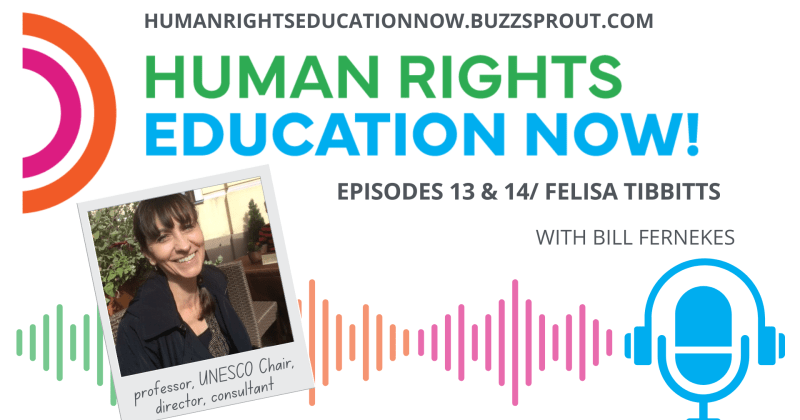
We are pleased to announce the availability of our fourth installment of podcast episodes in Human Rights Education NOW!. These two episodes feature conversations with Rosemary Blanchard. She is Professor Emeritus at California State University Sacramento and a long-time member of HRE USA. She has a Ph.D. in Educational Policy (University of Illinois, 2001), a J.D. (University of Connecticut School of Law, 1972) and an M.A. in Sociology (Johns Hopkins U., 1972).  

Full topic listing available for PDF download HERE. Listen on our Buzzsprout podcast website HERE.

Episode 7: Rosemary Blanchard Part One

In Episode 7, Rosemary Blanchard discusses her early interest in human rights issues and the importance of HRE in early education. She shares her background in civil rights law, and how witnessing extreme poverty on a trip to Brazil was transformative in shaping her views on HRE. She shares how working with the Navajo Nation as a policy analyst helped her to better understand international human rights frameworks, and how assimilation through education is a problematic issue in Navajo education. Rosemary then explains her views on the role of American exceptionalism in hampering HRE’s advance in the US. Rosemary discusses the NCSS HRE Community’s role in advancing HRE; its connections to humanitarian law; the lack of domestic understanding of international human rights in the USA; the impact of Abu Ghraib torture on her work in HRE; and the contradictions between US ideals and practices at Abu Ghraib. Finally, Rosemary shares her belief in the significance of building civil society on respect for human dignity.

Topics discussed:

  • Importance of HRE in early education
  • Civil rights law and extreme poverty as it relates to HRE
  • Navajo Nation and connections to HRE
  • American exceptionalism and its hampering of HRE
  • NCSS role in advancing HRE 
  • Abu Ghraib and contradictions between US ideals and practices
  • Significance of building society based on respect for human dignity


Episode 8: Rosemary Blanchard Part Two

In Episode 8, Rosemary Blanchard continues her discussion on the role of the NCSS Position Statements on HRE; connections between NCSS work and Civic Education coalition; and the problem of eroding civics education in K-12 spaces. Rosemary touches on overcoming the perception that human rights Issues are only “over there,” and the problem of examining human rights as a zero-sum challenge. Rosemary shares her views on avoiding the demonization of opposing views, and the importance of the Council of Europe’s work on democracy and human rights. She goes on to discuss the book chapter she co-wrote with Sandy Sohcot in Mindful Social Studies, and the effectiveness of helping young children create a powerful human rights culture. Rosemary shares her most influential role models in HRE – Nelson Mandela and Thích Nhất Hạnh. Finally, Rosemary shares her belief that HRE should be required in all curriculum standards, at all grade levels and how this belief was influenced by the work of Lawrence Senesh.   

Topics discussed:

  • NCSS Position Statements on HRE
  • Connections between NCSS work and Civic Education Coalition
  • Eroding civics education in K-12 spaces
  • Overcoming the perception that human rights Issues are only “over there”
  • The problem of examining human rights as a zero-sum challenge
  • Council of Europe’s work on democracy and human rights
  • Book chapter in Mindful Social Studies
  • Nelson Mandela and Thích Nhất Hạnh 
  • Work of Lawrence Senesh

CALL FOR NOMINATIONS: 2023 Edward O’Brien Human Rights Education Awards

Human Rights Educators USA (HRE USA) invites nominations for the 2023 Edward O’Brien Human Rights Education Awards. These awards were established in memory of Ed O’Brien, pioneer human right educator and valued member of HRE USA who died suddenly in 2015.

There are two awards annually. One recognizes an individual who has made an outstanding contribution to human rights education in the United States. The other honors an organization, institution, or program that has made a similarly outstanding contribution to human rights education in the United States. Please review descriptions of past winners on this page.

The 2023 Edward O’Brien Human Rights Education Awards will be presented on International Human Rights Day, December 10, 2023.

CALL FOR NOMINATIONS2023 Edward O’Brien Human Rights Education Awards

Edward O’Brien Human Rights Education Award Nomination Form

Deadline for nominations is September 15, 2023.

May 25-31 is International Week of Solidarity with the Peoples of Non-Self-Governing Territories

May 25-31 is International Week of Solidarity with the Peoples of Non-Self-Governing Territories. The related Declaration urges the administering Powers concerned to take effective measures to safeguard and guarantee the inalienable rights of the peoples to their natural resources, including land, and to establish and maintain control over the future development of those resources.

Two key resources about UN efforts to promote decolonization include Ten Frequently Asked Questions https://hrea.org/…/ten-frequently-asked-questions-on…/ and an infographic on the work of the UN Special Committee on Decolonization. https://hrea.org/…/infographic-special-committee-on…/

Human Rights Education Associates (HREA)‘s Online Resource Center contains resources for teaching about the rights of Indigenous peoples. Visit: https://hrea.org/searchbykeyword/… We hope that you will take time to explore these resources!

May 22: International Day for Biological Diversity

In 1993, the United Nations proclaimed May 22 the International Day for Biological Diversity (IDB) to increase understanding and awareness of biodiversity issues. According to UNESCO:

Biodiversity is the living fabric of our planet. It underpins human wellbeing in the present and in the future, and its rapid decline threatens nature and people alike. The main global drivers of biodiversity loss are climate change, invasive species, over-exploitation of natural resources, pollution and urbanization.

The COVID-19 pandemic is a key example of why biodiversity is critically important. In an article we recommend from ProPublica, How Climate Change Is Contributing to Skyrocketing Rates of Infectious Disease, environmental reporter Abrahm Lustgarten explains,

The warming of the climate is one of the principal drivers of the greatest — and fastest — loss of species diversity in the history of the planet, as shifting climate patterns force species to change habitats, push them into new regions or threaten their food and water supplies. What’s known as biodiversity is critical because the natural variety of plants and animals lends each species greater resiliency against threat and together offers a delicately balanced safety net for natural systems. As diversity wanes, the balance is upset, and remaining species are both more vulnerable to human influences and, according to a landmark 2010 study in the journal Nature, more likely to pass along powerful pathogens.

Also, listen to the interview with Ed Young on Democracy Now!, “We Created the Pandemicene”: Ed Yong on How the Climate Crisis Could Spark the Next Pandemic.

This is why we have a campaign to Teach Climate Justice. We offer free lessons and recommendations of books, films, and readings for K-12 classrooms. Young people around the world are organizing to demand an end to the policies and practices that are causing climate change, such as Zenile Ngcame of Masiphumelele High School and her peers who protested for action against climate change outside Parliament in Cape Town in 2019.

More classroom resources

The 22nd Century Conference

The 22nd Century Conference welcomes frontline activists and organizers, researchers, communicators, network weavers, narrative strategists, academics, elected officials, and donors who are confronting U.S. authoritarianism and white nationalism. The conference creates space for networking and organizing, as we build capacity, infrastructure, and resilience for our work ahead. 

July 6-9, 2023, Minneapolis, MN (and limited online access) 

>> Learn more and register

Amnesty International online courses to combat gender-based violence

Human Rights Education Amnesty International team offers two new online courses to combat gender-based violence.

The first course, “Combatting Gender-based Violence Online,” takes approximately 90 minutes to complete and is available in English, French, Spanish, Italian, and Polish. It covers the impact of technology on gender-based violence and the importance of creating safe and inclusive online spaces. https://academy.amnesty.org/…/combating-gender-based…

The second course, “Confronting and Countering Gender-based Violence,” takes approximately 90 minutes to complete and is available in English, French, Spanish, Hungarian, Slovenian, and Polish. Through real-world examples and interactive activities, learners will explore the root causes, impacts, and consequences of gender-based violence. https://academy.amnesty.org/…/confronting-and…

Both courses are free and accessible to learners of all backgrounds and experience levels.

 Summer Institute for Climate Change Education 

The Summer Institute for Climate Change Education returns virtually July 17–21 for a week of professional development around climate change education. We already have climate justice leaders planning workshops around storytelling and the intersection of Indigenous ecological knowledge and climate science. Registration is open now, with scholarships available to support educators needing financial assistance to attend.

Date: Three days during the week of July 17-21, 2023
Times: 10am CT to 6pm CT on July 17 & 18, may vary by cohort
Location: Virtual, may vary by cohort — more information about cohort day schedules available on the registration page.
Cost: $250 (may vary by cohort)
Attendees may apply for up to 20 continuing education credits.

LEARN MORE AND REGISTER

Bonus: Minnesota teachers are invited to participate in one of three TeachScience workshops happening this summer in the Twin Cities, Mankato, and Grand Rapids. Gain resources for teaching climate change, network with other educators and green career professionals in their community, and experience place-based learning practices that support new MN science standards. Learn more and register!

Human Rights Cities Leadership Summit

Human Rights Cities Alliance, Southern Center for Human Rights, Southern Poverty Law Center, Organization for Human Rights and Democracy, American Friends Service Committee-South Region

The Human Rights Cities Leadership Summit will take place in downtown Atlanta Georgia from May 18-21. Following the city’s recent passage of a resolution naming Atlanta the newest U.S. Human Rights City, Atlanta civil society and partners, along with supportive City Council members invite community activists, policy practitioners, legal experts, youth, and municipal leaders to come together to share ideas, lessons, and tools for promoting human rights in cities and communities. Now more than ever, cities need innovative ideas and strategies to address problems of affordable housing, community safety, climate change, racial and gender inequities, and reparatory justice. Learn how cities around the world are using international human rights law and institutions to shape local policies, with powerful impacts at the local level. Plenaries and breakout sessions will provide opportunities to learn, exchange and network. 

May 18-21, 2023, Atlanta, Georgia

>> Register

The UN Human Rights Council Training Programme is open for applications

The United Nations Institute for Training and Research (UNITAR) is now offering the June and September editions of the Human Rights Council Training Programme. This course will run online, in parallel with the official UN Human Rights Council in Geneva.

The deadline to apply for the June Edition is 1st June 2023, and for the September Edition, it is 7th September. For more information, please visit UNITAR’s official website.

>> Learn more