International Journal of Human Rights Education: Call for Special Issue Article Proposals

Queering Human Rights Education: Research, Praxis and Liberation for LGBTQIA2S+

>> Details and submission information
Guest Editors: David Donahue, Maria Autrey Noriega Lori Selke, Mauro Sifuentes
Description: This special issue of the International Journal of Human Rights Education (IJHRE)
queers human rights and human rights education, drawing on the multiple definitions of queer:
as a noun, adjective, and verb. As a noun, queer is an umbrella term for members of the
lesbian, gay, bisexual, transgender, queer/questioning, intersex, asexual/aromantic/agender,
two spirit (LGBTQIA2S+) community, with the plus sign in the acronym holding space for new
and expanding understanding about identity related to sexuality and gender. As an adjective,
queer speaks to departing from the norm, differing from expectations regarding sexual
orientation, gender identity and expression, and sex characteristics (SOGIESC). As a verb, queer
refers to challenging all that is considered normal and natural. Queering is about troubling
power and replacing binary thinking with more complex, fluid ways of understanding.
In keeping with these multiple definitions, the editors of the special issue seek articles that are
about the human rights desires and celebrations of LGBTQIA2S+ people as well as the
challenges and contestations of those rights. In addition, we seek articles that challenge
normative thinking about human rights and HRE, particularly in terms of gender and sexuality
and that trouble what it means to teach and research in the field of human rights. We welcome
scholarship that not only expands what we know but questions, challenges, and complicates
how we come to know something and why we think it is valuable. We are especially interested
in articles that:

  • Draw on, critique, extend, and operationalize the Yogyakarta Principles and Principles
    Plus Ten as part of HRE
  • Center trans perspectives and experiences at this moment of social and state-
    sanctioned violence and oppression against trans persons
  • Balance queer joy, desire, and creativity with the oppression, harm, and marginalization
    of LGBTQIA2S+ persons
  • Focus on practices and embodiments of queer liberation, including spaces where the
    rights of queer youth, advocates, and educators thrive
  • Employ queer theory, including queer futurity and temporality, to examine the
    assumptions and logic of education, including human rights education.

Scholars, teachers, community organizers, advocates, artists, and all other thinkers and doers,
including youth, are invited to submit proposals for empirical, theoretical, and reflective articles
that queer/are queering/have queered (but are not limited to) human rights and education.
We welcome contributions looking inside and outside of the classroom, across all global
settings, from early childhood, primary, and secondary education to higher education, adult
education, and immigrant/refugee education and their intersections with HRE curriculum and
educational materials; HRE pedagogy and practices; HRE community and spaces; HRE history
and scholarship; and/or HRE advocacy and policy. Visual art, poetry, and creative nonfiction are
welcomed as well as texts grounded in social science. We also seek book reviews, including
reviews focused on trade books and children’s literature, as well as scholarly texts, focused on
SOGIESC.
Proposal Guidelines: Email proposals to lead editor, David Donahue, at ddonahue@usfca.edu.
Proposals are due April 10, 2024. Authors will be notified of decisions within four weeks (by
mid-May) of the deadline. First manuscripts will be due September 1, 2024. Research articles
(6000-9000 words) are empirically-based works or original conceptual contributions. The
Pedagogy, Community, and Praxis section includes community-based commentaries, emerging
themes and ideas from empirical research, community-based work that may not be completed,
and creative works (3000 words maximum). In this special issue, such pieces may highlight the
work of queer/trans community members and/or leaders who may not be engaged in empirical
studies but whose ideas are grounded in queer(ed) thinking. Authors are instructed to follow
the IJHRE author guidelines available at:
https://repository.usfca.edu/ijhre/styleguide.html.
Article proposals should be in 12-point font and brief; descriptions should not exceed 500
words (including citations; references are not required for this stage). Please discuss the
research topic and how the work relates to the major components of this issue outlined in this
call for proposals. In addition, please include the working title of the article, the type of article
(Original Article; Pedagogy, Community & Practice piece; or book review, see here for
descriptions), name and affiliation of the author(s), and contact information for the
corresponding author (email and mailing address). Please send proposals in Word or PDF
format.
The special issue is aiming for publication in Spring 2025. IJHRE is a fully peer-reviewed and
open access, online journal; open access for all readers worldwide and regardless of
institutional affiliation is a central factor in the editors’ decision to work with this journal. To
date, articles in the journal have been downloaded nearly 60,000 times from more than 180
countries.
About the Special Guest Editors:
David Donahue (he/him) is a passionate advocate of queering curriculum and creating space for
LGBTQ+ students in schools. Currently, he is Professor of Education at the University of San

Francisco in the International and Multicultural Education department. Before coming to USF in
2015, he was a professor and administrator at Mills College. He is the author of articles,
chapters, and presentations on LGBTQ+ topics and co-author of the report Making the
Framework Fair (2014) which recommended changes for LGBTQ+ inclusion in the California
History-Social Sciences Framework for K-12 students in public schools.
Maria Autrey (she/they) is a queer immigrant educator and activist from Mexico with over a
decade of experience in teaching and facilitating experiential learning for High School and
College students. Maria’s research focuses on liberatory sexuality education, exploring the use
of critical pedagogy in non-formal grassroots projects to foster social change through the
promotion of radical acceptance, and erotic embodiment. Maria completed their doctorate in
International and Multicultural Education at the University of San Francisco and currently
serves as the Associate Director of Community Engaged Learning at Santa Clara University.
Lori Selke (she/they) is a doctoral candidate in the University of San Francisco Department of
International and Multicultural Education and an Assistant Managing Editor at the International
Journal of Human Rights Education (IJHRE). She co-edited the final edition of The Black Book, a
landmark directory of alternative sexuality resources, and co-curated the performance series
Perverts Put Out!, which was in its time San Francisco’s longest-running spoken-word
showcase. Her non-academic writing has appeared at Curve, Girlfriends, and NPR as well as in
numerous queer anthologies.
Mauro Sifuentes (any/all pronouns) is a scholar-educator whose academic work focuses on
decolonial queer and trans studies in education. He has spent over two decades working as an
LGBTQ+ advocate in public education systems across California, bringing queer-of-color and
queer Indigenous perspectives into student and youth advocacy and leadership development.
Mauro’s work prioritizes critical pedagogical experiments, political and human rights education
with youth, and community-informed feminist research methodologies.

Timeline
April 10 – 500 word abstracts due
May 15 – decision letters sent
Sept 1 – first versions of articles due
October 1 – reviews from peers
November 15 – revised articles due
March/April 2025 – launch of special issue

The Inaugural Human Rights Lecture: Human Rights in a Fractured World

Thu, 2 May 2024 11:30 – 12:30 GMT-5

This event is happening in person and online. This Eventbrite page is for booking online only.

If you wish to attend in person at Kellogg College please use the link below:

The Inaugural Human Rights Lecture: Human Rights in a Fractured World Tickets, Thu 2 May 2024 at 17:30 | Eventbrite

Join President Professor Jonathan Michie and Fellows online as we welcome Bynum Tudor Fellow Ban Ki-moon to Kellogg to deliver the Inaugural Lecture in a new annual series of Kellogg Lectures on Human Rights . This year’s lecture is titled ‘Human Rights in a Fractured World‘.

Ban Ki-moon’s ten years as Secretary General to the United Nations was marked by many successes. Throughout, he strove to enhance human rights globally. Indeed, Ban Ki-moon’s other successes – such as the Sustainable Development Goals, establishing UN Women, and the Paris agreement to limit the rise in global temperature to 1.5 degrees celcius – can all be seen as enhancing human rights broadly defined. The Sustainable Development Goals promote the whole range of economic and social rights. UN Women “is the UN organization delivering programmes, policies and standards that uphold women’s human rights”. And the climate crisis threatens the rights of millions, most immediately those who will be displaced, and those facing famine and disease as a result of climate change. Ban Ki-moon will reflect on the urgent need to defend and promote human rights, and will place this in the broader context of the need to promote women’s rights, pursue the Sustainable Development Goals, and tackle the climate crisis.

Professor Jonathan Michie, President of Kellogg College will chair the event.

You will be sent a link to watch the talk nearer to the event date.

Should you have any further queries, please contact events@kellogg.ox.ac.uk

New Issue: Rethinking Schools Magazine: Teach Palestine

The spring issue of Rethinking Schools focuses on Israel’s war on Gaza and the war on teaching about Palestine.

The editorial discusses how the attack on social justice teaching has expanded as part of the crackdown on dissent against U.S. support for Israel. Bill Bigelow draws on his Zinn Education Project “Teaching the Seeds of Violence” activity to argue that anti-Zionism is not automatically antisemitism. Jesse Hagopian traces connections between the war on history, education, and children in both countries. Oakland educators detail the story of what happened when they organized a teach-in for Palestine. A Palestinian student shares her experiences in the aftermath of Oct. 7, and the issue includes Naomi Shihab Nye’s poem, “Before I Was a Gazan.”

This issue also includes Cierra Kaler-Jones’ reflections on how to replace a pedagogy of control in teaching dance with one that encourages creativity and liberation. A Chicago educator discusses a new curriculum on the Young Lords. And more. Subscribe to Rethinking Schools.

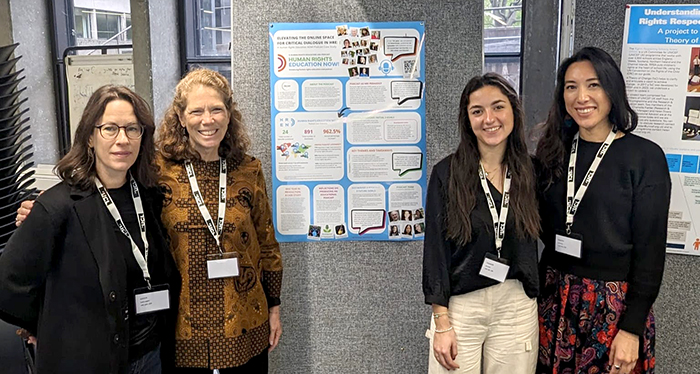
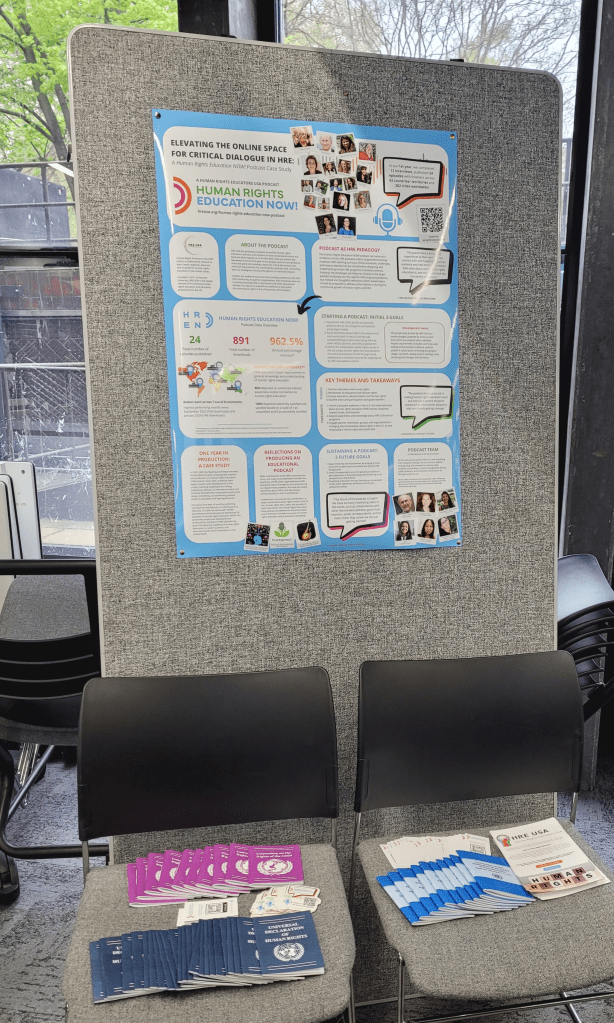
Episodes 27 & 28 with Maria Hantzopoulos are available on Human Rights Education NOW!

We are pleased to announce the availability of our latest installment of podcast episodes in Human Rights Education NOW! Episodes 27 & 28 feature conversations with  Maria Hantzopoulos. Maria Hantzopoulos earned her B.A. from Boston University in History, her M.A. in Social Studies Education from Teachers College, Columbia University and her doctorate at Teachers College in International Educational Development. Her work broadly considers how educational processes structure inequity in their contexts and beyond. Her research interests include school culture and climate, project-based assessment, peace and human rights education, migration and education, and social studies curricula. She is the author of the book Restoring Dignity: Human Rights in Action (Teachers College Press, 2016).   

Episode 27: Maria Hantzopoulos, Part One

In Episode 27, Maria Hantzopoulos discusses her origins of interest in human rights and human rights education, as well as her entry into public school teaching and her advocacy of social justice pedagogy. She then shares her practices of HRE and peace education in her teaching, and the importance of critiquing mainstream narratives. Next, Maria discusses her involvement in the doctoral program at Teachers College, Columbia University, and the importance of Paolo Freire’s work on critical consciousness. Maria then goes on to describe what she views are the challenges of educating teachers to act as transformative agents of change. Lastly, Maria explains Henry Giroux’s concept of schools as contested spaces.

Topics discussed:

  • Origins of interest in human rights and human rights education
  • Entry into public school teaching 
  • Advocacy of social justice pedagogy 
  • Practice of HRE and peace education in teaching
  • Importance of critiquing mainstream narratives
  • Involvement in doctoral program at Teachers College, Columbia University
  • Paolo Freire’s work on critical consciousness
  • Challenges of educating teachers as transformative agents  
  • Henry Grioux’s concept of schools as contested spaces 

Full topic listing available for PDF download HERE.

Listen on our Buzzsprout podcast website HERE


Episode 28: Maria Hantzopoulos, Part Two

In Episode 28, Maria Hantzopoulos discusses her work with non-governmental organizations, as well as her work in designing curriculum, which deals with human rights. Maria then shares what she views are challenges to mainstream narratives in global history, and the idea of curriculum interventions as contested spaces. She emphasizes the intersections of HRE and peace education, as well as the challenges of meeting students who have skill deficits. Next, Maria talks about the relationships between HRE and social justice and the development of a critical consciousness, as well as the heightened emphasis on decolonial education. Maria then describes the importance of using human rights language and concepts when addressing social change movements in the US, along with highlighting the Universal Declaration of Human Rights (UDHR) as a tool with young people. Maria shares influential role models for her work in human rights education and a significant quote, which guides her work in HRE.

Topics discussed:

  • Work with non-governmental organizations
  • Work designing human rights curriculum 
  • Challenges to mainstream narratives in global history 
  • Curriculum interventions as contested spaces
  • Intersections of HRE and peace education 
  • Challenges in meeting students’ needs who have skill deficits 
  • Relationship between HRE and social justice 
  • Development of critical consciousness
  • Heightened emphasis on decolonial education
  • Importance of using human rights language and concepts in social change movements
  • UDHR as tool to use with young people
  • Influential role model and significant quote  

Full topic listing available for PDF download HERE.

Listen on our Buzzsprout podcast website HERE.

📢 For Listeners: Moving from Google Podcasts to YouTube Music in April

  • Google Podcast will be discontinued on April 2, 2024.
  • We will move all our episodes onto YouTube Music. 
  • All previously published episodes will remain available on Apple Podcasts,Spotify, Overcast, Pocket Casts, Deezer, and PlayerFM. 

Thank you for supporting the Human Rights Education NOW! podcast!

Textbook critique: Does Your Textbook Lie About Reconstruction?

Last spring we posted Five Ways Textbooks Lie About Reconstruction by Mimi Eisen.

Eisen examined commonly used U.S. history textbooks. The first of five themes she found is that textbooks center Confederate states and ex-Confederates.

A contemporary textbook asks students to imagine themselves as former Confederate soldiers traveling the South and witnessing, with dismay, the destruction of “plantation manor homes.”

Textbooks encourage students to view Reconstruction from the perspectives of those who fought to preserve enslavement.
See more themes and textbook examples, and read our full national report, Erasing the Black Freedom Struggle.
Send us examples from YOUR history textbooks.
Invite students to read the article and examine their textbook. Send us what they find and in appreciation, we’ll highlight their work as textbook detectives and send you a signed copy of Black Was the Ink for your classroom.
Textbook Critique

Silenced Perspectives: The Unequal Effects of Censorship Across Communities

Friday, April 12 · 11am – 12pm CDT

Online event

Get free tickets

Freedom of expression is a fundamental human right. Free Speech is protected in our constitution. Yet, censorship runs rampant – particularly with the advent of social media and the increasing accessibility of expression online. This series has covered various topics ripe for censorship, including sexual expression and freedom. However, content is not the only victim of censorship, as it often affects the speakers and creators of said content differently. BIPOC and LGBTQIA+ individuals often report higher rates of censorship. This month, we’re discussing inequity in censorship practices. Jamila Aisha, Advocate & Educator, will join Mandy Salley to discuss discrimination in censorship. This is a long overdue conversation that you don’t want to miss.

ASL Interpretation will be provided.

Free Webinar: Women, War, and Citizenship: Exploring Diverse Perspectives

The Center for Civic Education invites you to attend “Women, War, and Citizenship: Exploring Diverse Perspectives,” a free webinar cohosted by the Center and the American Battlefield Trust this Wednesday, March 27, at 7 p.m. ET. The webinar will provide teachers with a comprehensive understanding of women’s pivotal role during the Civil War.
By highlighting their involvement in the suffrage movement and the passage of the 19th Amendment, this program will help teachers appreciate the historical significance of women’s contributions to the development of American democracy.
Register to receive the webinar link. Don’t miss out on this unique opportunity! Register for the Webinar

Salem State University & HRE USA: Children Around the World: Finding Hope in Times of Despair 

The world can be a challenging place for children. This conference will celebrate the courageous efforts that are occurring around the world to improve the provisions, protections, and participation of young people. You will be introduced to people whose work gives us hope.  They shine light the way ahead during these times of despair. We hear plenty about despair and not enough about hope and the wonderful things people are doing to make the lives of young people better.

This is a free, open to the public virtual conference. CEUs are available upon request.

This conference is an educational opportunity provided by the SSU Center for Childhood & Youth Studies.

April 5, 2024 – Starts at 8:30 am ET, virtual

>> Learn more and see schedule
>> Register 

Zinn Education Project: Teaching the Seeds of Violence in Palestine-Israel [New Lesson] 


The historian-activist Howard Zinn was fond of saying, “If you don’t know history it is as if you were born yesterday. And if you were born yesterday, anybody up there in a position of power can tell you anything, and you have no way of checking up on it.”

There is nothing in the world today more in need of an accurate historical account than the violence in Palestine-Israel — or more infected with obfuscation. Many people’s historical reckoning seems to go back no further than October 7, 2023. Even those more committed to understanding the present in terms of the past often reach back only to the Six Day War and occupation in 1967 or the UN partition of Palestine in 1947 and the 1948 War for Independence — for Israelis — or the Nakba, the Catastrophe — for Palestinians. Or they may simply say: It began with the Holocaust.

>> Access lesson
>> Access additional resources on teaching about violence in Palestine and Israel

Salem State University & HRE USA: Children Around the World: What We Are Doing to Improve Their Lives 

Around the world, young scholars are focusing their work on research that is designed to change the world for the better. The Fellow at Salem State University Center for Childhood and Youth Studies will share their cutting-edge ideas! This conference focuses on diversity and inclusion, particularly in families, schools, education, criminal justice, and in the challenges that refugee children face.

This is a free, open to the public virtual conference. CEUs are available upon request.

This conference is an educational opportunity provided by the SSU Center for Childhood & Youth Studies.

March 29, 2024 – 8:30 am – 4 pm (ET), virtual

>> Learn  more and see schedule
>> Register