Learning for Justice: A Webinar On Supporting Youth Activism

Register today to attend our next webinar —Supporting Youth Activismset for this Tuesday, April 16, at 3:30 p.m. CT! Join Learning for Justice, along with a diverse group of panelists from academia to organizational leaders to current young people who are working to affect change in their communities.

You will learn about youth activism, including both its history and present day realities, as well as how to address pushback. Through real world examples, you will gain tools, resources, and insights for supporting young people as they engage in activism in their communities. You won’t want to miss it! 

Here’s information about the webinar panelists:

  • Anoushka Lal is a high school senior from the Chicago Public School System and serves as her school’s Student Government president. Anoushka was previously the Public Health Chair of the Chicago Mayor’s Youth Commission at City Hall, working with two mayoral administrations to address the pressing needs of city youth, including mental health and resource consolidation for over 340,000 public high school students. She currently serves as a Civil Rights Scholar at the Chicago Public School District, countering bias-based harm, and has written socio-political Op-Eds in magazines like Teen Vogue to represent the voices of her generation.
     
  • Sara O’Brien is the Director of Curriculum and Pedagogy for the EdEthics initiative, which is housed at the Harvard Graduate School of Education and Edmond & Lily Safra Center for Ethics. In this role, she creates pedagogical tools that help educators, school and district leaders, and policy makers think through challenging ethical questions in education. A variety of these tools help educators unpack the challenges of supporting student-led activism in schools and provide resources for those adults looking to serve as allies and promote youth voice in schools.
     
  • Tamir Harper co-founded UrbEd Inc., a nonprofit that combines community organizing and policy to uplift students, educate communities, and develop coalitions to give students the education they deserve, at 16 years old. He is currently pursuing a Master’s in Education from the University of Pennsylvania and teaching 8th-grade students English and Social Studies in the School District of Philadelphia. Harper is a graduate of American University and an awardee of the Frederick Douglass Distinguished Scholars Program. 
     
  • Justin is an associate professor of digital media in the Comparative Media Studies/Writing department at MIT and the director of the Teaching Systems Lab. He is the author of “Iterate: The Secret to Innovation in Schools” and “Failure to Disrupt: Why Technology Alone Can’t Transform Education”, and he is the host of the TeachLab Podcast. He has helped to develop numerous online courses including Youth In Front: Understanding and Supporting Student-Led Activism.

J78 International Association for Human Rights Education Annual Conference 2024

Date of Event19th April 2024

Last Booking Date for this Event19th April 2024

More information

Description

The International Association for Human Rights Education (IAHRE) was established in June 2023 at the 15th International Conference for Education and Democratic Citizenship (ICEDC) held at University College Dublin. Its goal is to support the development of human rights education research, scholarship and practice internationally. IAHRE has its own scholarly journal, the award-winning Human Rights Education Review, founded in 2018.  

The ICEDC annual conference was set up as a meeting place for scholars, researchers, graduate students, education policymakers, and civil society activists from across Europe and internationally. Since 2019, it has been complemented by the WERA International Research Network on Human Rights Education, coordinated by Professors Audrey Osler and Hugh Starkey which in collaboration with Human Rights Education Review has run an international webinar series. The IAHRE International Conference aims to build on this experience, providing all with a unique opportunity to present and discuss current research and policy relating to human rights education and to questions of human rights within education.

Attendee CategoryCost   
1) Membership of IAHRE.£50.00Book Event[Read More]
2) Conference Registration IAHRE Members.£220.00Book Event[Read More]
3) Conference Registration Non Member.£250.00Book Event[Read More]

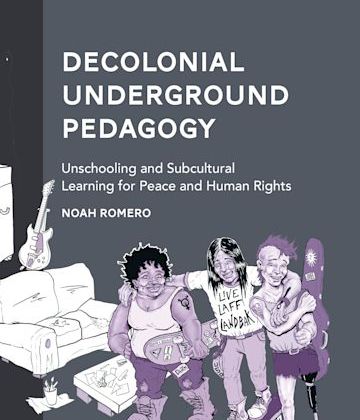
Book announcement: Decolonial Underground Pedagogy: Unschooling and Subcultural Learning for Peace and Human Rights

This book explores how minority-led skateboarding, punk rock, and unschooling communities engage in collective efforts to humanize education and construct kinder social frameworks. Noah Romero examines the roles of informal and community-embedded learning in actualizing transformative education and shows how decolonizing education can take place outside of school settings.

Grounded in the author’s own experience in minority-led Filipino subcultures, the book introduces a conceptual framework of subcultural learning and decolonizing education centred on the Philippines and its diaspora in Australia, New Zealand, and the United States. Romero argues that educational paradigms with peace, human rights, multiculturalism, social justice, and decolonization at the centre can extend beyond the classroom, curriculum, and teaching and into communities. By showing how minoritized people are redefining identity and knowledge through embodied community-responsive pedagogies, the book contributes to wider debates on Indigeneity, gender justice, human rights, peace studies, and decolonizing education.

Preorder now (it’s out in August), request for your library (a more affordable paperback will follow likely in 2025).

American Civic Education Teacher Awards: Great civics teachers deserve to be recognized!

At the Center for Civic Education, we believe that great civics teachers deserve to be recognized. That’s why we created the American Civic Education Teacher Awards along with the Center on Representative Government at Indiana University and the National Education Association.
Apply by May 1 for this prestigious award and have the chance to speak to a national audience at the National Council for the Social Studies Annual Conference in Boston this November. Winners will also be recognized by civic education leaders from around the country.

Three winners will be selected from among the pool of qualified candidates. You can read more about past winners on our ACETA webpage and watch a podcast interview with two of this year’s winners, Kimberly Huffman and Allison Sheridan.

Apply now!

Election Protection Administrative Assistant

The Lawyers’ Committee for Civil Rights Under Law is one of the nation’s leading national racial justice legal organizations. Formed in 1963 at the request of President John F. Kennedy, the Lawyers’ Committee uses legal advocacy to achieve racial justice, fighting inside and outside the courts to ensure that Black people and other people of color have the voice, opportunity, and power to make the promises of our democracy real.

The Lawyers’ Committee convenes the National Election Protection Coalition— the nation’s largest and longest-running nonpartisan voter protection effort, which works throughout the year to provide information, resources, and assistance to voters who have questions about the voting process or encounter barriers to the ballot box, with a focus on communities of color that voter suppression efforts have historically disenfranchised. In addition, the Lawyers’ Committee administers the 886-OUR-VOTE Hotline and provides programmatic support for state and national partners. The Lawyers’ Committee seeks an Administrative Assistant to support our Election Protection program.

The Administrative Assistant will support the Election Protection team, consisting of the Voting Rights Project Co-Directors, the National Director of Campaigns and Field Programs, the National Coordinators, and the Hotline Infrastructure team.

This is a full-time, exempt position based in Washington, DC. The Election Protection Administrative Assistant will work under the supervision of the National Director of Campaigns and Field Programs.

Specific Duties and Responsibilities:

Essential responsibilities of the Election Protection Administrative Assistant include but are not limited to the following:

  • Provide administrative support to the Election Protection team;
  • Provide administrative support to the Election Protection Steering Committee, including, among other tasks, scheduling meetings and taking notes;
  • Serve as an administrative point of contact for the Election Protection program for external partners, internal lawyers, and Coordinators;
  • Manage Election Protection and Voting Rights Strikeforce listservs and Working Group lists;
  • Manage internal and external EP partner orders and payments for Election Protection field materials;
  • Report back to Lawyers’ Committee staff, including Coordinators, on Steering Committee needs and agenda items follow-up;
  • Support maintenance and provide requested updates to the EP websites and social media platforms;
  • Support the creation and finalizing of Election Protection public education and other written materials, and assist with tracking EP Legal Materials as needed;
  • Assist the Hotline team as required and;
  • Other duties as assigned.

Minimum Requirements and Competencies:

  • Deep and demonstrated commitment to advancing racial justice and civil rights;
  • Bachelor’s Degree or two or more years of work experience as an Administrative Assistant, Program Assistant, Legal Assistant, or Program Coordinator;
  • Excellent organization, oral and written communication, and interpersonal and problem-solving skills;
  • Mastery of Microsoft Office Suite (Outlook, Excel, Word, PowerPoint, etc.), Google Drive, and related apps, comfort with project management software (e.g., Asana), and high level of comfort with learning/deploying communication and work management tools;
  • Website editing/HTML experience preferred;
  • Experience working with coalitions and;
  • Experience working with in a diverse environment.

To Apply: Please submit a cover letter and resume.

No calls will be accepted. The position will remain open until filled, and applications will be reviewed on a rolling basis. Salary and benefits are competitive for a nonprofit legal organization. Staff Benefits include Employer Sponsored (Medical, Dental, and Group Life & AD&D); Voluntary Benefits (Vision Insurance, Short-Term Disability, Long-Term Disability, and Supplemental Life) coverage; the opportunity to participate in the 403(b) Retirement Plan, Voluntary Flexible Spending (Medical and Dependent Care) and Stipends (Cell Phone and Commuter/Parking Benefits); 12 paid Holidays; and Vacation/Sick days.

Commitment to Diversity and Inclusion: The Lawyers’ Committee embraces diversity and inclusion in our workplace. We strongly encourage candidates of color and candidates from underrepresented communities to apply. The Lawyers’ Committee does not discriminate on the basis of actual or perceived race, religion, color, national origin, ancestry, disability, medical condition, marital status, sex, age, sexual orientation, gender identity or expression, family responsibility, personal appearance, genetic information, matriculation, political affiliation, or any other status protected under law.

Accessibility Assistance: Although calls will not be accepted regarding questions about the position, if you are an individual with a disability and need assistance completing the online application, please call 202-662-8600 and ask for an applicant accommodation; send an email with the subject line “Applicant Accommodation” to accommodation@lawyerscommittee.org 

Important Vaccination Requirement: The Lawyers’ Committee requires employees to be fully vaccinated (including all eligible boosters) against COVID-19 unless a medical or religious exemption is approved. Being fully vaccinated means an individual is at least two weeks past their final dose of an authorized COVID-19 vaccine regimen. As a condition of employment, newly hired employees will be required to provide proof of their COVID-19 vaccination.

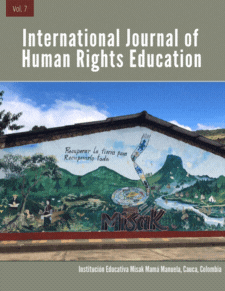
International Journal of Human Rights Education: Call for Special Issue Article Proposals

Queering Human Rights Education: Research, Praxis and Liberation for LGBTQIA2S+

>> Details and submission information
Guest Editors: David Donahue, Maria Autrey Noriega Lori Selke, Mauro Sifuentes
Description: This special issue of the International Journal of Human Rights Education (IJHRE)
queers human rights and human rights education, drawing on the multiple definitions of queer:
as a noun, adjective, and verb. As a noun, queer is an umbrella term for members of the
lesbian, gay, bisexual, transgender, queer/questioning, intersex, asexual/aromantic/agender,
two spirit (LGBTQIA2S+) community, with the plus sign in the acronym holding space for new
and expanding understanding about identity related to sexuality and gender. As an adjective,
queer speaks to departing from the norm, differing from expectations regarding sexual
orientation, gender identity and expression, and sex characteristics (SOGIESC). As a verb, queer
refers to challenging all that is considered normal and natural. Queering is about troubling
power and replacing binary thinking with more complex, fluid ways of understanding.
In keeping with these multiple definitions, the editors of the special issue seek articles that are
about the human rights desires and celebrations of LGBTQIA2S+ people as well as the
challenges and contestations of those rights. In addition, we seek articles that challenge
normative thinking about human rights and HRE, particularly in terms of gender and sexuality
and that trouble what it means to teach and research in the field of human rights. We welcome
scholarship that not only expands what we know but questions, challenges, and complicates
how we come to know something and why we think it is valuable. We are especially interested
in articles that:

  • Draw on, critique, extend, and operationalize the Yogyakarta Principles and Principles
    Plus Ten as part of HRE
  • Center trans perspectives and experiences at this moment of social and state-
    sanctioned violence and oppression against trans persons
  • Balance queer joy, desire, and creativity with the oppression, harm, and marginalization
    of LGBTQIA2S+ persons
  • Focus on practices and embodiments of queer liberation, including spaces where the
    rights of queer youth, advocates, and educators thrive
  • Employ queer theory, including queer futurity and temporality, to examine the
    assumptions and logic of education, including human rights education.

Scholars, teachers, community organizers, advocates, artists, and all other thinkers and doers,
including youth, are invited to submit proposals for empirical, theoretical, and reflective articles
that queer/are queering/have queered (but are not limited to) human rights and education.
We welcome contributions looking inside and outside of the classroom, across all global
settings, from early childhood, primary, and secondary education to higher education, adult
education, and immigrant/refugee education and their intersections with HRE curriculum and
educational materials; HRE pedagogy and practices; HRE community and spaces; HRE history
and scholarship; and/or HRE advocacy and policy. Visual art, poetry, and creative nonfiction are
welcomed as well as texts grounded in social science. We also seek book reviews, including
reviews focused on trade books and children’s literature, as well as scholarly texts, focused on
SOGIESC.
Proposal Guidelines: Email proposals to lead editor, David Donahue, at ddonahue@usfca.edu.
Proposals are due April 10, 2024. Authors will be notified of decisions within four weeks (by
mid-May) of the deadline. First manuscripts will be due September 1, 2024. Research articles
(6000-9000 words) are empirically-based works or original conceptual contributions. The
Pedagogy, Community, and Praxis section includes community-based commentaries, emerging
themes and ideas from empirical research, community-based work that may not be completed,
and creative works (3000 words maximum). In this special issue, such pieces may highlight the
work of queer/trans community members and/or leaders who may not be engaged in empirical
studies but whose ideas are grounded in queer(ed) thinking. Authors are instructed to follow
the IJHRE author guidelines available at:
https://repository.usfca.edu/ijhre/styleguide.html.
Article proposals should be in 12-point font and brief; descriptions should not exceed 500
words (including citations; references are not required for this stage). Please discuss the
research topic and how the work relates to the major components of this issue outlined in this
call for proposals. In addition, please include the working title of the article, the type of article
(Original Article; Pedagogy, Community & Practice piece; or book review, see here for
descriptions), name and affiliation of the author(s), and contact information for the
corresponding author (email and mailing address). Please send proposals in Word or PDF
format.
The special issue is aiming for publication in Spring 2025. IJHRE is a fully peer-reviewed and
open access, online journal; open access for all readers worldwide and regardless of
institutional affiliation is a central factor in the editors’ decision to work with this journal. To
date, articles in the journal have been downloaded nearly 60,000 times from more than 180
countries.
About the Special Guest Editors:
David Donahue (he/him) is a passionate advocate of queering curriculum and creating space for
LGBTQ+ students in schools. Currently, he is Professor of Education at the University of San

Francisco in the International and Multicultural Education department. Before coming to USF in
2015, he was a professor and administrator at Mills College. He is the author of articles,
chapters, and presentations on LGBTQ+ topics and co-author of the report Making the
Framework Fair (2014) which recommended changes for LGBTQ+ inclusion in the California
History-Social Sciences Framework for K-12 students in public schools.
Maria Autrey (she/they) is a queer immigrant educator and activist from Mexico with over a
decade of experience in teaching and facilitating experiential learning for High School and
College students. Maria’s research focuses on liberatory sexuality education, exploring the use
of critical pedagogy in non-formal grassroots projects to foster social change through the
promotion of radical acceptance, and erotic embodiment. Maria completed their doctorate in
International and Multicultural Education at the University of San Francisco and currently
serves as the Associate Director of Community Engaged Learning at Santa Clara University.
Lori Selke (she/they) is a doctoral candidate in the University of San Francisco Department of
International and Multicultural Education and an Assistant Managing Editor at the International
Journal of Human Rights Education (IJHRE). She co-edited the final edition of The Black Book, a
landmark directory of alternative sexuality resources, and co-curated the performance series
Perverts Put Out!, which was in its time San Francisco’s longest-running spoken-word
showcase. Her non-academic writing has appeared at Curve, Girlfriends, and NPR as well as in
numerous queer anthologies.
Mauro Sifuentes (any/all pronouns) is a scholar-educator whose academic work focuses on
decolonial queer and trans studies in education. He has spent over two decades working as an
LGBTQ+ advocate in public education systems across California, bringing queer-of-color and
queer Indigenous perspectives into student and youth advocacy and leadership development.
Mauro’s work prioritizes critical pedagogical experiments, political and human rights education
with youth, and community-informed feminist research methodologies.

Timeline
April 10 – 500 word abstracts due
May 15 – decision letters sent
Sept 1 – first versions of articles due
October 1 – reviews from peers
November 15 – revised articles due
March/April 2025 – launch of special issue
The Inaugural Human Rights Lecture: Human Rights in a Fractured World

Thu, 2 May 2024 11:30 – 12:30 GMT-5

This event is happening in person and online. This Eventbrite page is for booking online only.

If you wish to attend in person at Kellogg College please use the link below:

The Inaugural Human Rights Lecture: Human Rights in a Fractured World Tickets, Thu 2 May 2024 at 17:30 | Eventbrite

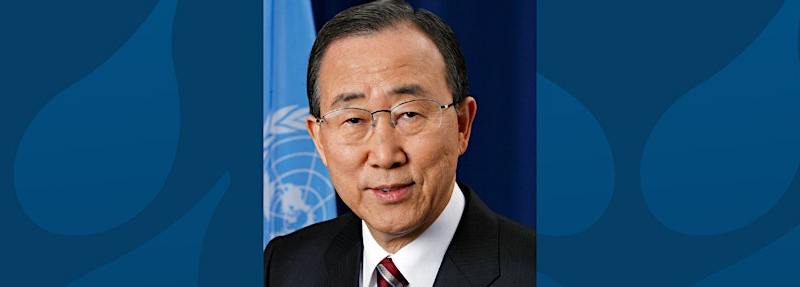
Join President Professor Jonathan Michie and Fellows online as we welcome Bynum Tudor Fellow Ban Ki-moon to Kellogg to deliver the Inaugural Lecture in a new annual series of Kellogg Lectures on Human Rights . This year’s lecture is titled ‘Human Rights in a Fractured World‘.

Ban Ki-moon’s ten years as Secretary General to the United Nations was marked by many successes. Throughout, he strove to enhance human rights globally. Indeed, Ban Ki-moon’s other successes – such as the Sustainable Development Goals, establishing UN Women, and the Paris agreement to limit the rise in global temperature to 1.5 degrees celcius – can all be seen as enhancing human rights broadly defined. The Sustainable Development Goals promote the whole range of economic and social rights. UN Women “is the UN organization delivering programmes, policies and standards that uphold women’s human rights”. And the climate crisis threatens the rights of millions, most immediately those who will be displaced, and those facing famine and disease as a result of climate change. Ban Ki-moon will reflect on the urgent need to defend and promote human rights, and will place this in the broader context of the need to promote women’s rights, pursue the Sustainable Development Goals, and tackle the climate crisis.

Professor Jonathan Michie, President of Kellogg College will chair the event.

You will be sent a link to watch the talk nearer to the event date.

Should you have any further queries, please contact events@kellogg.ox.ac.uk

New Issue: Rethinking Schools Magazine: Teach Palestine

The spring issue of Rethinking Schools focuses on Israel’s war on Gaza and the war on teaching about Palestine.

The editorial discusses how the attack on social justice teaching has expanded as part of the crackdown on dissent against U.S. support for Israel. Bill Bigelow draws on his Zinn Education Project “Teaching the Seeds of Violence” activity to argue that anti-Zionism is not automatically antisemitism. Jesse Hagopian traces connections between the war on history, education, and children in both countries. Oakland educators detail the story of what happened when they organized a teach-in for Palestine. A Palestinian student shares her experiences in the aftermath of Oct. 7, and the issue includes Naomi Shihab Nye’s poem, “Before I Was a Gazan.”

This issue also includes Cierra Kaler-Jones’ reflections on how to replace a pedagogy of control in teaching dance with one that encourages creativity and liberation. A Chicago educator discusses a new curriculum on the Young Lords. And more. Subscribe to Rethinking Schools.

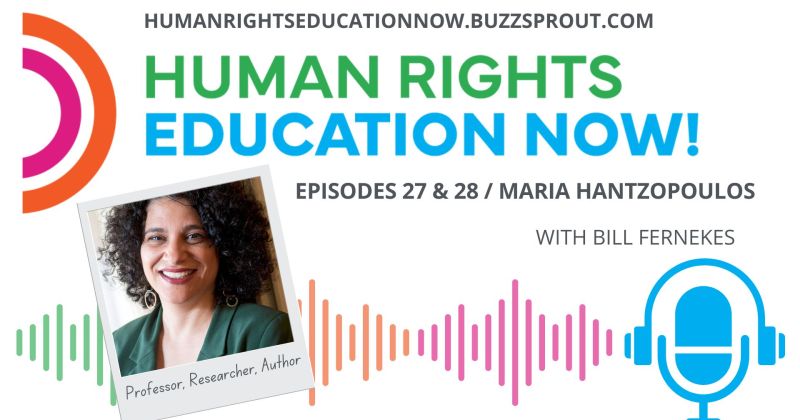
Episodes 27 & 28 with Maria Hantzopoulos are available on Human Rights Education NOW!

We are pleased to announce the availability of our latest installment of podcast episodes in Human Rights Education NOW! Episodes 27 & 28 feature conversations with  Maria Hantzopoulos. Maria Hantzopoulos earned her B.A. from Boston University in History, her M.A. in Social Studies Education from Teachers College, Columbia University and her doctorate at Teachers College in International Educational Development. Her work broadly considers how educational processes structure inequity in their contexts and beyond. Her research interests include school culture and climate, project-based assessment, peace and human rights education, migration and education, and social studies curricula. She is the author of the book Restoring Dignity: Human Rights in Action (Teachers College Press, 2016).   

Episode 27: Maria Hantzopoulos, Part One

In Episode 27, Maria Hantzopoulos discusses her origins of interest in human rights and human rights education, as well as her entry into public school teaching and her advocacy of social justice pedagogy. She then shares her practices of HRE and peace education in her teaching, and the importance of critiquing mainstream narratives. Next, Maria discusses her involvement in the doctoral program at Teachers College, Columbia University, and the importance of Paolo Freire’s work on critical consciousness. Maria then goes on to describe what she views are the challenges of educating teachers to act as transformative agents of change. Lastly, Maria explains Henry Giroux’s concept of schools as contested spaces.

Topics discussed:

  • Origins of interest in human rights and human rights education
  • Entry into public school teaching 
  • Advocacy of social justice pedagogy 
  • Practice of HRE and peace education in teaching
  • Importance of critiquing mainstream narratives
  • Involvement in doctoral program at Teachers College, Columbia University
  • Paolo Freire’s work on critical consciousness
  • Challenges of educating teachers as transformative agents  
  • Henry Grioux’s concept of schools as contested spaces 

Full topic listing available for PDF download HERE.

Listen on our Buzzsprout podcast website HERE


Episode 28: Maria Hantzopoulos, Part Two

In Episode 28, Maria Hantzopoulos discusses her work with non-governmental organizations, as well as her work in designing curriculum, which deals with human rights. Maria then shares what she views are challenges to mainstream narratives in global history, and the idea of curriculum interventions as contested spaces. She emphasizes the intersections of HRE and peace education, as well as the challenges of meeting students who have skill deficits. Next, Maria talks about the relationships between HRE and social justice and the development of a critical consciousness, as well as the heightened emphasis on decolonial education. Maria then describes the importance of using human rights language and concepts when addressing social change movements in the US, along with highlighting the Universal Declaration of Human Rights (UDHR) as a tool with young people. Maria shares influential role models for her work in human rights education and a significant quote, which guides her work in HRE.

Topics discussed:

  • Work with non-governmental organizations
  • Work designing human rights curriculum 
  • Challenges to mainstream narratives in global history 
  • Curriculum interventions as contested spaces
  • Intersections of HRE and peace education 
  • Challenges in meeting students’ needs who have skill deficits 
  • Relationship between HRE and social justice 
  • Development of critical consciousness
  • Heightened emphasis on decolonial education
  • Importance of using human rights language and concepts in social change movements
  • UDHR as tool to use with young people
  • Influential role model and significant quote  

Full topic listing available for PDF download HERE.

Listen on our Buzzsprout podcast website HERE.

📢 For Listeners: Moving from Google Podcasts to YouTube Music in April
  • Google Podcast will be discontinued on April 2, 2024.
  • We will move all our episodes onto YouTube Music. 
  • All previously published episodes will remain available on Apple Podcasts,Spotify, Overcast, Pocket Casts, Deezer, and PlayerFM. 

Thank you for supporting the Human Rights Education NOW! podcast!

Textbook critique: Does Your Textbook Lie About Reconstruction?

Last spring we posted Five Ways Textbooks Lie About Reconstruction by Mimi Eisen.

Eisen examined commonly used U.S. history textbooks. The first of five themes she found is that textbooks center Confederate states and ex-Confederates.

A contemporary textbook asks students to imagine themselves as former Confederate soldiers traveling the South and witnessing, with dismay, the destruction of “plantation manor homes.”

Textbooks encourage students to view Reconstruction from the perspectives of those who fought to preserve enslavement.
See more themes and textbook examples, and read our full national report, Erasing the Black Freedom Struggle.
Send us examples from YOUR history textbooks.
Invite students to read the article and examine their textbook. Send us what they find and in appreciation, we’ll highlight their work as textbook detectives and send you a signed copy of Black Was the Ink for your classroom.
Textbook Critique