HRE USA, U.S. Civil Society, and the Universal Period Review (UPR) – 2025

October 9, 2025

2025 is the date for the Universal Period Review of human rights by the United Nations Human Rights Council (UNHRC). The UPR is a “unique mechanism of the Human Rights Council that calls for each UN Member State to undergo a peer review of its human rights records every 4.5 years” (UNHRC). 2025 is the date for the U.S. UPR, its fourth review since the establishment of the UPR in 2006 and initial reviews in 2008.

Due to the United State’s withdrawal from the UPR in August of 2025 (Reuters) and refusal to participate scheduled UPR on November 7, 2025, HRE USA has joined other human rights organizations and civil society in co-signing on to the UPR Civil Society event for the People’s UPR and in support of UPR related events across the country. We have also co-signed and support The Advocates for Human Rights’ statement on the U.S. and the UPR (resources below.)

In the spring of 2025, we submitted reports for the UPR to the UNHRC with our organizational partners, which can be found Attacks on Academic Freedom: Columbia University and Beyond and PROTECTING THE RIGHT TO EDUCATION, ACADEMIC FREEDOM, AND HUMAN RIGHTS EDUCATION IN THE UNITED STATES (2025).

>> Read the Advocate for Human Rights’ statement and video: U.S. Human Rights Organizations Demand Leadership in Face of U.S. Attempts to Destabilize World Human Rights Framework 

>> UNHRC Documents on the U.S. UPR

>> Read the Summary of Stakeholders’ Submission to the UPR
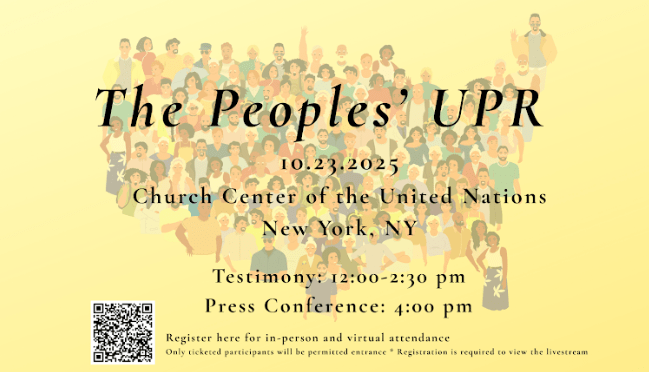
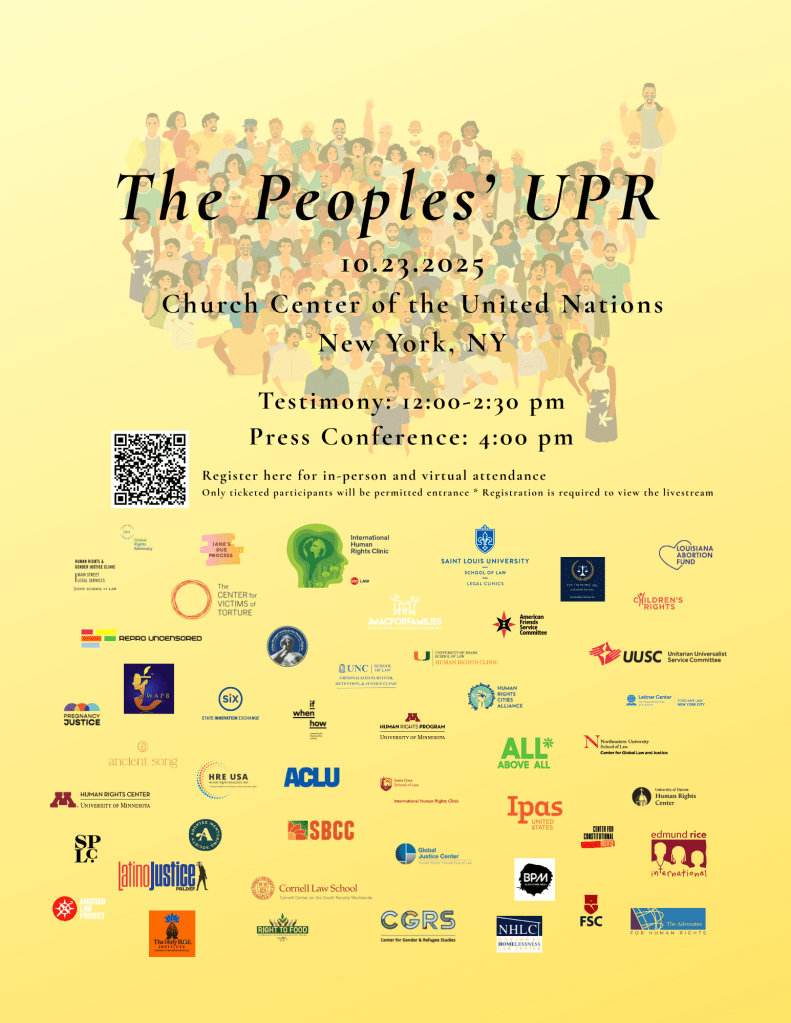
People's UPR flyer, yellow background with illustration of multiple people making up the shape of the continental United States

The People’s UPR and UPR-Related Events

In response to the announcement by the United States that it would not participate in its Universal Periodic Review—a mechanism of the UN Human Rights Council—HRE USA has joined a coalition of civil society stakeholders to make our voices heard and advocate for our country’s participation. 

Event: The People’s UPR
Thursday, October 23, 2025, starting at 12pm (ET) at the Church Center of the United Nations (777 United Nations Plaza, in New York, NY.) Lunch will be served. 
The event will also be livestreamed for those who wish to view from afar.

The Fourth Universal Periodic Review (UPR) of the United States has been set to take place in November 2025. The UPR is a unique United Nations Human Rights Council process that allows all United Nations Member States to undergo a peer review of their human rights records every 4.5 years. So far this year, the United States government is refusing to participate in this process. Nonetheless, U.S. civil society will mobilize to ensure that people’s voices are heard through important testimonies to build a record toward addressing human rights violations here in the United States. As part of those efforts to build a record, a People’s UPR is being organized as a side event during the Third Committee Session at the United Nations Headquarters in New York, NY.  We hope that the People’s UPR will be attended by United Nations, Country Mission, and Embassy staffers both in NY and in Geneva (via Zoom).

There will be opportunities for directly impacted persons (a ‘directly impacted person’ is someone who is personally and directly affected by the law, policy, practice, act or omission by the government) to testify in-person during the People’s UPR regarding human rights issues in the United States. The event will be livestreamed but there will be no opportunities for persons to testify live via the web. Instead, we will play prerecorded testimony received via video ahead of time from persons who cannot attend in-person.

>> Register (in-person or livestream) 
>> See the UPR-Related Calendar of Events

PedagogyFutures & Human Rights Education Associates (HREA): AI Human Rights Literacy Curriculum

HREA in collaboration with PedagogyFutures has just released a six-lesson module addressing AI Human Rights and Education! 

The curriculum empowers educators and students to critically engage with how AI shapes society, from education to governance, public services, and civil liberties. Through interactive lessons and real-world case studies, participants build essential literacy around AI’s potential and risks, all grounded in a commitment to dignity and human rights. 

>> The curriculum is free and can be downloaded from here: https://pedagogyfutures.io/ai-human-rights-education/

Council of Europe publishes Guidance on applying the RFCDC to Education for Sustainable Development

The Council of Europe’s Education Department has released a new Guidance document on applying the Reference Framework of Competences for Democratic Culture (RFCDC) to Education for Sustainable Development (ESD). The publication helps policy makers and educators connect sustainability learning with democratic participation and human rights by using the RFCDC’s competence model. 

Education for sustainable development is most powerful when it equips learners to think critically, act responsibly, and participate peacefully in democratic life. This guidance shows how to make that link in curricula, classrooms and communities,” said the Head of the Education Department.

The document sets out the purpose and benefits of using the RFCDC for ESD, including the added emphasis on democracy and human rights, and shows how the RFCDC’s 20 competences can be readily applied to strengthen learners’ ability to take responsible individual and collective democratic action in support of sustainability. 

What the Guidance provides:

  • How RFCDC and ESD fit together, and why the RFCDC adds value to ESD through its focus on democracy and human rights. 
  • Transformative pedagogies that make ESD concrete: co-operative learning, inquiry-based and project-based learning, service learning, outdoor learning and field work. 
  • Coherent implementation advice on aligning curriculum, pedagogy and assessment so students develop both subject knowledge and RFCDC-ESD competences. 
  • Practical examples and planning pointers that education authorities and schools can adapt to their context.

Who it is for:

The guidance addresses ministries of education and policy makers, teachers and school leaders (pre-primary to secondary), and non-formal educators such as youth workers, NGOs, museums and libraries. 

Availability:

The publication is available online

Voice of Witness: Ask An Oral Historian: Trauma-Informed Interviewing

In the next AAOH session, we’re exploring trauma-informed interviewing. It’s essential, it’s nuanced, and it’s at the heart of ethical oral history practice. Together, we’ll navigate the complexities of creating safe spaces for difficult conversations—and more importantly, how to support your narrators while gathering meaningful stories that honor their experiences. You’ll walk away with concrete strategies for recognizing trauma responses, techniques for building trust and establishing boundaries, and the confidence to conduct sensitive interviews with both compassion and professionalism.

Thursday, October 23, 2025 from 12pm PT / 3pm ET, virtual 

Ask An Oral Historian consultation hours are your chance to dive into the intricacies of oral history and learn alongside fellow storytellers. Whether you’re wrestling with a current project or just curious about the craft, these monthly 60-minute working sessions are your space to grow and ask questions in an intimate, small-group setting.
>> Register

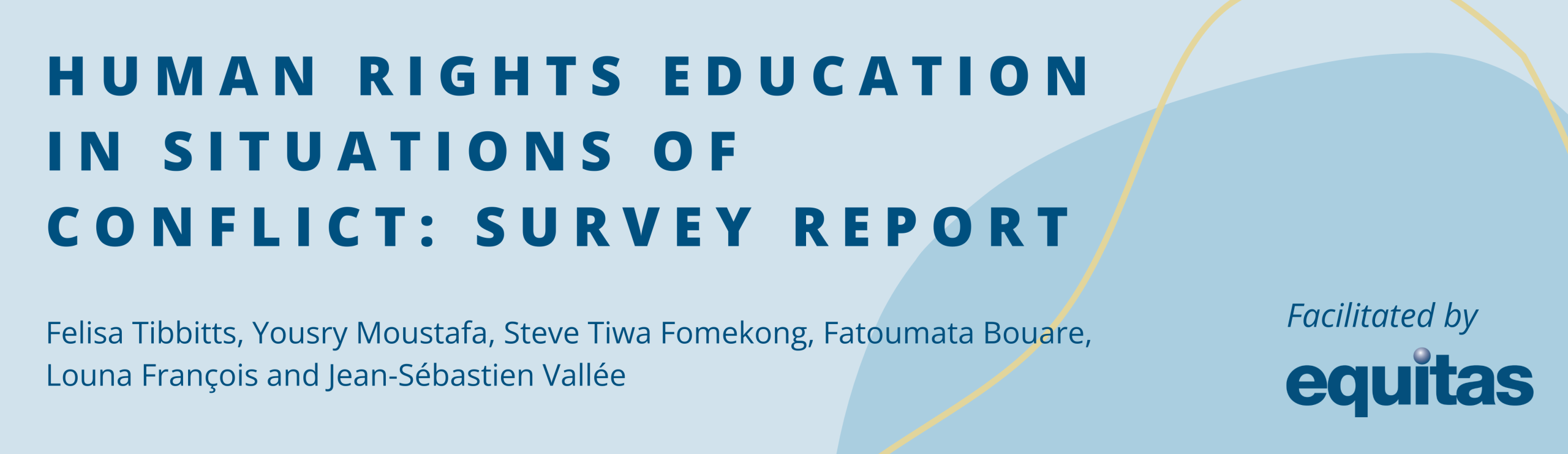
Equitas: Human Rights Education in Situations of Conflict

At a time when human rights violations are on the increase in conflict zones, Equitas coordinated the drafting of a report in collaboration with a working group of human rights defenders from several countries to highlight this essential lever of human rights education. The team included Felisa Tibbitts of HREA, Yousry Moustafa, Steve Tiwa Fomekong, Fatoumata Bouare,  Louna Francois and Jean-Sebastien Vallee.  

>> The report “Human Rights Education in Situations of Conflict” can be accessed in English and French here: Human rights education in situations of conflict | Equitas

October is Filipino American History Month

Filipino Americans are the second-largest Asian American group in the nation and the third-largest ethnic group in California, after Latinas/os and African Americans. The celebration of Filipino American History Month in October commemorates the first recorded presence of Filipinos in the continental United States, which occurred on October 18, 1587, when “Luzones Indios” came ashore from the Spanish galleon Nuestra Senora de Esperanza and landed at what is now Morro Bay, California. In 2009, U.S. Congress recognized October as Filipino American History Month in the United States. Various states, counties, and cities in the U.S. have established proclamations and resolutions declaring observance of Filipino American History Month. The late Dr. Fred Cordova, along with his wife, FANHS Founder Dr. Dorothy Laigo Cordova, first introduced October as Filipino American History Month in 1992 with a resolution from the FANHS National Board of Trustees.

>> Learn more

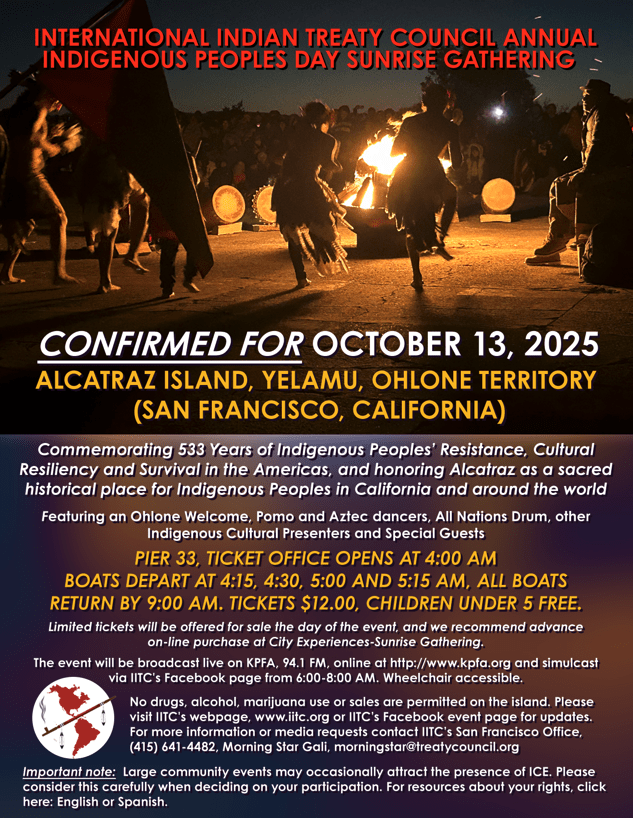
International Indian Treaty Council: Indigenous Peoples Day Sunrise Gathering

Commemorating 533 Years of Indigenous Peoples’ Resistance, Cultural Resiliency and Survival in the Americas, and honoring Alcatraz as a sacred historical place for Indigenous Peoples in California and around the world

Featuring an Ohlone Welcome, Pomo and Aztec dancers, All Nations Drum, other Indigenous Cultural Presenters and Special Guests

OCTOBER 13, 2025, ALCATRAZ ISLAND, YELAMU, OHLONE TERRITORY (SAN FRANCISCO, CALIFORNIA)  

  • PIER 33, TICKET OFFICE OPENS AT 4:00 AM 
  • BOATS DEPART AT 4:15, 4:30, 5:00 AND 5:15 AM, ALL BOATS RETURN BY 9:00 AM. TICKETS $12.00, CHILDREN UNDER 5 FREE.

Limited tickets will be offered for sale the day of the event, and we recommend advance on-line purchase at City Experiences-Sunrise Gathering.    

The event will be broadcast live on KPFA, 94.1 FM, online at http://www.kpfa.org and simulcast via IITC’s Facebook page from 6-8:00 AM. Wheelchair accessible.

>> Learn more 

The Center’s Research-Backed Textbooks Now Available Through Gibbs Smith Education

You can now purchase the Center for Civic Education’s research-backed textbooks through Gibbs Smith Education, the Center’s new distribution partner. As of today, October 1, the Center’s textbooks, such as We the People: The Citizen & the Constitution and Project Citizen: Community Engagement in Public Policy, will be offered exclusively through Gibbs Smith Education. To purchase any of the Center’s textbooks, customers should complete a brief form on the organization’s website. This new distribution partnership will allow the Center to reach more schools and students, increasing accessibility to impactful civic education. Customers placing orders with Gibbs Smith Education will experience the same high-quality, personalized service they have received from the Center. Gibbs Smith Education’s representatives are fully trained and knowledgeable about the Center’s publications and ready to help. Supporters of civic education can still purchase T-shirts and other apparel through the Center’s Bonfire store.

Purchase Textbooks Through Gibbs Smith Education

Banned Books Week: Let Freedom Read Day

The freedom to read is under attack — let’s do something about it!

On October 11, 2025, we’re asking everyone to take at least one action to help defend books from censorship and to stand up for the library staff, educators, writers, publishers, and booksellers who make them available!

Show us how you’re taking action on social media by using the hashtags #LetFreedomReadDay and #BannedBooksWeek!

We’ll continue to add resources in the coming days, so bookmark this page!

And don’t forget: Censorship won’t stop just because Banned Books Week does — you can take action any day of the year!

>> Download the action one-sheet to print & share

>> Download the voting one-sheet to print & share

>> Instagram Carousel (Actions)>> Learn more