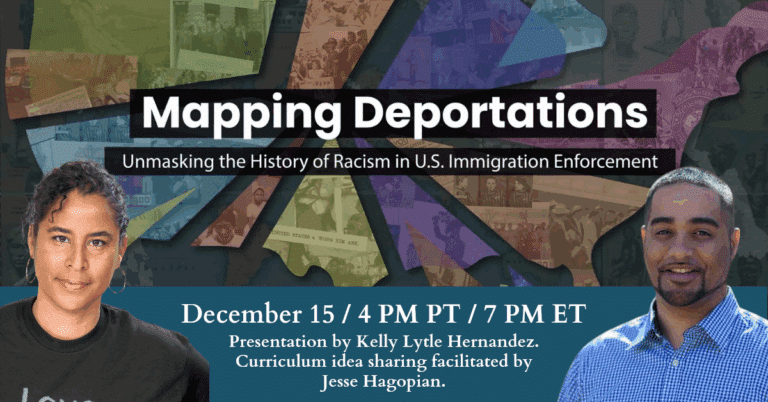
Join Citizens for Global Solutions – Minnesota (CGS-MN) for a practical conversation with attorney Flavia Santos Lloyd on the domestic legal foundations of U.S. immigration—how federal laws, agencies, and courts shape outcomes in visas, asylum, parole, enforcement, and due process.
Learn about the roles Haudenosaunee leaders and communities played during the American Revolution with a deep dive into two powerful new tools designed to bring Native voices and experiences into your classroom:
Native Women Leading the Way: From Revolution to the Future is a teaching poster that spotlights three remarkable Native women who led their communities through the conflict of the American Revolution and beyond.
How Did the Haudenosaunee Persevere Through the American Revolution? is an engaging digital book tailored for middle school students that emphasizes the resilience of the Haudenosaunee people.
From PBS: November is Native American and Alaska Native Heritage Month. The celebration of Indigenous cultures began as a week-long celebration in 1986, when President Reagan proclaimed the week of November 23-30, 1986 as “American Indian Week.” Every President since 1995 has issued annual proclamations designating the month of November as the time to celebrate the cultures, accomplishments, and contributions of Native American and Alaska Native communities.
Join us for our annual virtual International Human Rights Day event We will present awards from HRE USA and UCCHRE, showcase projects, and celebrate and connect with the HRE community working on important issues across the country and around the world.
Next Generation Climate is an interdisciplinary six-lesson climate change curriculum that uses the Next Generation Science Standards as a framework. Access here
The Next Generation Climate (NGC) curriculum was first developed in 2015 to meet a growing need for curricular materials that develop students’ climate literacy while supporting the Next Generation Science standards (NGSS). Over a decade later, climate change education has grown more comprehensive, but it remains no less important to educate students about the foundations of climate change and solutions to the crisis. The 2025 update includes current graphs and data sets, plus more interdisciplinary approaches that highlight climate justice leaders and perspectives.
This curriculum’s main purpose is to build students’ climate literacy. According to the 2024 Climate Literacy Guidelines, a climate-literate person: “Understands the essential principles of Earth’s climate system and the options to address human-caused climate change; recognizes credible information about climate change and knows where to find it; communicates about climate change in accurate and effective ways; and is able to make informed decisions related to climate change.”
We hope that NGC can serve as both an introduction to climate change and as a source of activities that deepen and broaden students’ climate literacy. Formal and non-formal educators will find that NGC aligns with their frameworks and can spark climate conversations in any subject area. We invite you to dive in!
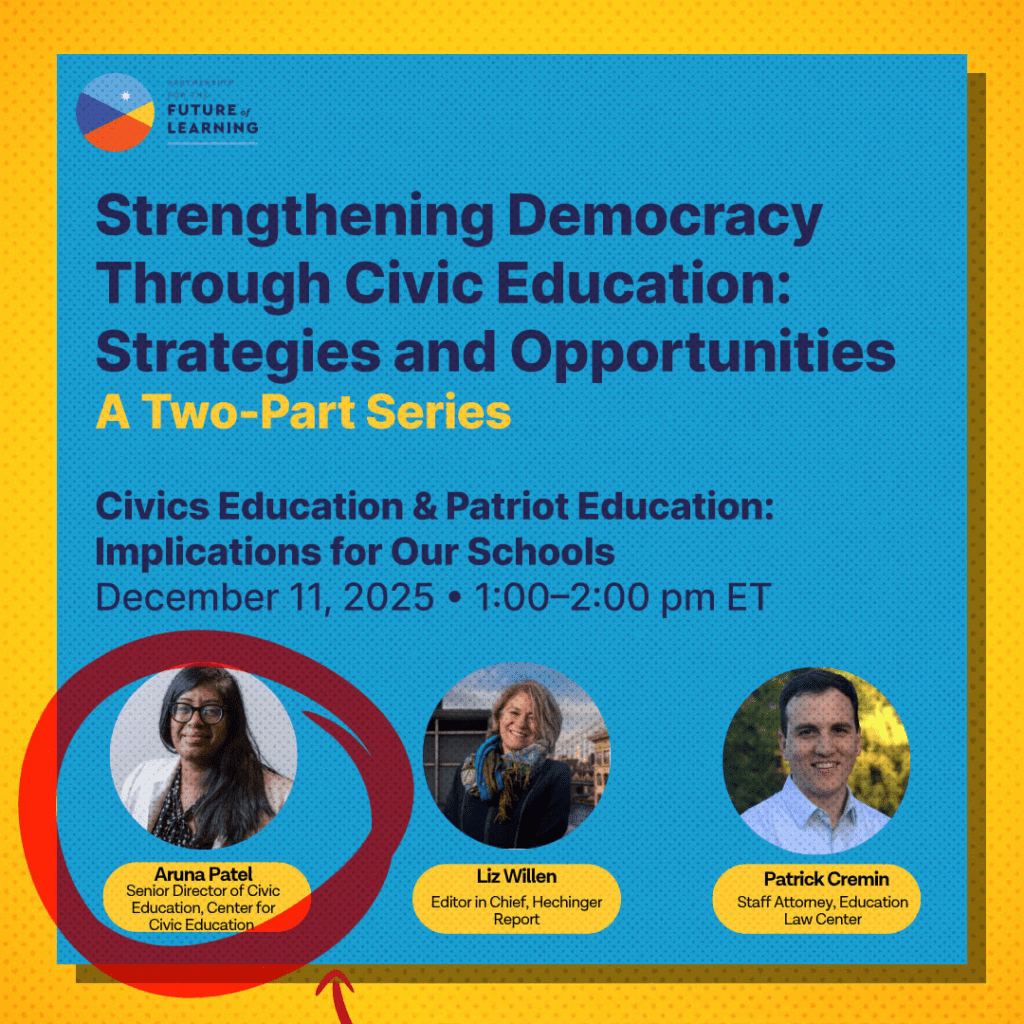
Who decides what patriotism looks like? Join the Center as we moderate a discussion between Danielle Allen of Harvard University and Paul Carrese of Arizona State University. This timely conversation on reflective patriotism will explore how the line between patriotism and dissent has shifted throughout American history. This session explores the intersections of protest, civic identity, and constitutional rights—key themes in Unit 6 of We the People: The Citizen & the Constitution. Cosponsored by ASU’s Center for American Civics and Harvard’s Allen Lab for Democracy Renovation, this program is part of the Center for Civic Education’s ongoing 60-Minute Civics webinar series. Register here and explore more offerings on our webinars homepage.
For over a decade, the Speak Truth to Power video contest has empowered students to use filmmaking as a tool for social change. Screened at the Tribeca Film Festival, these films shine a light on pressing human rights issues, celebrate the defenders working to create change across the nation, and drive real action and advocacy.
Students from all backgrounds can participate in the contest by submitting short three- to five-minute videos—whether they be documentaries, narrative films, or experimental—without needing expensive equipment or prior video editing skills.
Students interested in participating should submit their films for consideration by May 3, 2026.
Students should follow the guidelines for their category, grades 6-12 or College Guidelines. Submissions are judged by a panel of film industry experts, actors, and educators.
GENEVA – The United Nations Human Rights Council today called on the United States to resume its cooperation with the Universal Periodic Review (UPR), a mechanism that calls for each UN Member State to undergo a peer review of its human rights record every five years. In its decision, the Human Rights Council also announced that it would reschedule the UPR of the U.S. for 2026, while leaving open the possibility for it to be scheduled sooner. Read more
This module explores how Human Rights Education (HRE) equips educators and organizers to address controversial issues while promoting dialogue and free expression. Participants will learn strategies to engage diverse perspectives, mediate conflict, and create safe spaces for open discussion. The module highlights how HRE can reduce polarization, foster empathy, and encourage constructive civic engagement. Register here
Human Rights Educators USA’s annual Training as Action Series (TAAS) is a virtual training series focused on bridging personal and collective action on some of the most critical human rights issues of today. TAAS creates an educational space to connect and collaborate with others in human rights education and training. It also gives participants the skills and information needed to take action on rights issues in their communities.
The 2025–2026 Training as Action Series will center on the theme, “Defending Democracy and Human Rights in a Changing World.” This year’s sessions will explore urgent issues such as misinformation, protest rights, climate justice, and digital surveillance, highlighting how human rights education can equip communities to respond with clarity, courage, and collective action. Those who attend six or more sessions will receive a certificate from HRE USA. 2025-26 TAAS Flyer
HRE USA is a project of the Center for Transformative Action.