Resources for National Hispanic Heritage Month

Taking time to amplify and honor the cultures and contributions of Hispanic and Latino Americans is as imperative as it is galvanizing. Celebrating our pluralistic heritage is essential at a time when Xenophobia is gripping many mainstream news narratives and fueling the fire of a fraught upcoming election year. With the spotlight currently on schools, it is more crucial than ever to reimagine migration in the classroom, champion the powerful work already happening in schools, and build upon those efforts. 

Schools are potent sites of belonging and community building and are often one of the first institutions where immigrant families build immersive relationships. At Re-Imagining Migration, we know how many hats teachers and school administrators wear to make their schools centers of belonging, and we hope our resources will aid you in the process.

Re-Imagining Migration’s Resources for Teachers on a Time Crunch  

New Year Teacher Toolkit

Greater Than Hate Coalition Announces Parents Week of Action

The Human Rights Campaign (HRC), the nation’s largest lesbian, gay, bisexual, transgender, and queer (LGBTQ+) civil rights organization, the National Education Association (NEA), the nation’s largest professional employee organization representing more than 3 million elementary & secondary school teachers & faculty, and the “Greater than Hate” coalition of advocacy groups that share a common goal to oppose hate in all its forms, are joining forces to launch a “Parents Week of Action” from September 23 – September 30th, 2023 to show up & show out for LGBTQ+ youth as students get back in the swing of the school year.

Read more

Call for Proposals for Winter 2024 Special Issue: Conceptualizing Micro-Level Narratives in Thematic Constructs of Internationalization

Guest Editors: Omolabake Fakunle, University of Edinburgh: omolabake.fakunle@ed.ac.uk and Fiona Hunter, Centre for Higher Education Internationalisation. Università Cattolica del Sacro Cuore, Milano

This special issue invites contributions to submit reflective accounts, theoretical papers, or findings from empirical research pointing to the importance of micro-level individual dimension in internationalization. Contributors can utilise different theoretical approaches that speak to the relational dimension of internationalization, such as a decolonial approach or capability approach to underpin articulations of agency amidst structural affordances and constraints.

Proposals should be 500 words and submitted on or before October 1, 2024.

Authors will be notified of their acceptance by November 15, 2024. Completed articles should be submitted by January 30, 2024. All articles will undergo a double-blind peer review process and must follow the JCIHE guidelines: https://www.ojed.org/index.php/jcihe/about/submissions. 

>> See the full call
>> Proposals can be submitted directly to omolabake.fakunle@ed.ac.uk or can be submitted via the JCIHE website

UHRI: The Non-profit Industrial Complex: More Harm than Good?

Our next dialogue features activist and community organizer Jiji Wong (they/them) in dialogue with UHRI facilitator Abigayel Bryce (she/they) and you! We’ll explore the question posed by Jiji: While we think of non-profits as inherently philanthropic and overall beneficial, is there something more insidious about them?

The non-profit sector is a trillion dollar industry, with the non profit industrial complex tying non-profits intimately with governments, foundations, and the owning classes. Join the dialogue and share your perspectives on how the system of relationships can cover up more insidious goals and contribute to human rights violations. AND explore how certain community organizations and nonprofits use this knowledge to reduce harm.

As a multiply marginalized Malaysian Chinese person, JiJi (they/them) has a first hand understanding of what it means to be from the Global South living in the imperial core, thus bringing their complex and nuanced understanding of revolutionary struggles. They are an experienced disability justice advocate, transformative justice worker, and general community organizer who has done workshops for all ages from middle schoolers to university students to adults.

As a core member of Xin Sheng Project, a Chinese diasporic collective fighting mis- and dis-information, JiJi has led social media narrative change campaigns and built out the guiding charter to resist the non-profit industrial complex. They are also a founding member of Divine Zine and Think Out of Frame, both anti-imperial publications. At their day job, is a reference librarian straddling the line between social worker and teacher while building information on a microcommunity scale.

Wednesday, September 20, 2023
6-7:30pm PST / 9-10:30pm EST

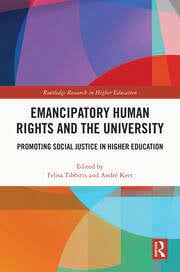
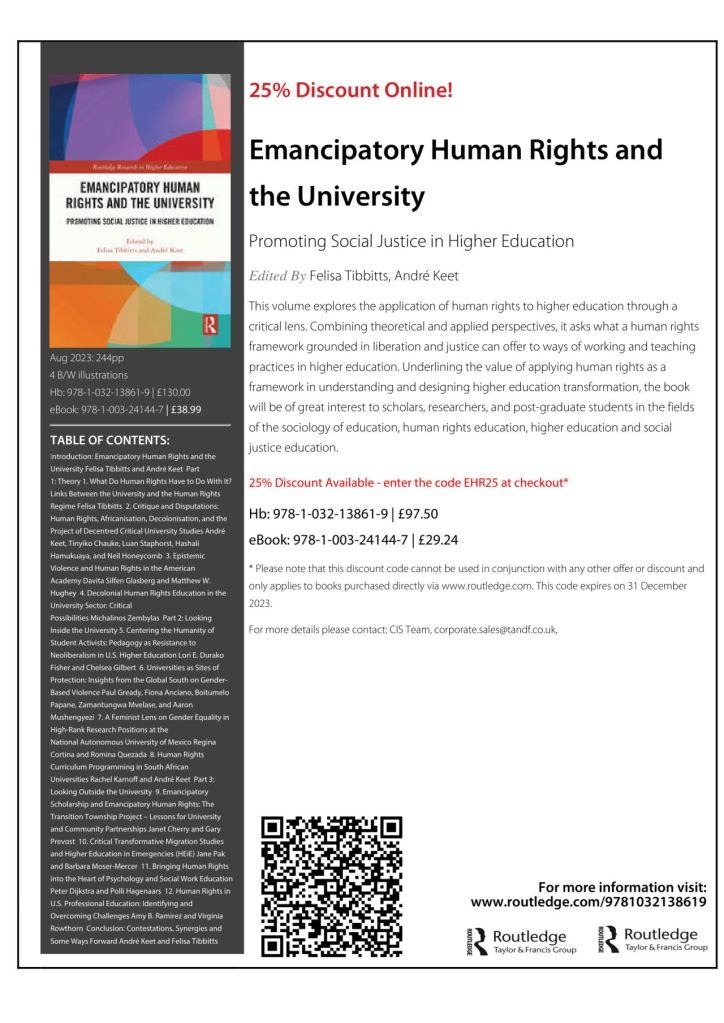
Book announcement: Emancipatory Human Rights and the University

Edited By Felisa TibbittsAndré Keet

Below is a flyer with a 25% discount for pre-orders – note the more affordable e-version!

This volume explores the application of human rights to higher education through a critical lens. Combining theoretical and applied perspectives, it asks what a human rights framework grounded in liberation and justice can offer to ways of working and teaching practices in higher education.

Human rights, in this edited compilation, call for continuous critical engagements around the higher education transformation project. The book recognizes human rights simultaneously as law, values, and emancipatory vision. It showcases global north and global south perspectives and encourages a dialogue between the human rights approach and other approaches to higher education transformation, such as decolonialization, anti-racism, diversity and inclusion, and intersectionality. Individual chapters featuring a range of case studies written from global south and north perspectives critically examine higher education practices linked with human rights, ranging from curricular practices to student activism and community partnerships. The critical space of the university and its role in the transformation of society is therefore viewed in multi-dimensional ways.

Underlining the value of applying human rights as a framework in understanding and designing higher education transformation, the book will be of great interest to scholars, researchers, and post-graduate students in the fields of the sociology of education, human rights education, higher education, and social justice education.

Family Declassified: Uncovering My Grandfather’s Journey from Spy to Children’s Book Author

Congratulations to HRE USA member Katherine Fennelly on the new book: Family Declassified: Uncovering My Grandfather’s Journey from Spy to Children’s Book Author.

In Family Declassified, social scientist Katherine Fennelly delves into the rationale and consequences of family secrets by studying her grandfather, Francis Kalnay, a high-level spy for the Allied Forces in Europe. In 1974 Francis abandoned his family and fled to Mexico for two decades where he reinvented himself as a children’s book author, an architect, and a gourmand. Until his death at age 93, he never spoke of his Jewish ancestry, his work as a spy, or of the murder of his sister and nephew at the hands of Hungarian Fascists.

Training as Action Series (TAAS): Introduction to HRE USA and Human Rights Education

Human Rights Educators USA’s annual Training as Action Series (TAAS) is a virtual training series focused on bridging personal and collective action on some of the most critical human rights issues of today. TAAS creates an educational space to connect and collaborate with others in human rights education and training. It also gives participants the skills and information needed to take action on rights issues in their communities. The 2023-2024 training series will celebrate the 75th anniversary of the Universal Declaration of Human Rights (UDHR) and center on the theme, “Protecting Democracy, Promoting Human Rights.” Sessions will discuss topics such as voting rights, facilitating difficult conversations, organizing an advocacy campaign, communicating with decision makers, protesting, and mental wellness.

Sessions

  • Introduction to HRE USA and Human Rights Education (Thursday, September 28th, 7-8 pm ET)
  • Protecting Democracy, Promoting Human Rights (Thursday, October 5th, 7-8:30 pm ET)
  • Voting Rights: What You Can Do to Combat Voter Suppression(Thursday, October 12th, 7-9 pm ET)
  • Calling In: Facilitating Difficult Conversations (Thursday, October 19th, 7-9 pm ET)
  • Human Rights in Action: Organizing an Advocacy Campaign (Thursday, October 26th, 7-9 pm ET)
  • Communicating with Decision Makers: How to Contact Influential Figures (Thursday, November 2nd, 7-9 pm ET)
  • Protest and Beyond: Powerful Ways to Promote Your Message(Thursday, November 9th, 7-9 pm ET)
  • Finding Joy: Integrating Mental Wellness into Your Advocacy Strategies (Thursday, November 16th, 7-9 pm ET)

>> Learn more

>> Register

Book annoucement: Children’s Human Rights in the USA: Challenges and Opportunities 

Author: Yvonne Vissing

This book critically examines why a human rights framework would improve the wellbeing and status of young people. It explores children’s rights to provision, protection, and participation from human rights and clinical sociological perspectives, and from historical to contemporary events. It discusses how different ideologies have shaped the way we view children and their place in society, and how, despite the rhetoric of children’s protection, people under 18 years of age experience more poverty, violence, and oppression than other group in society. The book points to the fact that the USA is the only member of the United Nations not to ratify a children’s human rights treaty; and the impact of this decision finds US children less healthy and less safe than children in other developed countries. It shows how a rights-respecting framework could be created to improve the lives of our youngest citizens – and the future of democracy. 

Authored by a renowned clinical sociologist and international human rights scholar, this book is of interest to researchers, students, social workers and policymakers working in the area of children’s wellbeing and human rights. 

What children’s rights are and why children need, deserve, and are entitled to them

How we have framed children and their rights

Why supporting children’s human rights also supports parents

Children are a minority group who face similar oppressions as other minority groups

What the Constitution says, and doesn’t, about human rights

Why “what is a child?” is so difficult to figure out

What does “child provision” mean?      What is child protection really today?

Child participation: they will name the game

Why professionals and organizations need human rights training

Why human rights parenting education is essential to make happy, healthy families

What human rights education could do to make our schools safer and our children smarter

Why children are not objects or property to be done-to

What it means to invest in children – and what it means not to

Watching our words: how to talk to and about children and youth

Why we need to pay attention to children’s rights – they are voters-in-progress

Why the treatment of children is laying the foundation for democracy – or autocracy

Children’s human rights as a misunderstood concept   Why a youth rights movement is essential

Democracy is in their hands, so give them good tools to build with

What can cities and towns do to become child friendly communities?

Steps communities can take to become rights respecting communities  – where every member counts

Call for Tracks | Special Issue of Black Educology: Punished For Dreaming

Editors:
Dre Carte, University of San Francisco
Eghosa Obaizamomwan-Hamilton, University of San Francisco
simple ant, simplewxnders.life

Special Guest Producer: Bettina Love | Teachers College, Columbia University

This call seeks submissions that not only build on her blistering critique of the educational system but also work to advance educational liberation for Black students and teachers. This special issue highlights select chapters from Punished for Dreaming to declare the utility and necessity of transformative education by acknowledging the need for educational reparations and affirming Black teachers | students ability to save ourselves. We invite submissions that build on key themes from Love’s work. Our goal is to work toward collective action that is rooted in building, fighting, and dreaming in ways that disrupt, subvert, and destroy antiblackness in education.

The producers invite original manuscripts (theoretical and empirical), creative, and afro-futuristic that have not yet been published on any website, journal, or book from educators, activists, scholars, and students that address any of the following topics: 

  • Black Children At Risk
    • How do schools work as a disservice to Black students|teachers?
  • No Entrepreneur Left Behind
    • What are the repercussions of educational policy on Black students?
  • Erasure
    • How have attacks on CRT worked to erase Black possibility and freedom dreaming?
  • Carceral Ineveitabilty
    • How do Black teachers disrupt the reproduction of carcerality in schools?
  • Standardizing Carcerality
    • How do we disrupt the “lynching tool” of standardized testing?
  • White Philanthropy
    • What would Teach for Black America look like?
  • The Trap of DEI
    • How can Black students|teachers be centered in DEI?
  • Let Us Celebrate
    • How do we build an ecosystem of Black joy, laughter, and affirmation as resistance within the apparatus of education?
  • A Call For Educational Reparations
    • How will educational reparations for Black people be good for all people?

Submission Guidelines: Please submit your manuscript (3,000-8000 words), creative works, or questions to blackeducology@gmail.com by November 10, 2023.

>> Learn more