Institute for the Study of Human Rights: Human Rights Advocates Program (HRAP)

Founded in 1989, the Human Rights Advocates Program (HRAP) is a unique and successful model of human rights capacity building. HRAP capitalizes on its affiliation with Columbia University and its location in New York City to provide grassroots leaders the tools, knowledge, access, and networks to promote the realization of human rights and strengthen their respective organizations.

HRAP’s comprehensive program of advocacy, networking, skills-building, and academic coursework provides advocates the opportunity to hone practical skills, develop a deeper understanding of human rights, and foster mutually beneficial relationships with organizations and individuals in their respective fields.

Applications accepted through 5:00 pm/ 17:00 ET on Friday, July 12th, 2024

>> Learn more

Call for Papers: Special Issue 2025: Global Citizenship Education and Human Rights


Human Rights Education Review invites submissions for a Special Issue on the intersection of Global Citizenship Education (GCE) and Human Rights Education (HRE), considering the role that HRE can play, in partnership with GCE, to enable hopeful futures. We welcome conceptual and empirical studies that explore the connections between human rights and global citizenship and expect this HRER Special Issue to uncover ways in which GCE founded in human rights is conceptualised and negotiated in a range of international contexts. In other words, it aims to explore ways are HRE and GCE interconnected, or not, within diverse contexts.

GCE responds to globalisation in multiple ways, informed by political and historical forces. Education for global citizenship founded in human rights is based on a cosmopolitan vision of our common humanity (Osler, 2011; Osler & Starkey, 2003; 2018). Yet the prevailing neoliberal environment and powerful interests of the Global North have frequently shaped global citizenship education as instrumental competencies for competition (Andreotti, 2006; Robertson, 2021). The proliferation of narrow expressions of GCE highlight the need for more meaningful and critical approaches (Ferguson & Brett, 2023; Smith & Neoh, 2023). Closer integration of GCE and HRE may confront the decontextualised limitations placed on both concepts (Rapoport, 2021). Transformative human rights also show potential for bringing empathy and compassion to citizenship education (von Berg, 2023). Exploring and expanding educational possibilities on rights, diversity and belonging may result in more inclusive global education agendas.

If you would like to make a submission in response to the Call for Papers send an extended abstract of no more than 300 words to Human Rights Education Review Managing Editor Kalpani Dambagolla to kalpanidambagolla@gmail.com by 1 July 2024. Your abstract should include a short list of indicative literature on which you expect to draw, from the fields of both GCE and HRE. Please ensure you use the subject line HRER: Global citizenship and human rights education in your email. You will hear back from us by 12 July 2024. All invited manuscripts will be subject to double-blind peer review. For invited papers for this special issue, submission of the full paper is due through the journal platform by 13 January 2025. We expect to publish this Special Issue as Volume 8 (3) 2025. 

Download full call for papers

Human Rights Watch: Researcher (China)

FULL-TIME JOB VACANCY
Researcher, China
Asia Division 
Multiple Locations Considered
Application deadline: 9 June 2024

The Asia Division of Human Rights Watch (HRW) is seeking a Researcher who will investigate, analyze, and advocate against human rights abuses in China. The Asia Division is one of HRW’s six regional research programs and is made up of about 30 staff, many of them based in the region and working in challenging environments.

This position reports to the East Asia Director and will preferably be based in one of the following HRW’s offices: Tokyo, Sydney, London, Brussels or Berlin. We will also consider having the successful candidate based in the region. The role is expected to start in July 2024.

The successful candidate may have the option to work remotely. We aim to be as flexible and supportive as possible in both the recruitment and onboarding of this position.

Responsibilities:

1. Research, monitor and document the human rights situation in China by collecting and analyzing information from a wide variety of sources including governments, media, academia, NGOs, victims, witnesses, journalists, diplomats, security forces and others;

2. Write and publicize reports, briefing papers, letters, news releases, op-eds, and submissions to international bodies; collect supporting documents and materials such as photographs and videos;

3. Assist in the development and implementation of local, regional, and international strategies to change abusive laws, policies, and practices;

4. Respond to queries from the media, public, and colleagues in the human rights community and take initiative to project concerns in public debates;

5. Assist the Director of the Division and HRW’s Development and Global Initiative Department in conducting fundraising, when needed;

6. Place abuses within the broader political, social and economic contexts and present human rights concerns to government officials, opinion leaders, inter-governmental agencies, and the media;

7. Work closely with non-governmental organizations (NGOs) and local human rights organizations to ensure that HRW’s work complements and enhances their own work without jeopardizing their security;

8. Liaise effectively with HRW staff located in multiple locations throughout the world to ensure effective coordination and delivery of activities;

9. Travel internationally, as required;

10. Deliver outputs in a timely manner and consistent with the agreed strategy and priorities of the Asia division, and

11. Perform other tasks, as may be required.

Learn more and apply
Episodes 31 & 32 with Dr. Alex Red Corn are available on Human Rights Education NOW!

We are pleased to announce the availability of our latest installment of podcast episodes in Human Rights Education NOW! Episodes 31 & 32 feature conversations with Dr. Alex Red Corn. Dr. Alex Red Corn is a citizen of the Osage Nation in what is now Oklahoma. He is an Associate Professor of Educational Leadership at Kansas State University (K-State), but is transitioning to the University of Kansas this summer where he will serve as Director and Associate Professor of Indigenous Studies, as well as Associate Vice Chancellor for Tribal Relations. Alex specializes in teaching qualitative research and Indigenous educational leadership. In addition to his university position, he serves as Executive Director of the Kansas Association for Native American Education (KANAE), and has collaborated with Native Nations and communities across the region, and is also the Chair of the new Kansas Advisory Council for Indigenous Education (KACIE).

Episode 31: Dr. Alex Red Corn, Part One

In Episode 31, Dr. Alex Red Corn shares his origins of interest in human rights and human rights education, as well as his evolution from being a social studies teacher to a human rights educator and expert on Indigenous education. Next, he discusses the challenges of helping others learn about American Indian cultures and history, and his thoughts on engaging with educational systems to improve understanding of Native cultures and society for all people in the US. Alex then explains the importance of meeting learners at their current state of knowledge while helping them recognize areas for growth. Furthermore, he addresses problems with existing social studies standards and stereotypical presentations of Indian life, as well as the importance of examining Indigenous issues within a human rights framework. He shares his thoughts on emphasizing the study of American Indian cultures and society as a political issue, not only through a racial/ethnic lens, and the Importance of studying the history and culture of specific Native tribes to counter the dominant assimilationist approach to education of American Indian children. Alex then expands on the importance of partnerships and collaboration between Indigenous nations and state/local educational systems, and various obstacles in changing education about Indigenous cultures and history. Next, he shares his thoughts on placing emphasis on sovereignty, collaboration, and co-governance in reforming educational systems through a problem-solving approach, as well as strategies for Indigenous students and academics to navigate the higher education system linked to settler colonialism. Finally, Alex links how helping one’s community is a core value of American Indians that leads to code-switching and navigating non-tribal systems in various situations.

Topics discussed:

  • Origins of interest in human rights and human rights education
  • Evolution from social studies teacher to human rights educator 
  • Challenges of teaching about Indian cultures and histories
  • Importance of meeting learners at their current state of knowledge
  • Problems with existing social studies standards and presentations of Indian life
  • Importance of examining Indian issues through a human rights framework
  • The study of Indian cultures and society as political, not merely racial/ethnic
  • Countering dominant assimilation approach to education of Indigenous children
  • Importance of partnerships between Indigenous nations / state and local education 
  • Sovereignty and co-governance in reforming education systems 
  • Strategies for Indian students and faculty in navigating higher education
  • Code-switching and navigating non-tribal systems

Full topic listing available for PDF download HERE.

Listen on our Buzzsprout podcast website HERE.

Episode 32:  Dr. Alex Red Corn, Part Two

In Episode 32, Dr. Alex Red Corn discusses leadership programs in Indian education in the Western US and the need for such programs in states east of the Mississippi. Next, he expands on the lack of knowledge among the public about federally recognized tribes. Alex then describes conflicts emerging from ignorance of tribal sovereignty, and the role of treaties between tribes and the US government when addressing Indian rights. He goes on to explain connections between Indian rights in the US and Indigenous Peoples across the globe, including collaborations across boundaries in the field of Indigenous studies. Alex then discusses the Maori work in education, and the continuing impact of colonialism on Indigenous Peoples. Next, he discusses the importance of strategic decision making by Indigenous Peoples to combat oppression and sustain native resistance. Alex emphasizes the power of education to address human rights abuses against Indigenous tribes and Indigenous Peoples. He then shares how critical thinking about federal policies is essential. Alex concludes by describing influential role models and key quotes he is inspired by.

Topics discussed:

  • Leadership programs in Indigenous education
  • Lack of knowledge among public about federally recognized tribes
  • Conflicts emerging from ignorance of tribal sovereignty
  • Role of treaties between tribes and US government
  • Connections between Indian rights in US and Indigenous Peoples across globe
  • Collaborations in the field of Indigenous studies
  • Maori work in education
  • Continuing impact of colonialism on Indigenous Peoples
  • Importance of strategic decision making by Indigenous Peoples to sustain native resistance
  • Power of education to address human rights abuses against Indian tribes

Full topic listing available for PDF download HERE.

Listen on our Buzzsprout podcast website HERE.

📢 For Listeners: Moved from Google Podcasts to YouTube Music in April

  • Google Podcast was discontinued on April 2, 2024.
  • We moved all our episodes onto YouTube Music.

Human Rights Watch Student Task Force: Celebrating 75 Years of Human Rights Toolkit 

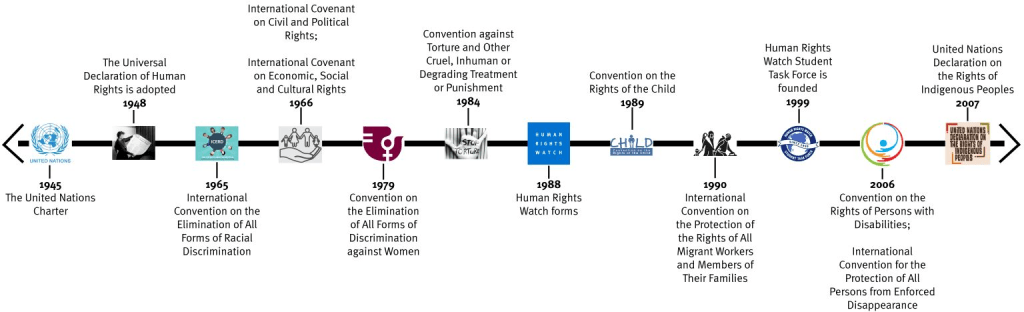
Thanks to the Universal Declaration of Human Rights (UDHR), and nations’ commitments to its principles, the dignity of millions has been uplifted, untold human suffering prevented and the foundations for a most just world have been laid.

For 75 years, the core ambition of the UDHR has been to infuse societies with equality, fundamental freedoms and justice. It solidifies the rights of all human beings and is a global blueprint for international, national, and local laws and policies.

While its promise is yet to be fulfilled, the very fact that it has stood the test of time is a testament to the enduring universality of its values of equality, justice and human dignity. 

>> Access resource

HRE USA at the IAHRE Conference

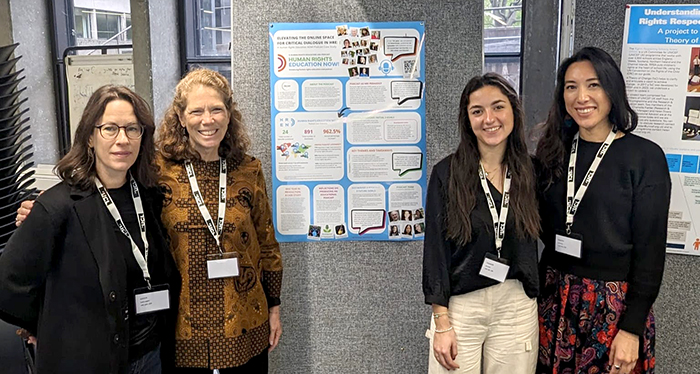
On April 19, 2024, members of the HRE USA podcast team attended the International Association for Human Rights Education (IAHRE) Conference. The 2024 IAHRE Conference: Extending Human Rights Education took place at the University College London. It built on the experiences of the WERA International Research Network on Human Rights Education and on fourteen previous International Conferences on Education and Democratic Citizenship (ICEDC) conferences.

The 2024 IAHRE Conference provided a unique opportunity to network with human rights educators from across the globe, share and discuss the latest research, and examine policy and practice relating to human rights education.

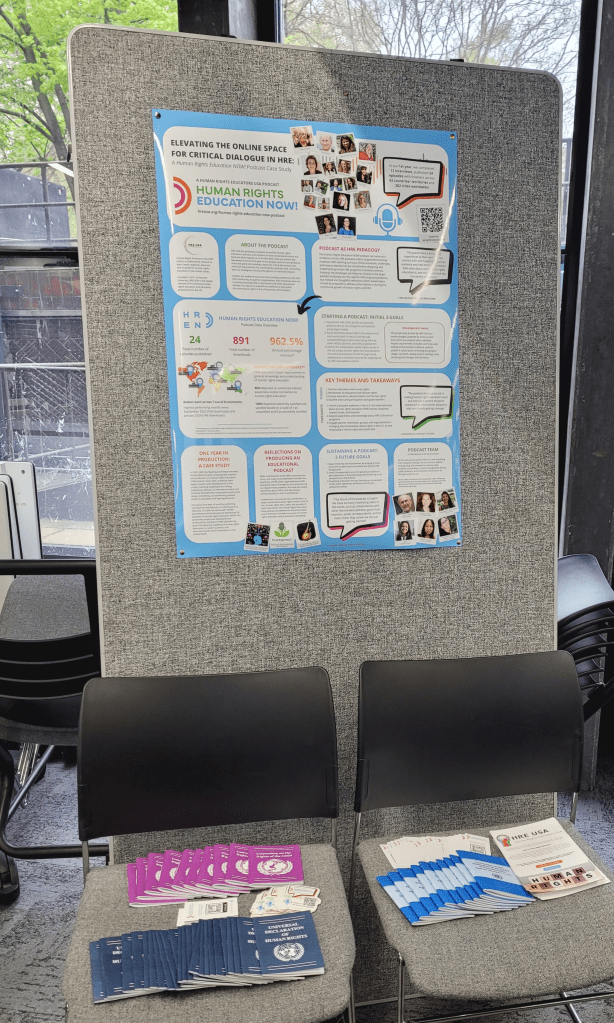
The HRE USA Podcast team offered a poster presentation based on our podcast, Human Rights Education NOW!. We shared key takeaways from our first year in production, such as the considerations that went into building a space for critical discussions and insights into the evolution and expansion of our project and the HRE USA movement in the US.

Their paper, “Elevating the Online Space for Critical Dialogue in HRE: A Human Rights Education NOW! Podcast Case Study” will be published in Human Rights Education Review later this year, and has been written by team members Bill Fernekes, Sabrina Sanchez, Jazzmin Gota, Kristi Rudelius-Palmer, Elizabeth Schwab, Jessica Terbrueggen.

Students Study Palestine: In Context of Colonial World History

Record numbers of educators are downloading Teaching the Seeds of Violence in Palestine-Israel. We’ve heard wonderful stories about the impact of the lesson, such as this one:

The most amazing aspect of this lesson was my students’ ability to recognize the common themes presented in the story of Palestine with stories of other colonial projects we had studied, including in India, the United States, Sudan, and the Congo.


Overall, this lesson helped my students understand the roots of the political issue that is Palestine and evaluate many of the common misconceptions of where the conflict comes from. — Rodrigo Palacios Tenorio, high school social studies teacher, Tempe, Arizona

Check out the lesson and more teaching stories.

Take Action: Bring Human Rights Home with a National Human Rights Institution

Democracies around the world – including key U.S. allies – have independent bodies dedicated to monitoring and promoting human rights. In this regard, the United States is a shameful outlier. Not a single domestic agency has the mandate to coordinate the implementation of our international human rights commitments – falling woefully short of meeting international standards.

The Biden administration has a once-in-a-generation opportunity to put the U.S. on a path toward compliance with international human rights obligations by establishing a federal commission to study the creation of a National Human Rights Institution (NHRI). We, the people, must do all we can to make sure this happens: Sign our petition today to tell President Biden that the time to act on a National Human Rights Institution is now.

The ACLU has long urged the U.S. government to take bold action on human rights – and now, alongside a broad coalition of civil and human rights groups and members of Congress – we are urging the White House to take this critical move toward realizing President Biden’s promise to demonstrate that our commitment to human rights starts at home.

An NHRI would help bring the U.S. in line with international human rights norms and full compliance with ratified treaties, including the International Convention on the Elimination of All Forms of Racial Discrimination. It would promote the Universal Declaration of Human Rights and everyone’s civil, political, economic, social and cultural rights.National Human Rights Institutions look different around the world, but a NHRI would be able to:

  • Promote and monitor the implementation of human rights obligations
  • Provide a public forum for the investigation of violations of human rights
  • Create a platform for recommendations to improve human rights compliance
  • Establish mechanisms to advise and inform legislative, judicial, and executive branches on human rights standards
  • Support and provide guidance to state and local human rights commissions

>> Take action

Storytelling for Social Change: Creating Space for Unheard Voices

Storytelling is a valuable tool for advancing social change, and an understanding of systemic oppression is incomplete without deep listening and learning from people who have experienced injustice firsthand. This webinar will offer participants an introduction to Voice of Witness (VOW), our oral history methodology, and the use of storytelling to amplify the voices of communities impacted by injustice.

We will explore the power of personal narrative as a format and discuss key elements of the oral history process, including best practices in ethical interviewing and project creation. The webinar will feature VOW staff and Katrina M. Powell, editor of the upcoming book Beginning Again: Stories of Movement and Migration in Appalachia.

This free event is for anyone interested in using first-person narratives to build community and advance justice.

May 21, 2024 at 2pm (Pacific), virtual 

>> Register

Human Rights Education Review: Call for Papers: Gender Perspectives in Human Rights Education

Special Issue for Human Rights Education Review (2025)

Guest editors: Beate Goldschmidt-Gjerløw & Sevda Clark

For this special issue, HRER invites contributions that strengthen understandings of gender perspectives within human rights-based education, an area of scholarly work that is, to date, underdeveloped. Human rights-based education links cultural, economic and social rights to political rights, which are critical for enhancing all human beings’ empowerment.

If you would like to make a submission in response to the CfP please send an extended abstract of no more than 300 words to the Human Rights Education Review Managing Editor Kalpani Dambagolla kalpidambagolla@gmail.com by 28 May 2024.

Your abstract should include a short list of indicative literature on which you expect to draw, from the fields of both gender and human rights education. Please ensure you use the subject line: HRER: Gender perspectives in human rights education in your email. You will hear back from us by 14 June 2024. All invited manuscripts will be subject to double-blind peer review. For invited papers for this special issue, submission of the full paper is due through the journal platform by 21 October 2024. We expect to publish this Special Issue in Volume 8, 2025.