You can now purchase the Center for Civic Education’s research-backed textbooks through Gibbs Smith Education, the Center’s new distribution partner. As of today, October 1, the Center’s textbooks, such as We the People: The Citizen & the Constitution and Project Citizen: Community Engagement in Public Policy, will be offered exclusively through Gibbs Smith Education. To purchase any of the Center’s textbooks, customers should complete a brief form on the organization’s website. This new distribution partnership will allow the Center to reach more schools and students, increasing accessibility to impactful civic education. Customers placing orders with Gibbs Smith Education will experience the same high-quality, personalized service they have received from the Center. Gibbs Smith Education’s representatives are fully trained and knowledgeable about the Center’s publications and ready to help. Supporters of civic education can still purchase T-shirts and other apparel through the Center’s Bonfire store.
The freedom to read is under attack — let’s do something about it!
On October 11, 2025, we’re asking everyone to take at least one action to help defend books from censorship and to stand up for the library staff, educators, writers, publishers, and booksellers who make them available!
Show us how you’re taking action on social media by using the hashtags #LetFreedomReadDay and #BannedBooksWeek!
We’ll continue to add resources in the coming days, so bookmark this page!
And don’t forget: Censorship won’t stop just because Banned Books Week does — you can take action any day of the year!
A quarter-century removed from the September 11 attacks, a new generation knows only the dread and despair that dominate the narrative of now. Authoritarian governance, climate collapse, and techno-dystopia recalibrate a reality once set on the promise of tomorrow. Human rights and democracy face unprecedented existential threats. Legal foundations fray under bombardment while illiberal forces celebrate cruelty. Nation-states retreat from cooperation with others, looking inward and backward for scapegoats and excuses.
What’s worse, the mechanics we have to build new futures have themselves been endangered and hacked. Local law enforcement chills free expression and violates the rights of assembly with military-grade gear, immigration enforcement is weaponized to punish political opposition, and terrorism statutes outlaw protest across continents. From heightened digital authoritarianism in East Asia to the suppression of civil society in parts of Africa, the criminalization of social movements across the Americas, and the tightening grip on media in Eastern Europe and Central Asia, threats to the basic freedoms of democracy are everywhere. Documentation could be deep-faked while malignant algorithms surveil and shape online communities. Reliable philanthropic resources are evaporating at the very moment when investment in movement infrastructure is so essential.
These are difficult times, but a shift is underway.
Amidst this contracting civic space, a powerful counter-narrative is emerging. From mural movements and punk protests to indigenous artistic revivals, from digital memorials and silent theater to TikTok activism and algorithmic subversion, social movements are redefining the very act of resistance and actively defending fundamental human rights in powerfully creative ways. These movements are at the forefront of protecting the rights to assembly, association, belief, opinion, free expression, and dissent – all indispensable pillars of a healthy democracy. In this hostile environment, artistic expression and digital technologies have not merely become modes of activism and advocacy; they are now urgent tools for preserving democratic space, directly challenging structural violence, and amplifying marginalized voices. This convening of social movement scholars and practitioners of human rights links directly to the defense of democracy as a core objective.
In this spirit, the Human Rights Center at the University of Dayton will convene the 2026 Social Practice of Human Rights (SPHR) conference to center this critical conjuncture. As the weight of disinformation, militarization, and belligerent politics bears down, communities are demonstrating remarkable adaptability. They are innovating, finding new ways to speak truth to power, to organize effective movements, and to reclaim public discourse. From the poignant street art that bears witness to state violence to the encrypted messaging apps that enable safe mobilization, the convergence of art and technology is fundamentally reshaping the architecture of protest and the defense of democratic ideals.
SPHR26 will take place on April 9-11 at the University of Dayton in Dayton, Ohio. #SPHR26 is planned as a hybrid event experience at this time. Virtual, as well as some in-person participation, is envisioned.
Submissions are welcome on topics that address themes and their intersections, including:
Artivism as Resistance: The leveraging of visual, performative, and literary activism (murals, theater, spoken word, zines, music) for memory, imagination, and political intervention. How does this work drive change and foster dialogue in the face of repression?
Upholding the Human Right to Protest and Dissent: Investigates the human right to protest and dissent, examining the legal frameworks, the strategic role of movement lawyering, and international mechanisms that safeguard collective action in an era of evolving social movements.
Technological Transformation: The implications and promise of artificial intelligence (AI), autonomous systems, technology-based innovation, and the role of digital freedom and the opportunity for engagement with stakeholders across public and private sectors.
The Future of International Law: Creative resistance challenges, reinforces and redefines the impact of international legal mechanisms, and the viability of multilateralism and global governance is being challenged like never before. How can we reimagine human rights advocacy to create stronger institutions for peace and justice?
We especially encourage workshops, roundtables, and panels that bridge coalition thinking by placing scholars, policy designers, practitioners, artists, and activists in a space of engagement.
SPHR26 will feature a diverse program including keynote speeches, plenary sessions, roundtables, panel discussions, and cultural events. We particularly encourage proposals for creative works, performances, visual art, workshops, roundtables, and panels that foster meaningful dialogue between scholars and practitioners, as well as community collaborations, such as showcases for youth talent and initiatives.
🏆 The 2025 O’Brien Awards recognize an individual and an organization that has made a significant contribution to human rights education in the United States.
🏆 To encourage a new generation of human rights activists, the 2025 Youth in Action for Human Rights Awards recognize youth leaders, one individual and one group, whose work explicitly or implicitly reflects and promotes human rights values. Because young activists must nominate themselves for the awards, HRE USA urges adults familiar with their work to urge them to apply.
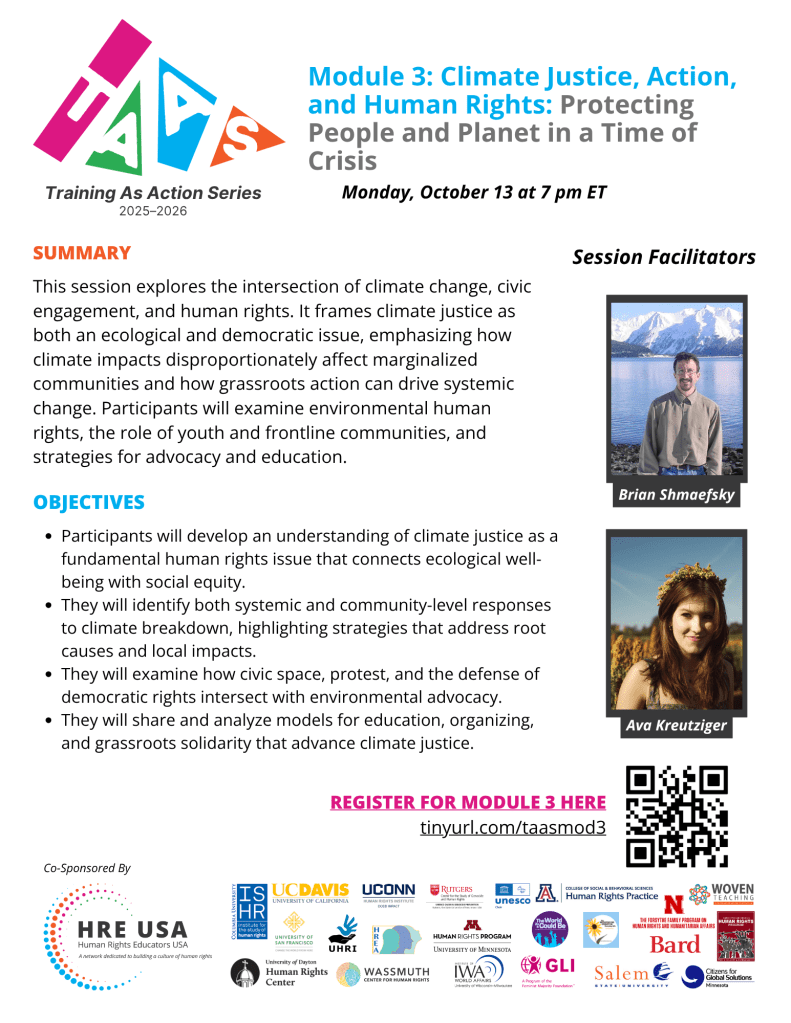
This module explores the intersection of climate change, civic engagement, and human rights. It frames climate justice as both an ecological and democratic issue, emphasizing how climate impacts disproportionately affect marginalized communities and how grassroots action can drive systemic change. Participants will examine environmental human rights, the role of youth and frontline communities, and strategies for advocacy and education.
Human Rights Educators USA’s annual Training as Action Series (TAAS) is a virtual training series focused on bridging personal and collective action on some of the most critical human rights issues of today. TAAS creates an educational space to connect and collaborate with others in human rights education and training. It also gives participants the skills and information needed to take action on rights issues in their communities.
The 2025–2026 Training as Action Series will center on the theme, “Defending Democracy and Human Rights in a Changing World.” This year’s sessions will explore urgent issues such as misinformation, protest rights, climate justice, and digital surveillance, highlighting how human rights education can equip communities to respond with clarity, courage, and collective action. Those who attend six or more sessions will receive a certificate from HRE USA. 2025-26 TAAS Flyer
HRE USA is a project of the Center for Transformative Action.
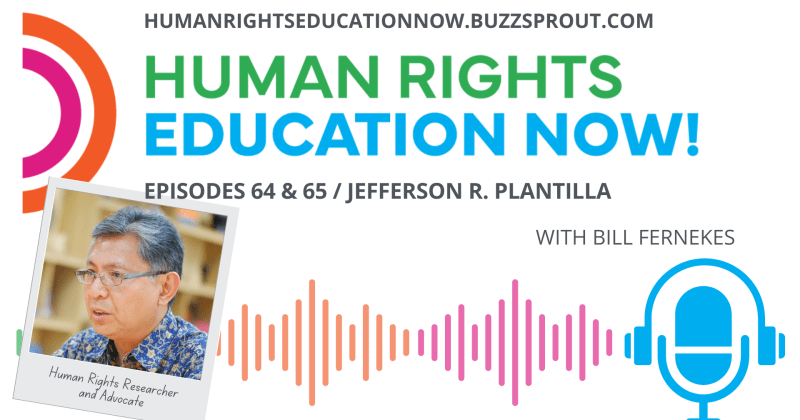
We are pleased to announce the availability of our latest installment of podcast episodes in Human Rights Education NOW! Episodes 64 & 65 feature conversations with Jefferson R. Plantilla.
Jefferson R. Plantilla started legal education work in the Philippines in 1985 in the Structural Alternative Legal Assistance for the Grassroots (SALAG). He became the Coordinator of the Asian Regional Resource Center on Human Rights Education (ARRC) in Thailand from 1992 to 1995. From July 1995, he started working at the Asia-Pacific Human Rights Information Center (HURIGHTS OSAKA) in Japan. He conducts research, develops international teaching materials, and edits the annual Human Rights Education in Asia-Pacific publication, as well as several training resources used throughout the region. He participates as a resource person in workshops and conferences in Asia. His writings are available at HURIGHTS OSAKA website, https://www.hurights.or.jp/english/publication.html, and also in Academia,https://hurights.academia.edu/JeffersonRonanPlantilla.
Episode 64: Jefferson R. Plantilla Part One
In Episode 64, Jeff Plantilla recounts his journey into human rights education (HRE), beginning with his law school training and the impact of living under martial law during the Marcos regime in the Philippines. His early exposure to human rights violations shaped his activism and lifelong dedication to Human Rights Education (HRE).
Jeff describes his influential work with the Asia-Pacific Human Rights Information Center, where he advanced education initiatives during the UN Decade for Human Rights Education. With support from local governments in Osaka, his work included collaborating with national human rights commissions, organizing workshops, and producing instructional materials. These efforts contributed to the creation of regional networks that shared resources and strategies across the Asia-Pacific.
The episode also explores human rights education in Japan, highlighting the legal mandate for HRE, challenges of addressing systemic human rights conflicts versus interpersonal relations, and anti-discrimination education focused on the Burakumin community in western Japan. Jeff notes the lack of public awareness about discrimination against Burakumin and stresses the importance of embedding these topics into legal and educational frameworks.
Topics Discussed:
Origins of interest: Law school training and life under Marcos’ martial law
Impact of violations: How Philippine human rights abuses shaped his activism
Asia-Pacific HRE work: Building networks, workshops, instructional materials, and government support in Osaka
National human rights commissions: Their role in advancing HRE
HRE in Japan: Legal mandates, human rights conflicts vs. human relations, and anti-discrimination work with Burakumin communities
Closing reflections on sustaining HRE initiatives in the region
Full topic listing available for PDF download HERE.
In Episode 65, Jeff Plantilla offers insights on strengthening human rights education (HRE) by emphasizing diversity, supporting local initiatives, and adapting messages to cultural contexts. He highlights the importance of addressing concrete issues, such as housing as a human right, and reflects on the challenges facing HRE in Japan.
Jeff shares that the individuals who have influenced him are those who show humility, respect, patience, and determination. He cites a quote from a Filipino farmer leader—“We should not entrust to people with full stomachs, the resolution of problems of us who are hungry”—which echoes Paulo Freire’s approach of listening to people and empowering communities.
For advancing HRE in Asia, Jeff recommends targeting concrete issues central to people’s lives, basing actions on careful study of their lived experiences, and co-developing solutions with communities from the ground up.
Topics Discussed:
Leadership recommendations: Diversity in HRE and prioritizing local initiatives
Housing as a human right and specific challenges in Japan
Cultural adaptation: Tailoring HRE messaging to local norms
Influences: Humility, patience, and determination as guiding traits
Key quotes: Empowerment through listening to marginalized voices
Strategic recommendation: Ground HRE work in local issues and community-driven solutions
Closing reflections
Full topic listing available for PDF download HERE.
While it is always important to teach about Central America, this year the need is amplified by the dehumanizing policies of this administration towards Central American immigrant communities. Teachers across the country have joined the call to teach about Central America, during Teach Central America Week October 6–10. We ask you to join us.
Looking for ideas for what to do during Teach Central America Week? Read below to learn about a lesson for 3rd grade: Who Deserves a Monument and a high school unit on Panama, two books on deportations, and our online workshop for elementary teachers on Monday, October 6.
How can education catalyse the evolution of society? In HundrED’s newest “Spotlight on Education for Societal Change” we are looking for innovative educational practices from the Global South that catalyse societal change through approaches such as, but not limited to, peace education, gender equity, inclusivity, climate action, and social justice.
Ultimately, we aim to bring together a selection of high-quality, evidence-backed, scalable innovations that inspire positive change across education ecosystems and can strengthen the quality of education through reshaping values and opportunities.
This initiative is being carried out in partnership with VVOB and eNSPIRED.
With our virtual speakers bureau you can connect with human rights experts who are willing to join your class, meeting, or conference. Search the speaker database for folks with expertise on a given human rights issue. Decide on a speaker and email them. Their profile will tell you their areas of expertise, their fees (or suggested donations to NGOs), their biography, publications, and more. Once you have successfully held a video conference, let us know so that we can keep track of the use of this feature.









 HRE USA