International Association for Human Rights Education: 2024 Conference and  Call for papers

Extending human rights education  

Friday 19 April 2024

9.30 – 17.00 

 Venue: IOE UCL’s Faculty of Education and Society 20 Bedford Way, London WC1H 0AL, UK 

 Background 

The International Association for Human Rights Education (IAHRE) was established in June 2023 at the 15th International Conference for Education and Democratic Citizenship (ICEDC) held at University College Dublin. Its goal is to support the development of human rights education research, scholarship and practice internationally. IAHRE has its own scholarly journal, the award-winning Human Rights Education Review, founded in 2018.   

The ICEDC annual conference was set up as a meeting place for scholars, researchers, graduate students, education policymakers, and civil society activists from across Europe and internationally. Since 2019, it has been complemented by the WERA International Research Network on Human Rights Education, coordinated by Professors Audrey Osler and Hugh Starkey which in collaboration with Human Rights Education Review has run an international webinar series. The IAHRE International Conference aims to build on this experience, providing all with a unique opportunity to present and discuss current research and policy relating to human rights education and to questions of human rights within education.  

Keynote speakers  

Our two keynote speakers are:  

Professor Sonia Livingstone Department of Media and Communications, LSE, whose research focuses on children’s rights in the digital age 

Professor Farzana Shain Geroge Wood Professor, Goldsmiths, University of London whose interests include educational inequalities, education policy, politics and human rights.   

Call for papers 

We invite scholars to submit papers to this first IAHRE International Conference Extending human rights educationWe welcome contributions that review and critically reflect on human rights education, child rights education and the wider area of education and human rights from a range of perspectives, including sociology, education, law, history, politics, geography and other relevant disciplines. Papers concerned with analyses of policy and case studies of campaigns are likewise invited. We welcome contributions from researchers at all stages of their careers.  

While we invite research addressing education at all levels, we are conscious that in most societies children and young people struggle to make their voices heard since they are excluded from formal political mechanisms and frequently regarded as lacking the competence to contribute to decision-making processes. Young people also face a world of political and social uncertainties in which information sources are not always reliable. Climate change, terrorism, conflict, hate speech and xenophobia confront them in the starkest terms. Intergenerational justice is the aim of the United Nations Sustainable Development Goals (SDGs). Sustainable development includes ‘sustainable lifestyles, human rights, gender equality, promotion of a culture of peace and non-violence, global citizenship and appreciation of cultural diversity and of culture’s contribution to sustainable development’ (SDG 4). Our conference will consider how education policy and practice and education professionals, including teachers. can respond to these challenges. 

The following are indicative themes: 

  • Children’s digital worlds, intergenerational justice and human rights   
  • Human rights education and curriculum development  
  • Critical approaches to global citizenship education 
  • Migration, citizenship and rights education  
  • Teacher education and human rights  
  • Human rights education and language learning 
  • Worldviews education and human rights 
  • History education, decolonisation and human rights    

Abstracts of no more than 300 words including name, institutional affiliation and contact email should be sent, no later than Thursday 7 December 2023 to: Professor Hugh Starkey h.starkey@ucl.ac.uk. All abstracts will be peer reviewed by members of the IAHRE Conference Steering Group. Please indicate whether you would prefer to give an oral or a poster presentation. Applicants will be informed of the outcome of the review by Wednesday 20 December 2023. Selected papers will be considered for publication in our peer-reviewed journal Human Rights Education Review.

Registration will open in January 2024. IAHRE members are eligible for a discount. Membership categories are as follows:  

Ordinary annual member: £50 

Supporting annual member: £100+ 

Life membership: £800 

Institutional annual membership: £250 (with membership benefits for up to 6 named individuals)    

Conference registration fees (to include conference pack, lunch and all refreshments)

Early bird fees will apply to all bookings made by 4 March 2024.  

Early bird (member): £195 

Early bird (non-member): £210 

Standard (member): £220 

Standard (non-member) £230     

Two new podcast episodes with Yvonne Vissing, PhD, Professor of Healthcare Studies and Director of the Center for Childhood & Youth Studies and the Center for Human Rights Education at Salem State University

We are pleased to announce the availability of our latest installment of podcast episodes in Human Rights Education NOW! Episodes 17 & 18 feature conversations with Yvonne Vissing.

Sociologist Yvonne Vissing, PhD, is Professor of Healthcare Studies and Director of the Center for Childhood & Youth Studies and the Center for Human Rights Education at Salem State University.  Author of 20 books, including Children’s Human Rights in the USA, she is US policy chair for the Hope for Children CRC Policy Center in Cyprus and on committees of HRE USA and the American Association for the Advancement of Science, and a former NIMH Post-doctoral research fellow.

Episode 17:  Yvonne Vissing, Part One

In Episode 17, Yvonne Vissing discusses her Initial interest in human rights and human rights education, as well as the significance of the Convention on the Rights of the Child (CRC), and her work in dealing with the social problems of children. She shares her thoughts on the United States’ failure to ratify the CRC, and the connections between her clinical experience and human rights education. Next, Yvonne shares her thoughts on the way in which human rights treaties can inform strategies to address social problems, including strategies for educating the population about homelessness. Lastly, she discusses her work with the Centers for Children and Youth and Human Rights Education at Salem State University and programs delivered by the centers. 

Topics discussed:

  • Initial interest in human rights and human rights education
  • Convention on the Rights of the Child
  • Social problems with children
  • The United States’ failure to ratify the CRC
  • Connection between clinical experience and human rights education
  • Human rights treaties informing strategies to address social issues
  • Strategies for educating the population about homelessness
  • The Center for Children and Youth and Human Rights Education

Full topic listing available for PDF download HERE.

Listen on our Buzzsprout podcast website HERE

Episode 18: Yvonne Vissing, Part Two

In Episode 18, Yvonne Vissing shares her thoughts on the absence of discussion around human rights in public discourse and the lack of US knowledge around the Convention on the Rights of the Child (CRC). She goes on to discuss human rights education (HRE) and social justice connections along with the significance of the human rights framework as a way to encompass social justice concerns. Yvonne then expounds upon the necessity of keeping children safe and protected. She elaborates on the ongoing failure of governments to address children’s needs. She shares her thoughts on the integration of HRE within strategies to address children’s needs and the importance of training childcare workers and educating parents, while holding professionals accountable. Next, Yvonne discusses Felisa Tibbitts’ HRE model of professional accountability and the integration of HRE as a central focus for professional training to protect children. Lastly, Yvonne shares a few of her key role models for her work in HRE. 

Topics discussed:

  • Absence of discussion around human rights in public discourse
  • Lack of knowledge around the Convention on the Rights of the Child
  • Human rights education and social justice connections 
  • Human rights framework as a way to encompass social issues
  • Necessity of keeping children safe and protected
  • Ongoing failure of governments to address children’s needs
  • Integration of HRE into training for professionals who work with children
  • Felisa Tibbitts’ HRE model for professional accountability 
  • Key role models in human rights education

Full topic listing available for PDF download HERE.

Listen on our Buzzsprout podcast website HERE.

New podcast episodes in Human Rights Education NOW! are available

We are pleased to announce the availability of our latest installment of podcast episodes in Human Rights Education NOW!. Episodes 17 & 18 feature conversations with Sociologist Yvonne Vissing, PhD, is Professor of Healthcare Studies and Director of the Center for Childhood & Youth Studies and the Center for Human Rights Education at Salem State University.  Author of 20 books, including Children’s Human Rights in the USA, she is US policy chair for the Hope for Children CRC Policy Center in Cyprus and on committees of HRE USA and the American Association for the Advancement of Science, and a former NIMH Post-doctoral research fellow.

Webinar: Elections, Then and Now: A Journey through Democracy

Join the Center for Civic Education and the Bob and Marion Wilson Teacher Institute of Colonial Williamsburg this Wednesday, November 1, at 7 p.m. ET for Elections, Then and Now: A Journey through Democracy.

REGISTER FOR THE WEBINAR

You will discover the fascinating stories of elections in early America through unique 18th-century sources. As a bonus, you will also explore the Center’s newest resources and acquire practical strategies for engaging students in discussions about electoral processes, analyzing campaign rhetoric, and encouraging critical thinking skills. Don’t miss this opportunity for unique and engaging professional learning!

2023 SIMA Changemaker Award 

Applications open until November 15, 2023

Winners are announced on November 29, 2023

The annual global SIMA Changemaker Award celebrates educators and youth using SIMA films to catalyze transformative change in their communities.

We honor students and young leaders who have utilized SIMA’s social impact films as an inspiration for their own creative impact projects, and recognize the outstanding achievements of educators using SIMA resources to foster global competencies and inspire the next generation of changemakers.

Award winners are selected by the SIMA Academy Jury and select Partners consisting of renowned experts in the fields of global education, media and social innovation.

AWARDS + CATEGORIES

Educator Changemaker Award

Two Educators Will Be Awarded: One Winner and One Special Mention

Student Changemaker Award

Two Students Will Be Awarded: One Winner and One Special Mention

ELIGIBILITY

You must be an educator, student or leader who has been inspired by a SIMA Academy film to implement an impact project in your community or school. Candidates may apply once annually.

ENTRY CATEGORIES include: community and outreach projects, local and global campaigns, as well as media and mixed media projects (visual, literal and audio).


TIMELINE

Call for entries are open and rolling annually until November 15, 2023

WINNERS will be announced on November 29, 2023

READY? LET’S GET STARTED

Submit your General Application Form Here:

SUBMIT

PRIZES

  • Featured Impact Story on SIMA Academy platform and social media
  • Mentorship and Professional Development opportunities
  • Sponsored Jury Prizes:
  • > The winning educator will receive a GEEO Teacher Travel Program Jury Prize: A $500 grant to travel on the GEEO program of their choice and then share that experience with their classroom.
  • > The winning student will receive a SIMA Studios Mentorship Jury Prize: A 3-session 1:1 virtual mentorship about the power of purpose, authenticity and global impact storytelling to create positive change in the world.
  • Custom Jury Prize from participating partners (where applicable)
  • > Global Lighthouse Studio Jury Prize*: Full scholarship for one teacher and their classroom to attend the 8-week Storytelling Course. *For Global Lighthouse Studios Participants Only.

Online Teach-In on Native American Classroom Resources

Saturday, November 4, 2023

12:00 PM – 3:00 PM EST / 9:00 AM – 12:00 PM PST

Join the Smithsonian’s National Museum of the American Indian (NMAI) and Teaching for Change for a day of online conversation, curriculum highlights, workshops, and idea exchange — preceded by a short keynote presentation by Assistant Secretary of Indian Affairs Bryan Newland. The teach-in will be held virtually via Zoom. Registration cost is $15.

Teachers select two 50-minute workshop sessions that include relevant and resource-rich training experiences to support effective use of American Indian-focused classroom lessons, and resources from Teaching for Change and NMAI. Teaching for Change and NMAI museum educators will share key concepts from NMAI’s Essential Understandings Framework, children’s literature from Social Justice Books, and classroom materials from NMAI’s Native Knowledge 360° education initiative.

Learn More and Register

Training as Action Series (TAAS): Communicating with Decision Makers: How to Contact Influential Figures

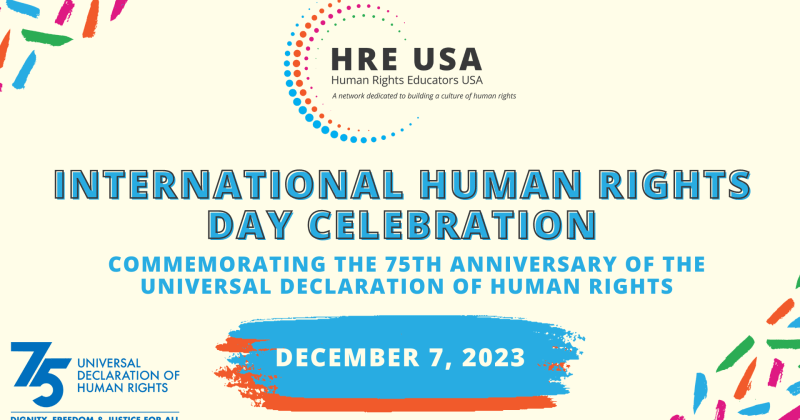
Human Rights Educators USA’s annual Training as Action Series (TAAS) is a virtual training series focused on bridging personal and collective action on some of the most critical human rights issues of today. TAAS creates an educational space to connect and collaborate with others in human rights education and training. It also gives participants the skills and information needed to take action on rights issues in their communities. The 2023-2024 training series will celebrate the 75th anniversary of the Universal Declaration of Human Rights (UDHR) and center on the theme, “Protecting Democracy, Promoting Human Rights.” Sessions will discuss topics such as voting rights, facilitating difficult conversations, organizing an advocacy campaign, communicating with decision makers, protesting, and mental wellness.

Summary
Communicating with decision makers such as elected officials is key to enacting change. This module will explore the different ways to contact those in positions of power and equip participants with the skills needed to do so effectively.

Objectives

  • Identify the role of communicating with decision makers in a democracy and its importance for protecting rights
  • Discuss the primary ways to contact decision makers: letters/emails, phone calls, and meetings
  • Develop the knowledge and skills needed to communicate with decision makers
  • Explore how to use collective action when contacting decision makers, such as through letter writing campaigns, and how these actions can be incorporated into a classroom/educational environment
  • Role play advocacy meetings and the Dos and Don’ts of an advocacy meeting

TAAS Sessions:

  • Communicating with Decision Makers: How to Contact Influential Figures (Thursday, November 2nd, 7-9 pm ET)
  • Protest and Beyond: Powerful Ways to Promote Your Message(Thursday, November 9th, 7-9 pm ET)
  • Finding Joy: Integrating Mental Wellness into Your Advocacy Strategies (Thursday, November 16th, 7-9 pm ET)

>> Learn more

>> Register

Human Rights Careers: Master of Science in Humanitarian Action (MSHA)

Apply now

The Master of Science in Humanitarian Action is a online advanced degree within the University of San Diego’s Joan B. Kroc School of Peace Studies. This program is designed for both recent graduates and experienced professionals and provides the opportunity for students to learn from executive-level directors, experienced consultants and regional coordinators who work directly for humanitarian-related organizations.

This master’s program takes a multidisciplinary approach to prepare students to become the type of critical thinkers and humanitarian leaders who will help solve some of the world’s biggest challenges. Blending conflict analysis, transformation and social innovation with peacebuilding practices, the M.S. in Humanitarian Action intentionally dissolves the barriers between international humanitarian and domestic emergency management.

The 20-month program admits candidates throughout the year to begin their degree in either the Spring, Summer or Fall. Students will take two courses during each 14-week term, focusing on one 7-week course at a time. Course curriculum includes topics such as assessing humanitarian needs, aid delivery, management and logistics, leadership, effective communication, and more. The program culminates in a capstone simulation exercise where students will tackle a complex humanitarian emergency demonstrating their learned skills and knowledge in order to design, implement and evaluate creative solutions in a real-time scenario.

Spring 2024 Application Deadline: 1 December 2023

Duration: 20 months

Admission Requirements

  • Bachelor’s degree from an accredited college or university with a cumulative GPA of 3.0 or higher on a 4.0 scale (official transcripts required).
    • Candidates with a GPA under 3.0 will be asked to provide an essay in support of their candidacy. It is recommended that candidates with a GPA under 3.0 complete a standardized test such as the GRE or GMAT, but it is not required.
  • One personal statement comprised of four short essays each addressing a different prompt provided in the application
  • Resume or CV
  • One letter of recommendation from the candidate’s professional supervisor or professor or two letters of reference
  • For international applicants:
    • A TOEFL exam score of 83 or higher
    • A course-by-course transcript evaluation and report by an approved agency

Zinn Education Project: The Climate Crisis Has a History

Climate emergencies surround us today. The gap between the severity of the climate crisis and the inadequate response in schools threatens students’ lives and the future of the planet. Young people deserve tools that help them understand who shaped the warming world they inherited and how to meet the crises in front of them.

Timelines can be useful tools for distilling long, complex histories, and timelines of climate change are nothing new. A simple Google search can reveal dozens of sites or articles that claim to document its development. But the stories most timelines tell about the climate crisis misleadingly cast it as a product of the “natural” world — not as a consequence of human history, of choices, of systems through which profit and injustice flow. These accounts often laser-focus on the steady buildup of CO₂ in the atmosphere and climbing temperatures with little-to-no attention to the authors of global warming, movements to curb it, and populations that bear the brunt of its effects. They promote a sense of inevitability, fueling a dangerous mix of despair and inaction. We have developed a different timeline of the crisis at hand.

The Climate Crisis Timeline is a brand new resource, and we’re eager to hear how you use it in your classrooms and curricula. Experiment with it, send us your teaching stories, and spread the word on social media (#TeachClimateJustice).

>> Access resource