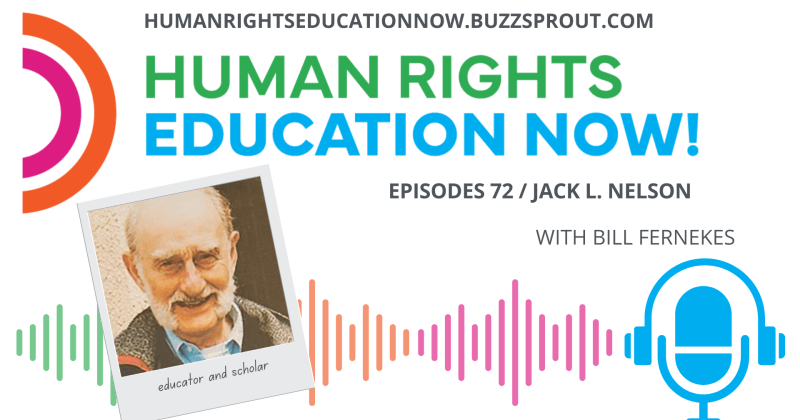

Jack L. Nelson is a veteran educator and scholar whose career spans public schools and higher education in the United States and abroad. In 2001, Jack received the National Council for the Social Studies’ National Academic Freedom Award. He began teaching in Denver, Colorado, and later worked with migrant worker children in Riverside, California. Jack earned his B.A. from the University of Denver, his M.A. from California State University, Los Angeles, and his Ed.D. from the University of Southern California.
He has served on the faculty at California State University, Los Angeles; the University at Buffalo; and Rutgers University, where he also received grant funding to establish an international center. A co-founder of the Buffalo Center for International Security Studies, Nelson has led federally funded programs on civil liberties in urban America and global education initiatives at Cambridge University. He has been a visiting scholar at universities in the United Kingdom, Australia, and the United States, and has worked closely with organizations such as the ACLU and the American Association of University Professors. His published work addresses nationalistic education, civil rights and liberties, global education, and academic freedom.
In Episode 72, Jack L. Nelson reflects on his career in education and his lifelong defense of academic freedom as a fundamental human right. He traces the origins of his critical stance to the era of McCarthyism, describing how censorship, political persecution, and fear shaped academic life in the mid-20th century. Jack discusses the marginalization of critical scholars, the suppression of dissenting curricular materials, and the personal costs borne by educators who challenged dominant narratives.
The conversation explores the evolution of his work in human rights education and its deep connections to social studies education, emphasizing that democratic education must engage students with controversial issues and alternative perspectives. Jack addresses ongoing threats to intellectual freedom, including book bans, political pressure, and the erosion of tenure protections, while warning of the dangers posed by growing numbers of non-tenured faculty. He argues that academic freedom requires more than ethical commitments—it demands enforceable legal and structural protections. Drawing inspiration from figures such as John Dewey and Bob O’Neill, Jack concludes by calling for national standards for tenure protections across K–12 and higher education and for stronger coalitions among educators to defend intellectual freedom as a cornerstone of democracy.
Topics discussed:
- Origins of Jack Nelson’s career in education
- McCarthyism and its lasting impact on academic freedom
- Critical scholarship and challenges to mainstream history education
- Censorship of educators and curricular materials
- Human rights education within social studies education
- Academic freedom as a human right
- Tenure, intellectual freedom, and structural protections
- Contemporary threats to democracy and education
- Role of professional associations in defending educators
- John Dewey’s influence on democratic and civic education
Tags:
Academic freedom; Intellectual freedom; McCarthyism; K–12 education; Higher education; Social studies education; Civic education; Professional associations; National Council for the Social Studies; National Council of Teachers of English; American Association of University Professors; Book banning; Censorship; Anti-communism; Academic tenure protections; John Dewey; Lawrence Metcalf; James Shaver; Harold Rugg; Robert O’Neill
Full topic listing available for PDF download HERE.
Listen on our Buzzsprout podcast website HERE.
All episodes of Human Rights Education Now! are available on:
Buzzsprout, Spotify, Apple Podcasts, Google Podcasts, Deezer, PlayerFM, Pocket Casts, and the HRE USA website,
Thank you for supporting the Human Rights Education NOW! podcast!
HRE USA is a project of the Center for Transformative Action.
 HRE USA