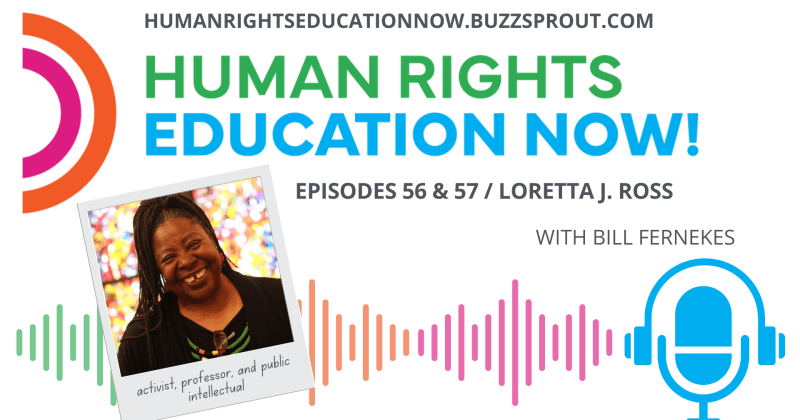

We are pleased to announce the availability of our latest installment of podcast episodes in Human Rights Education NOW! Episodes 56 & 57 feature conversations with Loretta J. Ross.
Loretta J. Ross is a Professor at Smith College in the Program for the Study of Women and Gender, where she teaches courses on white supremacy, human rights, and calling in the calling-out culture. A lifelong activist and scholar, she co-created the theory of Reproductive Justice and has led national movements for over five decades, including organizing the 2004 March for Women’s Lives and serving as the director of SisterSong from 2005 to 2012. Loretta has held leadership roles in organizations such as the National Black Women’s Health Project and the D.C. Rape Crisis Center, where she was one of the first African American women to serve as director. She is a MacArthur Fellow (Class of 2022), a 2024 National Women’s Hall of Fame inductee, and the author of multiple books on reproductive justice and social change, including Calling In. A survivor of rape, incest, and sterilization abuse, Loretta continues to inspire through her resilience, scholarship, and commitment to justice. She is also a mother, grandmother, and great-grandmother.
Episode 56: Loretta J. Ross, Part One
In this episode, Loretta J. Ross reflects on her lifelong commitment to human rights education (HRE), inspired by leaders like Shulamith Koenig and Dr. Martin Luther King Jr.’s vision of a “Triple Revolution” toward a human rights movement. She shares how she’s infused HRE into her work since the 1990s, including founding the National Center for Human Rights Education, which trained activists and promoted widespread distribution of the Universal Declaration of Human Rights (UDHR). Loretta discusses her work on the 14th Amendment, highlighting its importance for reproductive rights and immigrant justice. She also outlines the founding of SisterSong, a reproductive justice collective built on shared values across political divides, emphasizing bodily autonomy and family rights. Finally, she describes her current teaching at Smith College and her focus on transforming “call-out culture” into compassionate, effective activism—a theme explored in her latest book.
Topics Discussed:
- Human rights journey: Inspired by Shulamith Koenig and Martin Luther King, Jr.’s vision of a human rights revolution
- HRE activism: Creation of the National Center for Human Rights Education; UDHR advocacy; “human rights cities”
- 14th Amendment: Advocacy for inclusive application to immigrants, women, and marginalized groups
- SisterSong: Co-founding, core principles of reproductive justice, bridging pro-life and pro-choice dialogues
- Teaching approach: Addressing call-out culture with compassion; promoting constructive activism over cancel culture
- Final reflections on sustaining change and mentoring youth activists
Full topic listing available for PDF download HERE.
Listen on our Buzzsprout podcast website HERE.
Episode 57: Loretta J. Ross, Part Two
Loretta J. Ross discusses her approach to teaching about white supremacy, framing it as both an ideology and a social construct tied to identity. She emphasizes the importance of truth, evidence, and history in defending academic freedom—especially in the face of authoritarian practices like those seen during the Trump administration. Loretta offers strategic recommendations for institutions under attack, advocating a “Block and Build” approach and urging Diversity, Equity, and Inclusion (DEI) efforts to align with the legal and moral power of human rights. She highlights human rights education as an accessible, non-threatening tool rooted in dignity and justice, especially important for marginalized communities. Loretta underscores the need for children to learn the Universal Declaration of Human Rights (UDHR) and credits Shulamith Koenig and Maya Angelou as key influences in her work.
Topics Discussed:
- Teaching white supremacy: Ideology vs. Identity; combating fascism through academic freedom
- Institutional strategy: “Block and Build” approach; pivot DEI to human rights framework
- Human rights education: Universal, legally grounded, and dignity-centered; critical for underserved communities
- Historical advocacy: Raising the minimum wage and expanding the definition of human rights beyond civil/political rights
- Role models: Influence of Shulamith Koenig and Maya Angelou’s legacy
- Education reform: Advocacy for including UDHR in K–12 public education
- Final reflections on lasting emotional impact over words
Full topic listing available for PDF download HERE.
Listen on our Buzzsprout podcast website HERE.
Thank you for supporting the Human Rights Education NOW! podcast!
 HRE USA